
I’m sure you’ve been on the banks staring at that glassed-over water and thinking to yourself that something’s not right with your spinnerbait. You make the cast and use a speed that seems right, but you get no bites. They’re there. You can see them in the glassy water and they won’t even touch the thing. Your casts aren’t bad. Your retrieve isn’t either.
It is almost never the retrieve or the cast. It’s nearly always selecting the incorrect blade for the situation. Spinnerbaits are not a one-size-fits-all lure, and that mistake will cost you some time on the water.
How to Choose the Right Spinnerbait Blade
For clear water, it’s gotta be the willow leaf blade. Most folks reaches for the rounded Colorado blade initially. In contrast, the willow leaf is a long, narrow blade that matches shape of an actual willow leaf. It produces a lot of flash but not much vibration. That means it mimics the silvery side of a baitfish while producing little turbulence that can warns wary bass off in clean water.
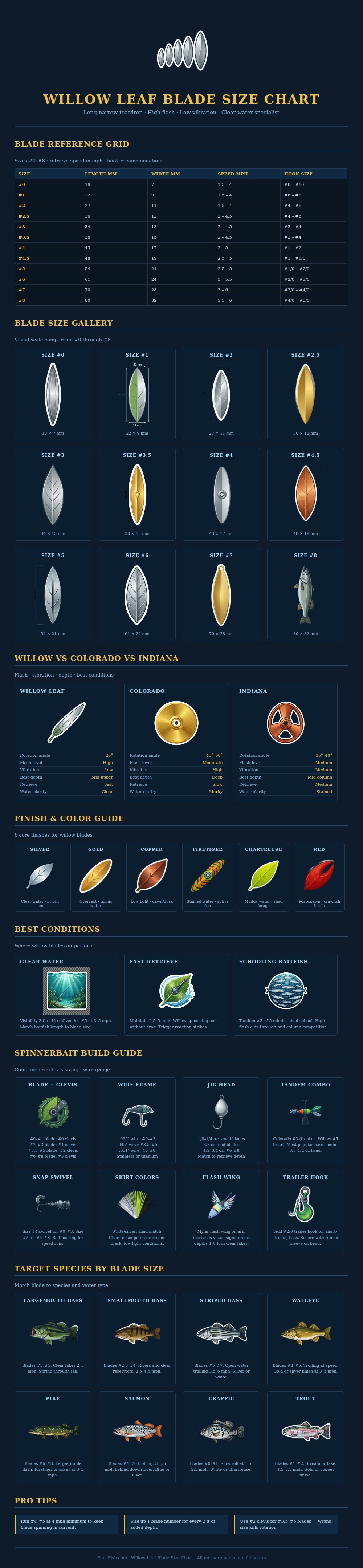
This chart breaks down exactly what those sizes look like from tiny crappie-sized lure all the way up to giant pike-trapping monsters, so you’ll know exactly which sizes to use and at what speeds they should be retrieved. Knowing this sequence is important because it helps you match your retrieve speed to your chosen blade size for a true spin instead of dragging.
The key mistake many anglers make is rigging a big willow leaf blade with oversized clevises and heavy wire. For the bigger blades, heavier components are fine. And for the small ones, go light with your hardware; down to a size zero clevis for the tiniest blades. Any more weight than that and the little blade won’t spin freely. It’s just too much weight for such a small blade.
Then a blade that isn’t spinning look like an injured baitfish. Sure, that’ll get a few strikes, but it doesn’t attract an aggressive predator from afar. Again, you want it to rotate. That flash is what stops ’em in their tracks.
If you look at the blade profiles side by side, you see how much bigger they are immediately. That size jump from a size three to a size five isn’t a minor change. It makes a huge difference in how the lure moves and how deep it runs.
For example, willow leaf spinners that measure size three or four has a wonderful action in spring for largemouth bass, as well as on clear waters like reservoirs with good visibility. Because the profile is narrow, they cut through without snagging in weeds and you can pull them a little quicker. However, when you get into walleye trolling or other fisheries with big fish like striped bass, the opposite is true. Those same blades will be too small. The larger ones such as five, six and even seven is needed to put off a lot more flash and disturbance to draw strikes from longer distances away.
To drive home the point of specificity, you can compare the willow leaf blade to other blade styles. A Colorado blade has more vibration and a slower spin, which makes it a great choice in dirty water where a bass will hunt with their feel versus their sight. An Indiana leaf is somewhere in the middle. However, nothing has the clean flash of a willow leaf when it’s real sunny out and the water is crystal clear. You don’t get that cloudy mess behind it; instead, you just have a sharp, appealing mirror image that the baitfish immediately identify.
The dynamics here are also played out by the right color finish. Gold will be better in stained water or lowlight situations and silver excels in clear water or very bright conditions. Occasionally I’ll put a little bit of flash on the wing of the arm for a little more visibility in deeper lakes. It needs to stay pretty subtle because you want to attract them, not confuse them.
When the retrieval speed matches what the blades are for and the size of the blade matches the water clarity, that’s when the lure comes to life. It goes from being plastic to looking like food. That makes the difference between empty days and full coolers. You should of seen how much better it works with the right gear.