
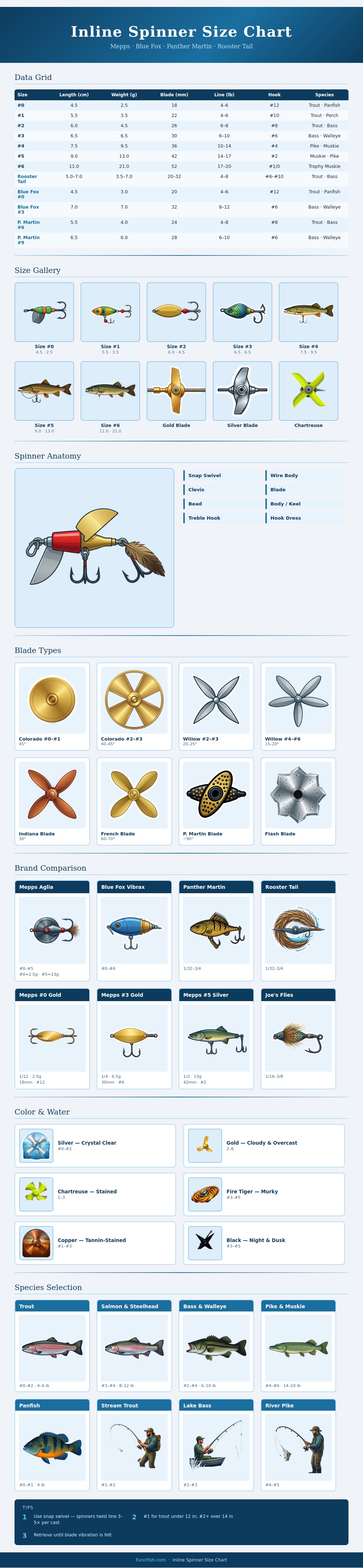
This is a simple tool with an important caveat. An inline spinner is a pretty straightforward tool. But it’s key to have the right size for the job. If the blade and weight is too big or too small, you won’t look like prey; instead, you will just make noise underwater that scare the fish away.
This chart details how all this fits together by species. It transforms guessing into strategy. The idea makes sense. The details are what throw people off.
How to Choose the Right Inline Spinner
A size zero spinner isn’t very big and weigh only about two and a half grams. Even so, they is still spinning some metal. Because they are small, they really aren’t going to disturb much water on the retrieve. Again, if you’re fishing small trout or panfish in clearer waters, this is exactly right; little weight, no intrusion into their world.
But when you get up to a size four or five, you have a nearly 42-millimeter-wide blade weighing more than nine grams. You’re not daintily placing this thing in front of a musky anymore. Instead, it rely on vibration and muscle to draw in the musky or pike. These fish use low-frequency sound to locate their prey deep in dark waters.
These charts also show that brand consistency is important. Just because one company’s size-two lure is the same as another company’s doesn’t mean they performs exactly alike. Weights can also differ between brands even when they’re the same size. The Mepps Aglia size-two, for instance, will weigh different than the same size from another company. Their similar-sized Blue Fox Vibrax in size-zero weighs 3 grams whereas the same size from Mepps is 2-and-a-half grams.
That may not sound like much but that affects its rate of sinking once cast. When battling current or wind, that additional heft prevents your spinner from floating around awkwardly; it helps keep it on plane. Knowing what weight profile your preferred brand employs help ensure your lure stays on plane rather than floating awkwardley.
The color of your blades will be determined more than anything else by water clarity. Gold in overcast conditions; silver in crystal clear conditions is a basic bit of advice here. But why? Well, there is more to it than just how much the colors reflect. In stained to clear water where the bass might be looking at the warmer colors of an older fish or crustacean in lower light, gold is a good choice. Or in super clear water where flash of scales on a baitfish might catch their eye, silver works great there. On those dark, stained, weedy lakes, copper or chartreuse are also worth trying because they show up better in dark water than bright silver. Don’t throw something mirror-bright in blackwater and fight the water! Let color complement the ambient light.
Hook size is another hidden variable that can ruin your presentations if ignored. Number ten or number 12 hooks is heavy hooks for smaller blade sizes, as in finesse fishing. Number six or number four hooks are strong enough to handle both walleyes and bass. Larger blades are paired with those hooks. So again, bigger hooks won’t be right if used with small blades; instead, the lure won’t spin properly or dive as deep. Always match the hook gape to fish’s mouth size, not the body of the lure.
Last, keep in mind that due to constant spinner rotation, line twist is a major issue. Without a snap swivel, this will wrap your leader into itself. This is why the chart suggest using four to six pound test lines for smaller sizes. These are light enough to detect a slight nibble while maintaining enough strength to manage the drag.
Maintain a steady retrieve until you feel the vibration in your rod tip; that hum tells you the blade is spinning correctly. That means the blade is spinning properly. Stop the hum? The lure has either stalled out or is hung somewhere and it’s time to change depths or retrieve speeds. Inline spinners don’t require much precision on the cast like many other baits. It’s all about dialing in the mechanical rhythm of the retrieve and when it clicks, fish bite.