
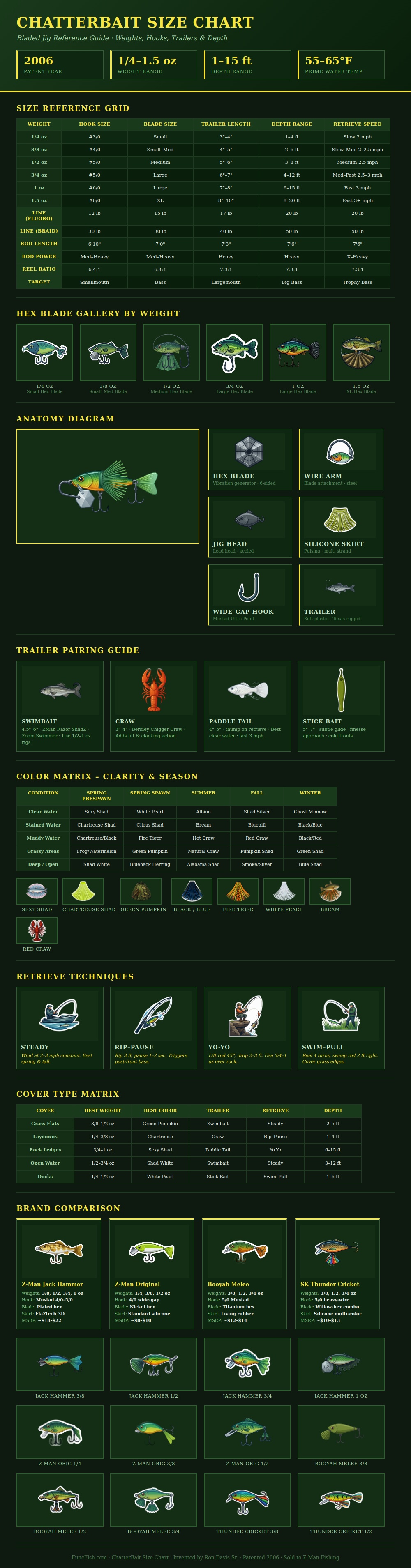
Ever have one smack a bait in your face and then dissapears before you do anything? That’s why it’s about physics as much or more than personal preference. Bass eat a bait like this because they feel it without seeing it. So there’s no point in grabbing a different size out of the box, it looks good but does nothing unless it matches what’s around you. Besides influencing sink rate, weight also relates to blade profile and hook size (see chart above). That’s important because a big heavy head with a little hex blade puts out too much of a signal that bass don’t accept. You’re looking for something that feels right to them… Natural, not some foreign thing.
The lighter setups excel on shallow flats around grass. They are longer in the strike zone and can be fished slowly to mimic a struggling shad. But drop the same light rig in deep open water and the current will wash it away before they even get close enough to feel the pulse. When chucking that big rig out over rock laden ledges, you want to throw something with beefy hex blades and a hefty jig head. It needs to chop through the turbulence down deep, it gives off a powerful signal through the structure. We aren’t talking about finesse here. It’s a matter of brute force transmission. Enough flex to cause havoc but not so much as to snap under pressure.
How to Choose the Right Crankbait
Water temp is what most guys think about, but clarity plays an equally huge role. In stained water you want vibration matched by color and flash. When the visibility is limited a good chartreuse skirt draws the eyeballs. Clearer conditions call for natural tones. Shad patterns or even a white pearl will do. This keeps them from spooking those wary trophy fish.
Trailer selection can be an error for many. Those suggested soft plastic and weight combinations are no accident; the paddle tails on the heavier heads create drag which lets you fish it faster while keeping it up in the water column. This turns it from a vibrating irritant to a swimming threat. Lighter jigs works better with smaller craw imitators or small stick baits. These hold a low profile to help the action without killing the flutter of the blades. The trailer complements the action without stopping the flutter of the blades. Bulky trailers choke it and kill the vibration, then you lost what you wanted the bait to do in the first place.
The last part of the puzzle happens with the retrieve. Many times, the best technique for these spring spawning events is a steady two or three mile per hour retrieve. This will give the blade an opportunity to do its thing without any erratic rod movement interfering. However, when conditions get tough like after a cold front, incorporating some lifts and pauses can change things. The quick stop stimulates their predatory instinct that they may not react to with constant motion. This is more about moving the lure in three dimensions versus simply dragging it along the bottom.
It’s not so much learning numbers as it is learning the relationship between your fish and your lure. You’re delivering a message through an environment that impairs vision and absorbs sound. If the weight, blade and trailer all work together, they deliver the message loud and clear. The next time you find yourself standing on the bank trying to decide which tackle box compartment to open, know that using the right size is what does the job. Let the vibration do the talking. Let the fish answer.