Boat Launch Fee Split Calculator
Split ramp, parking, inspection, and washdown charges across the crew with a fair method for trailer owners, pass holders, and shared launch days.
📌Launch day presets
⚙Split inputs
Launch fee split
Formula breakdown
🛠Launch equipment comparison grid
Kayak Pair
Bass Boat
Pontoon
Offshore Trailer
📋Ramp line item reference
| Line item | Usually charged by | Split treatment | Calculator input |
|---|---|---|---|
| Ramp launch or retrieval | Boat or trailer | Shared by the fee crew | Ramp or launch charge |
| Tow vehicle parking | Parking pass | All crew or pass holders | Passes and per-pass charge |
| Inspection or washdown | Boat visit | Shared with launch fee | Add-on fee |
| Lock, gate, or access token | Trip or entry | Shared unless tied to one vehicle | Add-on fee |
| Overnight trailer stay | Vehicle-night | Usually pass-holder weighted | Parking charge per pass |
📐Split method behavior
| Method | Best for | Parking handling | Formula effect |
|---|---|---|---|
| Even crew split | Simple day trips | Parking shared with all fees | Total divided by crew |
| Trailer owner credit | One person tows and rigs | Parking shared with all fees | Credit lowers towing share |
| Parking only to pass holders | Multiple vehicles | Pass holders keep parking line | Ramp pool split, parking separate |
| Skipper absorbs parking | Host-paid casual trips | Parking stays with pre-payer | Only ramp pool reimbursed |
📊Launch setting adjustment table
| Launch setting | Typical crew | Credit guide | Fee notes |
|---|---|---|---|
| Public day ramp | 2-4 | 8% | Simple ramp and parking receipt |
| Marina trailer ramp | 3-6 | 12% | Often combines gate and ramp lines |
| Hoist or sling launch | 3-6 | 18% | Higher handling effort and wait time |
| Kayak or carry-in access | 1-4 | 0% | Parking is usually the main shared line |
| Overnight trailer parking | 2-5 | 15% | Pass-holder parking method is useful |
🧾Crew role reference
| Crew role | Common share | When to adjust | Calculator match |
|---|---|---|---|
| Pre-payer or skipper | One share | When they also tow or absorb parking | Reimbursement card |
| Tow vehicle owner | Reduced net share | When launch work is meaningful | Trailer owner net card |
| Passenger angler | Standard share | When no vehicle pass is used | Crew share card |
| Separate pass holder | Share plus own parking | When multiple vehicles park | Pass-holder method |
💡Split checks
Tip: Enter parking as a per-pass charge rather than a lump sum. That keeps multi-vehicle trips cleaner when only some people need a pass.
Tip: Use the trailer owner credit only when one person handled towing, ramp staging, launch retrieval, or a heavier boat setup.
It’s another day on the water. You pull up to the ramp, warm engine running, buddies in tow. A twenty changes hands for a day pass.
Then you get your receipt back and it look more like a tax audit than a day of fishing. A launch fee? Check. Parking permit? Check. Environmental inspection? Check. Washdown charge if you’ve got a mess from fish to clean off? Check. And then there’s the one thing it always adds up to: not one single number. It is a pile of little numbers that each person have to pay for before anyone can get back into the vehicle and proceed.
How to Split Boat Fees Fairly
But here’s where the argument begins, how do you divvy up that pile? Some believe all you need to do is take the grand total and divide it by how many people was there. It is a perfect solution for a spur-of-the-moment day trip in kayak.
But what happens if someone pulled a big ol’ offshore boat out there while everyone else brought tackle box? Yeah, the guy who had to pull the boat felt like they did most of the work. They retrieved it, they hauled it onto the ramp and they got stuck with the wear and tear on their rig. It did not feel right to them that they should of shared equally because they bought the gear and put in the time.
The total doesn’t matter as much here than the variables that went into it. These are fixed versus variable costs. Was the launch fee dependent on how many people were in your group? Usually not. Launch fees applies to the boat itself; they’re a flat-rate no matter how big or small the group.
Parking does scale by vehicle count, however. Did you park 3 trucks when you had only 2 drivers? Don’t divide the parking bill among all 6 folks. Leave that line item with whoever drove the car/truck/etc. By default, the above calculator will separate these out after you indicate who has what pass. Enter per-pass amount and the # of tow vehicles. It’ll separate those expenses from common launch fee.
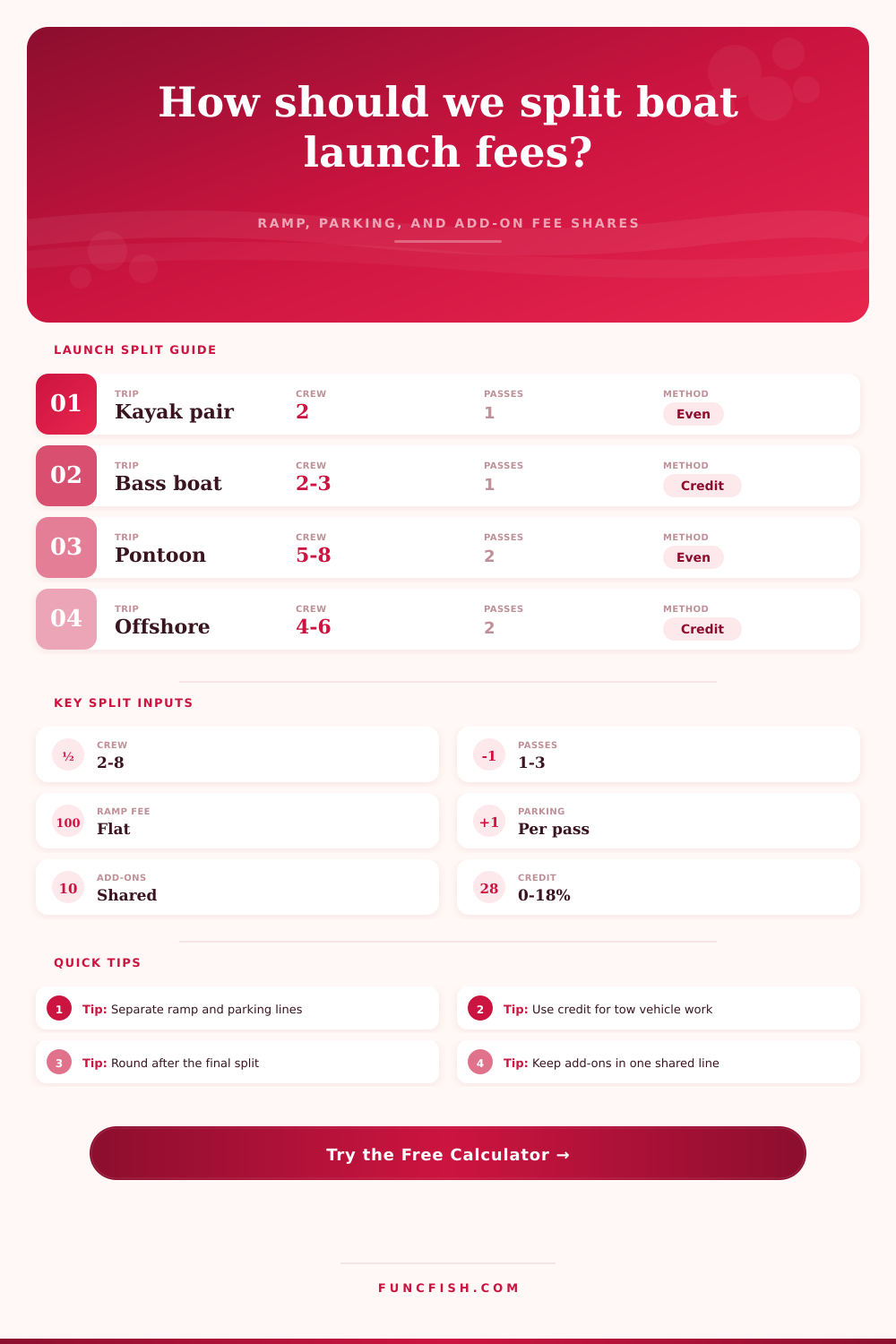
On the other hand, it is about being fair to the tow owner/skipper. Many folks in boating circles have an understanding where the owner of the trailer or boat are given some sort of credit. This isn’t about charity, but it does recognize the wear and tear from towing a two-ton piece of equipment over gravel.
On the page reference tables, you’ll notice a trailer owner credit can be anywhere from ten to eighteen percent with a complex launch. It can be none at all if it’s just launching a couple of kayaks. Launching a full family day with a pontoon may requires some very minor adjustment. For an offshore launch with a trailer that requires close maneuvering, more credit is required for the skipper.
Agreeing beforehand is key. There’s no worse way to kill a day of fishing than arguing about who owes who five bucks at the check-in kiosk. Decide on a split that fits your dynamic. If each person has their own equipment, then go with an even split. If someone hosts, make it so they pick up the parking and you both pays half for the ramp. If you’re just splitting costs across the board, go with a credit system where the tow guy gets less. You’ll be able to switch back and forth between these scenarios in seconds. Here we’ve moved from an even split to a credit system, and you can see how this changes the reimbursement amount.
The add-ons gets forgotten by most folks. There are little things like inspection fees and lock box rentals that add up. They’re usually shared costs, every boat uses ‘em regardless of engine size, so keeping ‘em in the shared pool cleans up the math. You see what everybody’s paying, the standard crew share, the owner’s adjusted net, and the total bill on the output cards. No more awkward silence while somebody pays who doesn’t offer to pay. Transparency is good.
“It’s all about how much we both pay for that access, but not so much the experience at the end of the day. What you catch or what waves you ride will be your own. It’s just the price of admission. Pay your fair share, and you can get the boat in the water. That’s the deal. Get on the lake without the burden of a poor split and return with clear heads. If you do it right, the math is easy. The rest is water.”