Persons Capacity From Boat Length Calculator
Estimate practical passenger count from boat length, beam, hull style, side depth, gear load, motor size, and water conditions.
📌Descriptive boat presets
⚙Boat capacity inputs
Capacity estimate
Formula breakdown
📋Hull comparison and capacity grid
Jon boat
Deep-V
Pontoon
Inflatable
Canoe
Kayak
Bay boat
Bass skiff
📚Capacity reference tables
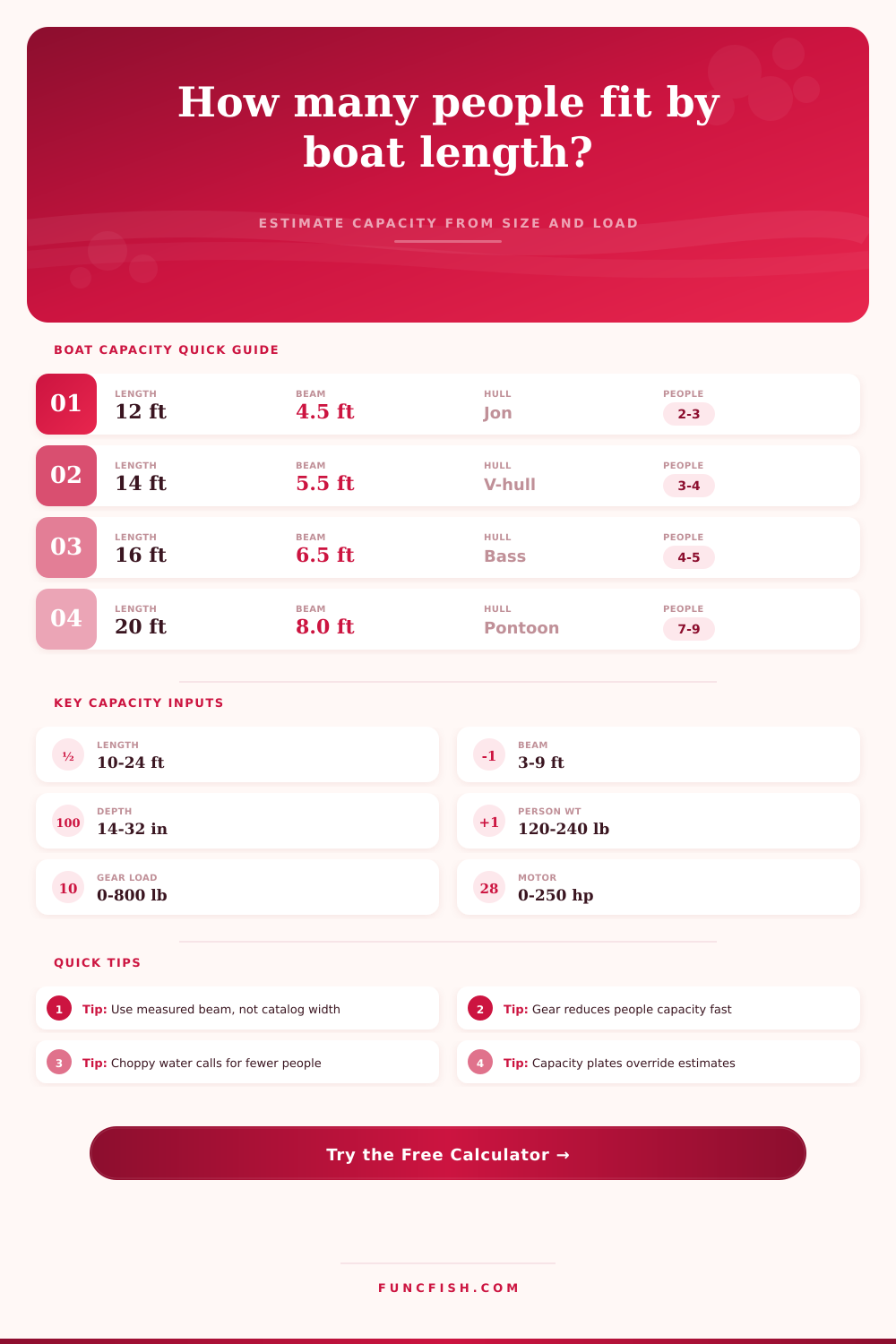
| Length band | Typical beam | Calm-water persons range | Common use case |
|---|---|---|---|
| 10 to 12 ft | 3.6 to 4.8 ft | 1 to 3 people | Tender, pond, small creek |
| 13 to 15 ft | 4.5 to 5.8 ft | 2 to 4 people | Utility fishing and light gear |
| 16 to 18 ft | 5.8 to 7.4 ft | 3 to 6 people | Fishing, casting decks, family day |
| 19 to 21 ft | 7.2 to 8.4 ft | 5 to 8 people | Bay, deck, larger lake boat |
| 22 to 24 ft | 8.0 to 8.8 ft | 7 to 11 people | Pontoon or wide deck layout |
| Hull style | Person formula adjustment | Payload rate | Capacity behavior |
|---|---|---|---|
| Flat-bottom jon | Baseline area divisor | 9.0 lb per sq ft | Stable at rest, watch freeboard |
| Utility semi-V | 5% lower than jon | 8.7 lb per sq ft | Balanced for small lakes |
| Deep-V fishing | 6% lower for narrower floor | 8.6 lb per sq ft | Better ride, less flat deck area |
| Pontoon | Higher deck stability factor | 11.8 lb per sq ft | Wide stance supports more passengers |
| Canoe or kayak | Narrow-hull penalty | 5.8 to 6.4 lb per sq ft | Load balance matters more than count |
| Water condition | Person multiplier | Payload multiplier | Practical reading |
|---|---|---|---|
| Sheltered pond or canal | 1.05 | 1.00 | Best-case protected water |
| Calm lake | 1.00 | 1.00 | Normal calculator baseline |
| Light chop | 0.88 | 0.92 | Keep a little more freeboard |
| Open, choppy water | 0.72 | 0.80 | Reduce the passenger count |
| Cold water reserve | 0.78 | 0.86 | Favor extra margin and dry deck |
| Motor power | Estimated motor weight | Capacity effect | When to revise input |
|---|---|---|---|
| 0 hp | 0 lb | No motor payload deduction | Human-powered craft |
| 2 to 9.9 hp | 35 to 90 lb | Small but noticeable deduction | Portable outboard or tender |
| 15 to 40 hp | 105 to 220 lb | May remove one person | Tiller and small console boats |
| 50 to 115 hp | 240 to 410 lb | Large stern load | Center console or bass layout |
| 150 hp and up | 455 lb and up | Check real engine tag | Use actual engine weight when known |
💡Capacity calculation checks
Tip: Enter the measured beam at the widest point and the usable interior depth near midship. Small changes in beam and side height can move the final passenger count.
Tip: Use the boat capacity plate, manufacturer rating, and local requirements when they apply. This calculator is an estimate for planning loads and comparing setups.
Here’s where you are… You’ve got a cooler, three kids, and a fishing rod that weighs more than it should, and you’re standing on the boat ramp. The boat is big enough for sure, right? But will it fit all of you and not sits dangerously low in the water?
Run the numbers above to find out before you get it started. It goes way beyond a good guesstimate based off length alone. It gets down into actual physics of your particular boat. Sure, length is important but it’s just the beginning. Oftentimes a 20 foot narrow fishing boat can carry less folks safely than a shorter wide pontoon, simply due to volume and stability of the boat.
Why You Should Use This Calculator
For instance, they want to know the maximum beam and the interior side depth, not the width from the catalog, but the beam that defines largest dimension of the hull. That’s what dictates your surface area in which to spread weight. If you have a wide boat, it distribute the weight better, meaning you can put more people on it before you start running out of freeboard.
Why does depth matter? It is the same principle. The deeper the hull, the faster it will fill up. If you’re sitting in a high-sided, deep-V fishing boat, you’ll have more reserve buoyancy, but you won’t have as much usable deck space to accommodate passenger comfortly. It’s those types of geometric realities that the tool takes into consideration and compares with weight intended to be carried aboard.
The weight of your gear also adds to the total. These include lifejackets, batteries, fuel, and tackle boxes. All add up. And that weight occupies space inside boat’s allowable weight limit, reducing amount of available space for occupants. In fact if you’re going on a doozy of a fish trip with a large outboard motor, that motor itself will take the weight capacity away from one or more passenger. The calculator subtracts an estimate of the motor weight along with the weight of your other gear from the overall capacity and then informs you how many folks can squeeze in there.
Harsh? Yes. It is better than being one of those who thinks they’ve packed their boat full, only to hit the water and find it’s still overweight.
The math changes dramatically different than water conditions. What is ideal for sitting in a sheltered pond won’t sit as well and handle as well in open choppy water. Slap, slap, slap go the waves against the hull. Rock, rock, rock goes the boat. When selecting cold or rough water conditions the tool apply a multiplier to decrease amount of passengers it recommends bringing. A small group provides a safer ride than being at maxed out capacity and feeling each and every swell. This is especially true if hypothermia is a concern. It is much more dangerous to quickly capsize in cold water.
When I say a boat holds X amount of people, that’s the max number it could possibly carry; it doesn’t necessarily mean you’ll enjoy having all those folks in there. You might be able to jam 5 bodies inside a fourteen-foot skiff, but should you? Safety IS comfort. When people are crammed into small spaces and continually have to shift their weight to balance themselves, odds is higher they will topple into the drink.
Generally speaking, the charts on this page provide typical rates across various hull styles and give you a starting point from which to judge your own configuration. As you’d expect, a narrow kayak has a very low payload rate… Stability is delicate. Whereas a wide-stanced pontoon naturaly accommodates more riders. If you are trying to figure out what will fit, do not try to second guess the manufacturer’s plate on your boat’s transom. They have tested their boats and know the capacities to meet all of the liability and testing requirements.
This calculator is a way to make some decisions about what to bring or leave home based off weight, as well as see how all of your gear impacts the load balance. It allows you to see the balance of taking one more person or another piece of equipment. Ultimately, it makes it very clear when loading up at the ramp what fits and what must go back into the vehicle, that’s the best safety feature you could of added.