Soft Plastic Salt Calculator
Calculate fine salt, plastisol, additive displacement, finished density, and usable bait count for soft plastic fishing lure batches.
📌Scenario presets
⚙Batch inputs
Use water fill volume for one finished cavity.
Soft plastic salt mix results
Formula breakdown
🧪Mixing equipment grid
Scale
Salt Sieve
Injector
Mix Cup
📊Salt loading by bait style
| Bait style | Typical salt by weight | Target specific gravity | Common lure behavior |
|---|---|---|---|
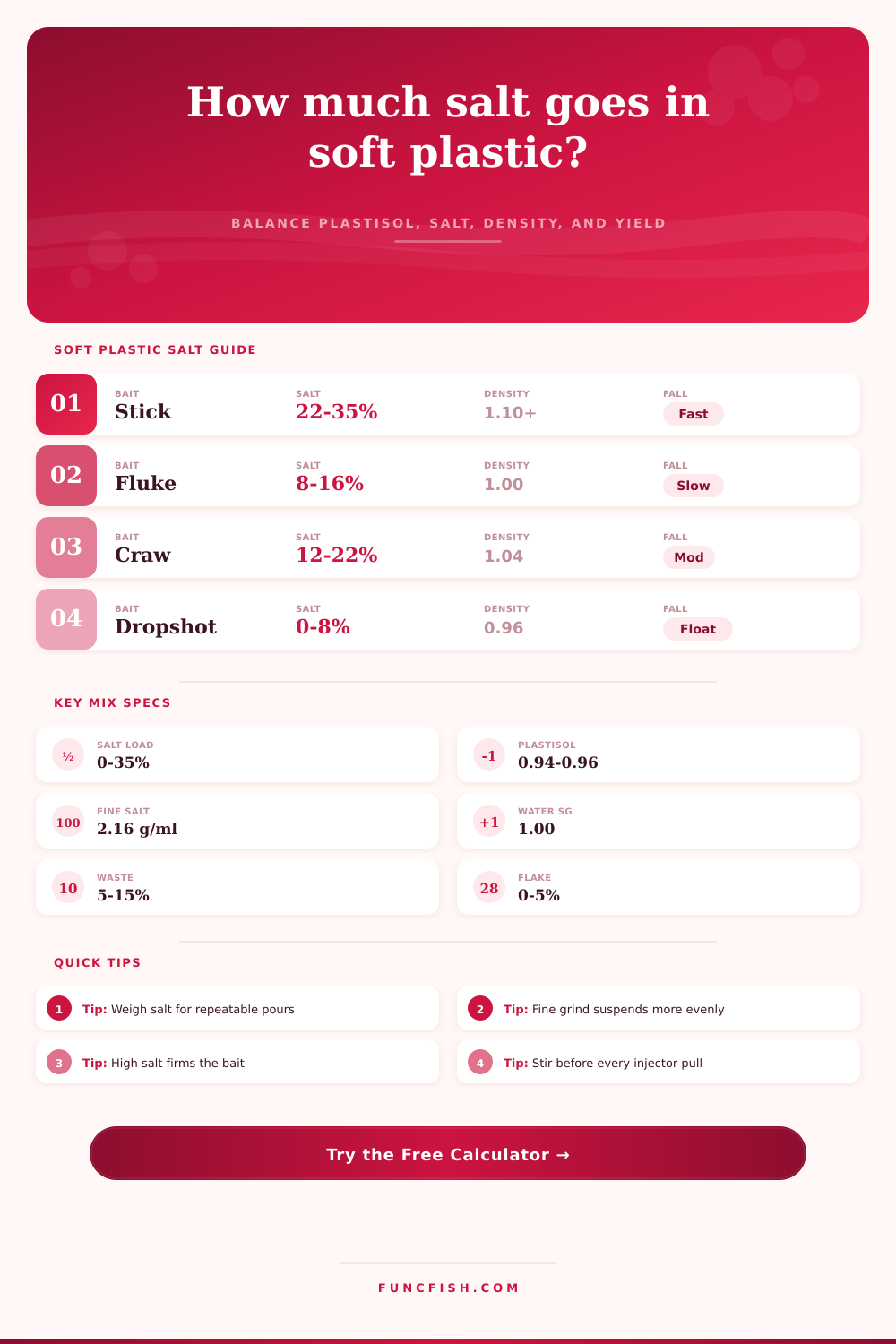
| Stick worm | 22-35% | 1.08-1.22 | Fast horizontal shimmy |
| Ned worm | 6-14% | 0.99-1.05 | Neutral stand-up bait |
| Fluke / jerk minnow | 8-16% | 1.00-1.07 | Slow glide with nose dip |
| Tube body | 10-20% | 1.02-1.10 | Spiral fall with jig head |
| Swimbait / shad | 5-14% | 0.99-1.06 | Moderate keel and track |
| Drop shot worm | 0-8% | 0.92-1.00 | Tail-up hover |
| Craw / creature | 12-22% | 1.03-1.12 | Bottom-contact fall |
| Micro finesse bait | 0-10% | 0.94-1.02 | Subtle sink or hover |
⚖Blend and salt density reference
| Material | Density used | Mixing effect | Calculator note |
|---|---|---|---|
| Soft plastisol | 0.94 g/ml | More action, less firmness | Needs less salt for neutral |
| Medium plastisol | 0.95 g/ml | Balanced bait feel | Default all-purpose base |
| Firm plastisol | 0.96 g/ml | Better hook slot strength | Slightly denser base |
| Floating blend | 0.88 g/ml | Tail-up presentation | Salt rises slowly from zero |
| Fine sodium chloride | 2.16 g/ml | Raises density quickly | True displacement value |
| Color / scent / flake | 1.05 g/ml | Small volume displacement | Entered as batch percent |
📏Cavity volume estimator
| Bait length | Slim worm cavity | Thick stick cavity | Creature / shad cavity |
|---|---|---|---|
| 2 in / 5 cm | 2-3 ml | 4-6 ml | 5-8 ml |
| 3 in / 8 cm | 4-6 ml | 7-10 ml | 9-14 ml |
| 4 in / 10 cm | 7-10 ml | 11-16 ml | 15-22 ml |
| 5 in / 13 cm | 10-14 ml | 17-24 ml | 23-34 ml |
| 6 in / 15 cm | 14-20 ml | 25-34 ml | 35-50 ml |
📋Sink profile comparison
| Profile | Specific gravity window | Salt range cue | Equipment match |
|---|---|---|---|
| Floating / tail-up | 0.88-0.98 | 0-5% salt | Floating blend, light hook |
| Neutral hover | 0.98-1.02 | 4-10% salt | Medium blend, small weight |
| Slow fall | 1.02-1.07 | 8-16% salt | Fine salt, open hook slot |
| Moderate sink | 1.07-1.13 | 14-24% salt | Firm blend, steady stirring |
| Fast sink | 1.13-1.22 | 22-35% salt | Powder salt, larger injector |
| Dense bottom contact | 1.22+ | 30%+ salt | Firm blend, short pour cycle |
💡Pouring checks
Tip: Use weight for salt and volume for mold capacity. Spoon measures drift because salt grind and packing change from batch to batch.
Tip: High-salt mixes settle fast. Stir immediately before drawing the injector so the first and last baits do not cure at different densities.
The calculator is designed to take your preferred sink rate (as expressed in terms of profile) and give you grams of weight needed to achieve that sink rate. It’s a way to get away from guessing and get down to engineering your bait’s density.
A lot of anglers will throw salt at their baits and then season until it feels right. The problem with that is that you can’t taste density. When the fish are finicky or it’s cold out, all bets is off for your intuition.
Why You Should Use the Calculator
Displacement is at the heart of it. Plastisol has a density of about 0.94 grams per milliliter for a typical soft blend. That means pure plastic float. To counteract that, you have to add weight. The best thing for that is sodium chloride (salt) which is cheap and works realy well.
Salt occupies space; every gram of salt you dump into the cup pushes out an equal volume of plastic. Therefore, if you don’t take into account the displacement, then you’ll end up making something that’s too firm and too dense. It might even weigh more than the tool can hold. That’s why the tool asks for desired percent of salt in your mix before asking what kind of plastic you’re using, because you must subtract the same number of milliliters of plastic as there is salt.
Think about what type of bait you’re creating. A bass fishing stick worm needs a quick and sharp fall, usually achieved with 20-35% salt (by weight). But your dropshot tail should suspend within water column. So it will often hover just slightly above or below neutral buoyancy with very little if any salt inside.
Based off those inputs, the calculator figures out how much plastisol go into each piece. If you pick a firmer saltwater blend than that’s its base density. And the system automatically decreases the amount of salt required to achieve same specific gravity. Getting the blend wrong throw off the whole calculation.
There are also additives. Salt is not the only thing that displaces plastic volume. Consider scent, colorants, or glitter flakes. The form typically includes a small percentage of volume displacement. For big batches, a few percentage points can realy add up. Skipping this part will result in a higher-than-expected final density.
The total batch yield section on the results page breaks it all down. It factors in waste from the injector cup and sprue. Ten to fifteen percent is a good estimate of waste for a sloppy set-up. Knowing exactly how much you’ll get to use means no more running-out-of-mix mid-cure-cycle.
You’ll find some sanity checking tables on page. The reference tables of course let you see the specific gravity range. A slow-fall fluke would put you around 1.02 or so; which just above 1.00, so it’s going to fall slowly but not race to the bottom. That’s the sweet spot for a lot of finesse stuff.
The other grid, equipment, is there as a reminder that no, you can’t get by without a scale. Salt comes in different crystal sizes and different levels of packing density, which makes volume measurements like teaspoons worthless. Only weight counts. And yes you should stir between each pull. Salt settles quickly and your last baits out of the cup is denser than those you pulled from the top initially.
Getting that right becomes part of the craft of pouring what used to be a hobby. Now you control the behavior of the bait in the water which in turn controls how the fish reacts to the bait. A smooth pour means the math worked and the baits will cure actualy how you want them to. You should of known it would take practice. You learn to work with the plastic and not fight it.
That’s where you separate the guy that throws random worms in a bucket and the guy that can dial in a specific fall rate for every given situation. It’s not magic. It is just good numbers.