Lead Melting Quantity Calculator
Estimate melt charge, finished tackle yield, sprue allowance, dross loss, and mold cycles for casting fishing sinkers, jig heads, and weighted inserts.
📌Batch presets
⚙Lead batch inputs
Lead melting batch result
Formula breakdown
🧪Alloy and material comparison grid
Soft Lead
Range Lead
Wheel Mix
Hardball
Linotype Scrap
Dirty Reclaim
Remelted Sprues
Mixed Scrap
📊Lead casting reference tables
| Fishing mold style | Typical finished weight | Sprue allowance | Batch note |
|---|---|---|---|
| Split shot mold | 0.02-0.12 oz / 0.6-3.4 g | 2-5% | Many cavities, small reserve |
| Round jig head | 1/32-1 oz / 0.9-28 g | 4-9% | Hook rejects can matter |
| Bullet sinker | 1/16-2 oz / 1.8-57 g | 5-10% | Runner weight varies by mold |
| Drop-shot cylinder | 1/8-1 oz / 3.5-28 g | 5-8% | Swivel inserts add handling loss |
| Bank sinker | 1-8 oz / 28-227 g | 6-11% | Large cavities cool slower |
| Pyramid surf sinker | 2-12 oz / 57-340 g | 7-13% | High mass per pour |
| Alloy or source | Density g/cm³ | Typical dross loss | Use in calculator |
|---|---|---|---|
| Soft lead | 11.34 | 2-5% | Clean sinkers and split shot |
| Clean range lead | 11.20 | 4-8% | General jig heads and sinkers |
| Clip-on wheel weight mix | 11.00 | 5-9% | Harder sinkers, more reserve |
| Hardball alloy | 10.90 | 5-9% | Firm inserts and cores |
| Linotype-rich scrap | 10.70 | 6-11% | Hard, lower density output |
| Dirty reclaim lead | 10.95 | 8-14% | Increase dross and reserve |
| Target fishing batch | Common count | Useful cavity count | Planning range |
|---|---|---|---|
| Trout shot refill | 100-250 pieces | 8-12 cavities | 0.5-2 lb / 0.2-0.9 kg |
| Panfish jigs | 50-150 pieces | 4-8 cavities | 1-4 lb / 0.5-1.8 kg |
| Bass worm weights | 75-200 pieces | 4-8 cavities | 2-8 lb / 0.9-3.6 kg |
| Catfish sinkers | 25-100 pieces | 2-4 cavities | 5-20 lb / 2.3-9.1 kg |
| Surf sinkers | 20-80 pieces | 1-3 cavities | 8-35 lb / 3.6-15.9 kg |
| Trolling cores | 20-60 pieces | 1-4 cavities | 6-24 lb / 2.7-10.9 kg |
| Usable pot charge | Best batch size | Keep below | Calculator meaning |
|---|---|---|---|
| 2 lb / 0.9 kg | Split shot and tiny jigs | 1.7 lb / 0.8 kg | Multiple reloads for heavy sinkers |
| 5 lb / 2.3 kg | Jigs and bass weights | 4.3 lb / 2.0 kg | Small-shop planning charge |
| 10 lb / 4.5 kg | Most sinker batches | 8.5 lb / 3.9 kg | Good baseline pot input |
| 20 lb / 9.1 kg | Catfish and surf sinkers | 17 lb / 7.7 kg | Fewer reloads, longer heat time |
| 40 lb / 18.1 kg | Large repeated batches | 34 lb / 15.4 kg | Use load count for staging ingots |
💡Batch calculation checks
Tip: Use the actual cooled piece weight when you can. Mold labels are a starting point, but alloy hardness and inserts can shift finished weight.
Tip: Sprues that go straight back into the pot still occupy starting charge. Keep them in the allowance so the first pour is not short.
A lead melt batch is simple math: how much do I want to make plus some extra for scrap. Plug that in with some estimate of losses, and the calculator does the rest. You won’t have to guess if you should of made one more. It becomes a straightforward supply-chain issue.
You figure out how many ingot of each piece of material you’ll need for all those parts, and throw in a little more for scrap. The trick is to learn your buffer. Each alloy are unique within the mould. For instance soft lead flows great. As it cools however, it does shrink a little bit. So you want a little extra space to ensure that all the lead goes into the cavity and does not fall short. Denser harder alloys don’t fill out corners as easy so you want a greater sprue allowance to account for missing fill and turbulence caused by the alloy. If you miss this fact, you will underestimate amount of lead lost and end up with partially filled cavities. Then you have to melt them back down.
How to Calculate Your Lead Melt
This is where many folks fail. They get hung up on the final weight. They neglect that the runner system consumes actualy material. The inputs include dross and reserve which are determined by experience. Dross is oxidized molten lead skin. It thickens and floats. Skim it off and dump it. The cleaner the lead, the less dross. Mixed scrap or dirty reclaim will lose a lot of weight to oxidation. Add a reserve percentage for rejects. You’ll inevitably have misshapen pieces or those too light to fish. If you ignore losses, you fall short in final count.
Your workflow is dictated by size of your pot. For instance, you’re not going to charge a ten pound pot with twenty pounds of lead. That’s too much. Metal will expand as it melts and overflow. Also, the element can gets overheated. It helps you know how many load you have to do with what pot you have. Say you’ve got a fifteen pound batch but your pot only holds ten. Right away you’ll know this is a multi-load job. Do you want to stage your ingots? Maybe you need to run another melt cycle? This avoids the issue of your pot running out halfway through a pour.
How long until my job is finished? That’s what mold cycle calculation means. You’ll be pouring on those molds twenty-five times for every one hundred parts. You have to strip them and cool them off then heat them back up, repeating this over and over depending on how many pours you have. It also determines whether you’ll batch out the job or spread it over time. Split shot can be done in small batches because they’re small and have lots of cavities so they come out fast. Heavy surf sinkers take longer per pour. You must handle them with care to prevent air bubbles.
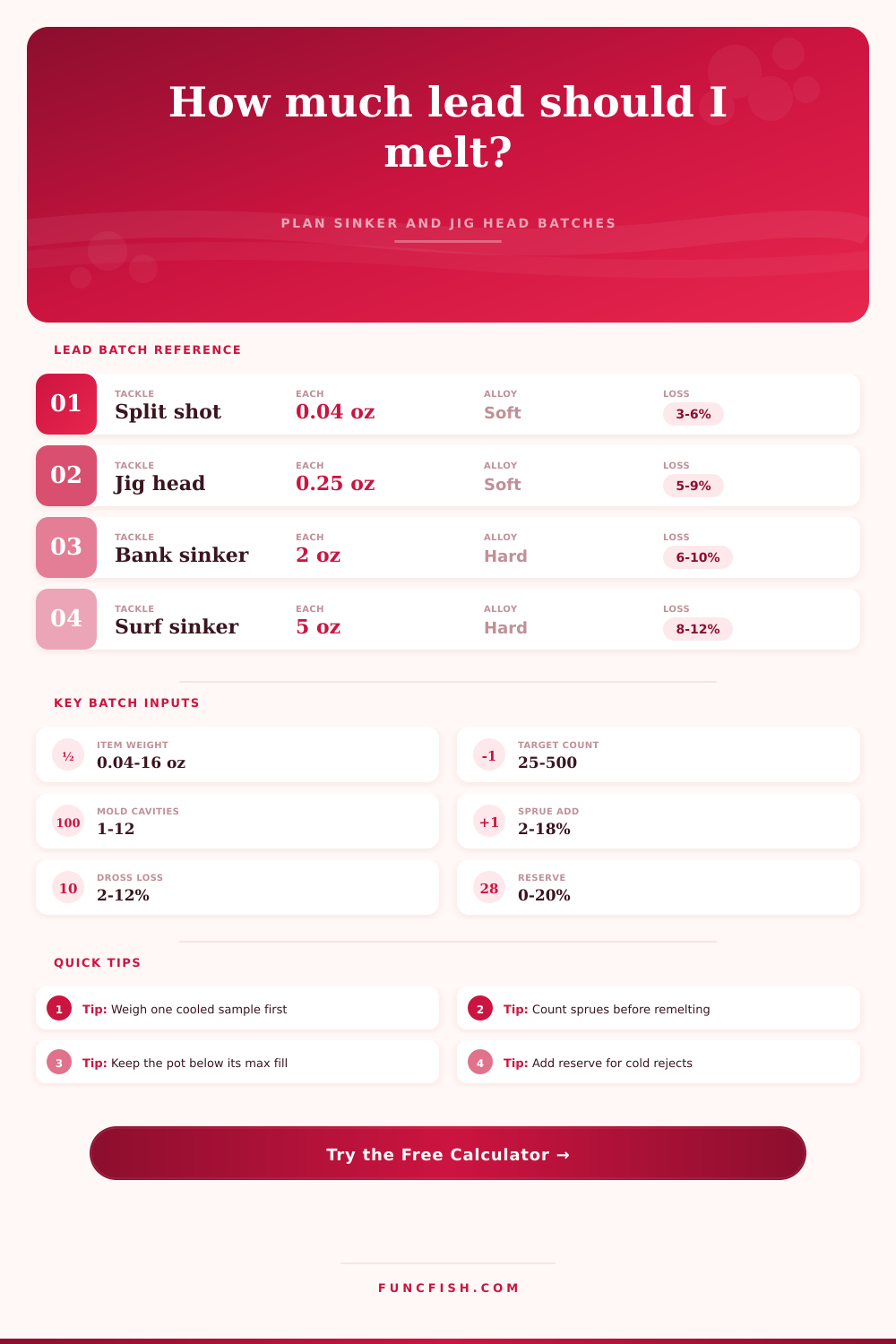
The reference tables is a sanity check on what you input. It lets you know split shot requires a lower sprue allowance then, say, a pyramid sinker. Before you calculate, it gives you time to adjust your settings based off that knowledge. It grounds your expectations in the real world instead of just going off of intuition. You begin to notice patterns between alloy hardness, cavity count and weight.
Lead casting is not only a matter of production; it’s also a matter of waste managment. Skimming dross properly means keeping the metal clean for the next pour. Each ounce of that metal recovers heat energy from the sprue that gets returned to the pot. A good first charge minimizes stress when it comes time to cast. You don’t have to worry about running dry, so you can concentrate on quality instead. It’s simple math, but you need to respect the metal in order to carry out the plan. Charge your pot, plan your loss, and let the metal do the work.