Fishing Weight Lead Cost Calculator
Estimate sinker lead needed, batch yield, scrap return, and per-weight material cost for common fishing weight styles.
📌Batch presets
⚙Lead batch inputs
Lead cost results
Formula breakdown
🧱Material comparison grid
Soft Ingot Lead
Reclaimed Sinkers
Wheel-Weight Alloy
Bismuth-Tin
📊Reference tables
| Sinker style | Typical weight range | Common waste allowance | Hardware allowance |
|---|---|---|---|
| Split shot | 1/32-1/4 oz / 0.9-7 g | 12-18% | None |
| Drop shot cylinder | 1/8-1 oz / 3.5-28 g | 7-12% | Clip eye |
| Egg sinker | 1/4-4 oz / 7-113 g | 6-10% | None |
| Bank sinker | 1-8 oz / 28-227 g | 5-9% | Eye loop |
| Pyramid surf weight | 2-10 oz / 57-283 g | 5-9% | Brass eye |
| Trolling keel | 4-32 oz / 113-907 g | 4-8% | Swivel pair |
| Lead source | Density factor | Clean yield | Planning note |
|---|---|---|---|
| Soft ingot lead | 1.00 | 96% | Most predictable mold fill |
| Reclaimed sinkers | 0.98 | 92% | Screen for line and sand |
| Clean range lead | 0.96 | 90% | Skim jackets and grit |
| Wheel-weight alloy | 0.94 | 88% | Harder alloy, lighter volume |
| Mixed scrap lead | 0.93 | 84% | Use higher dross allowance |
| Bismuth-tin substitute | 0.86 | 94% | Needs more volume for weight |
| Finished weight | Pieces per pound | Pieces per kilogram | Use case |
|---|---|---|---|
| 1/8 oz / 3.5 g | 128 | 286 | Drop shot and trout |
| 1/2 oz / 14 g | 32 | 71 | Kayak drifting |
| 1 oz / 28 g | 16 | 36 | General bottom rigs |
| 3 oz / 85 g | 5.3 | 11.8 | River and surf |
| 6 oz / 170 g | 2.7 | 5.9 | Surf and pier |
| 16 oz / 454 g | 1 | 2.2 | Trolling and deep drop |
| Batch condition | Adjustment | Calculator input | Why it matters |
|---|---|---|---|
| Small cavities | Raise waste | 12-18% | More sprue per ounce |
| Large cavities | Lower waste | 4-8% | Less sprue per finished weight |
| Dirty scrap | Raise rejects | 8-14% | Dross and incomplete fill |
| Wire eyes added | Add hardware | $0.02-$0.12 | Eyes and swivels add per piece |
| Powder coating | Add finish | $0.01-$0.08 | Coating adds small piece cost |
| Clean ingots | Lower rejects | 1-4% | More consistent mold fill |
💡Lead cost checks
Tip: Enter rejects separately from sprue. Rejects increase the number of cavities poured, while sprue increases the melt charge for each pour.
Tip: For reclaimed lead, use the lower clean-yield source setting and round the melt requirement up to the next usable ingot or muffin size.
There’s something satisfying about making your own fishing weights as the cost of tackle continues to rise. At least, that’s how it feels. You are standing over melting pot and watching the dull gray metal become liquid. Seems pretty simple: Get some lead, melt it into weight, do it again.
Doesn’t always work that way. Most hobby angler lose money on the difference between buying the ingot and selling the finished product. It is not just the cost of the raw material, what you purchase to use it, and what you discard in the process. What you waste. What you buy to convert it.
How to Count the Real Cost of Making Fishing Weights
Once you know what you’re making, the calculator will handle heavy lifting. But knowing the inputs will keep you from getting surprised at the end.
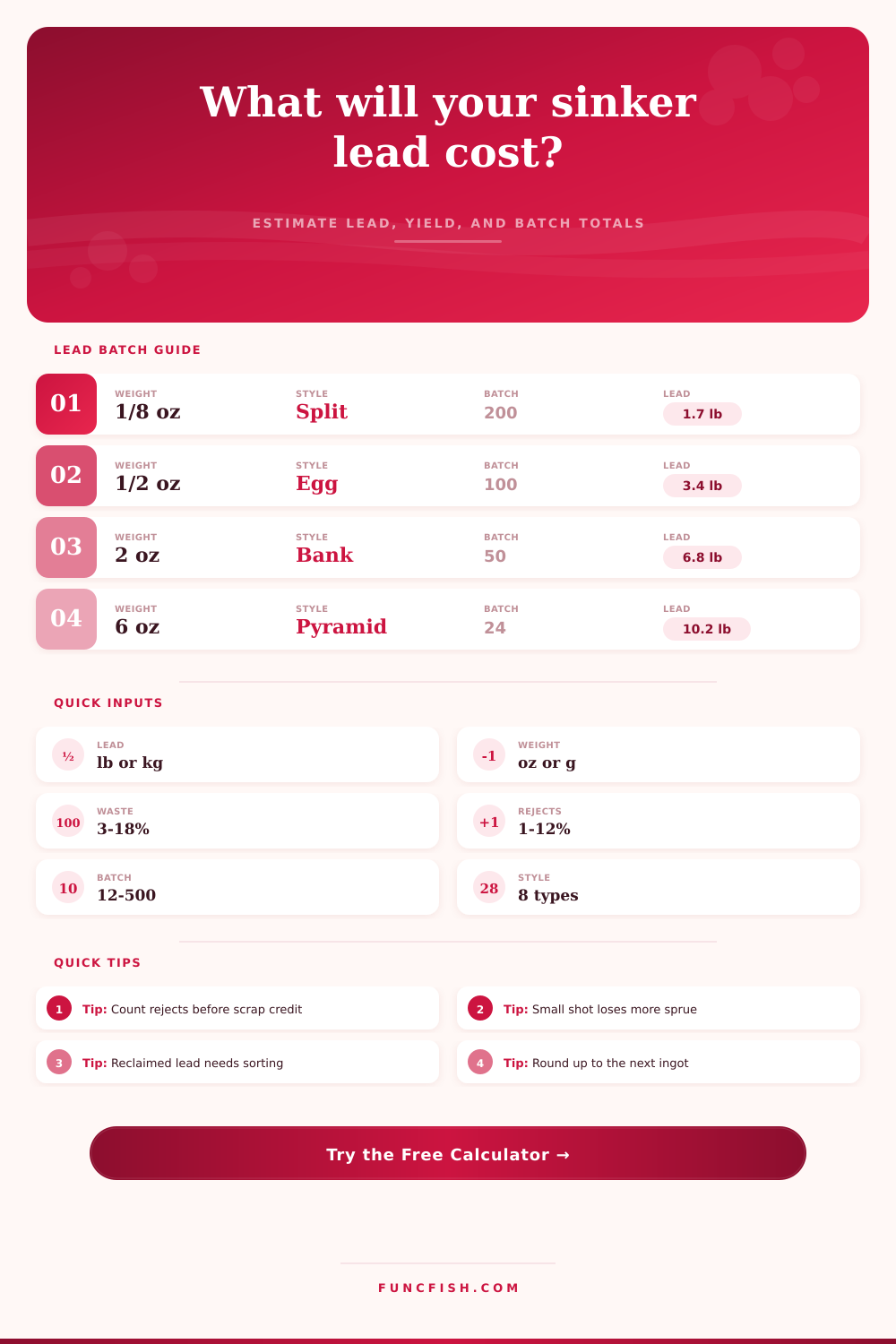
Waste. This is the largest silent expense. Melted lead isn’t just making sinker. It is also making sprue. Sprue is the leftover metal that solidifies in the channel funnels of your molds. And what happens to it? It doesn’t go away. It’s stuck to each of those sinkers you draw from your mold. Now if you’re casting tiny drop-shot cylinder, that sprue is a huge percentage of your overall weight. With bigger pyramid weights, it becomes a smaller portion, but the actual amount of waste increases. Before you begin melting, you must consider this loss.
The tool will adjust your melt charge according to the percent waste. This tweak is the difference between properly preparing for your pour versus falling short mid-session.
And then there’s the issue of rejects. Not every pour goes perfectly. There are some sinkers with air bubbles inside. There are also those with rough edges or partial fills that won’t sit well in a rig. Can’t sell ‘em. Can’t use ’em. Should they remelt them and waste more time and energy? Or they simply write off all that metal as a complete loss of material.
Most folks misjudge things here. They believe themselves to be careful, but they’re not. Five to ten percent is a realistic reject figure for any non-professional working without an assembly-line mindset. This is factored into the yield by the calculator. It informs you just how many ingot it’ll take to achieve your desired number of usable weights. This keeps you from ordering too little lead and having to get another shipment soon after.
But the equation shifts a lot depending off your source material. Pure soft ingot lead is the gold standard. It’s predictable. It fills the mold cleanly. It yields well. Reclaimed lead from someone’s range weights or old sinkers is less expensive. But it’s dirty. It has grit. Oxidation. May have unwanted mixed metals in it which reduce the density. And lower density require more volume to get equal weight. Replacing tin with bismuth for environmental reasons may reduce density even more. You may require as much as 15% additional metal by volume to sink at the same rate as pure lead.
This is where the reference grid on the page comes into play. It lays it out plainly. It shows how each source affects density and yield. It isn’t merely a matter of price. It is a matter of physics.
The last variable is hardware. You can pour the perfect sinker, but if it doesn’t have a good eye loop on it or some sort of protective coating, it’s still just a rock. Brass eyes, swivels, zinc plating all add a fixed cost per unit which doesn’t change at the same rate as amount of metal. If you’re pouring fifty large pyramid weights, then the lead is the dominating cost. If you’re pouring five hundred little split shots, then your time plus the hardware is the bulk of the expense.
The calculator rolls up all those littel per-unit costs together into a total for a batch. It lets you know your real cost per sinker. That’s what counts when you consider buying versus pouring yourself. You’re not trying to make a penny. You’re trying to make enough so that it’s worth the mess, the heat, the effort.
So if your weights cost you 40 cents to make at home and you can get them already made for 30, then you are paying for this hobby. That is good. You aren’t saving money. But you’ll know what you’re paying.
It’s simple math but there are lots of variables. Consider the density of your source. Add for sprues. Account for rejects. Include the hardware. And do all that and you would of known exactly the value of each one of your sinkers. Not guess work. Not pour by feel. Pour confidently.