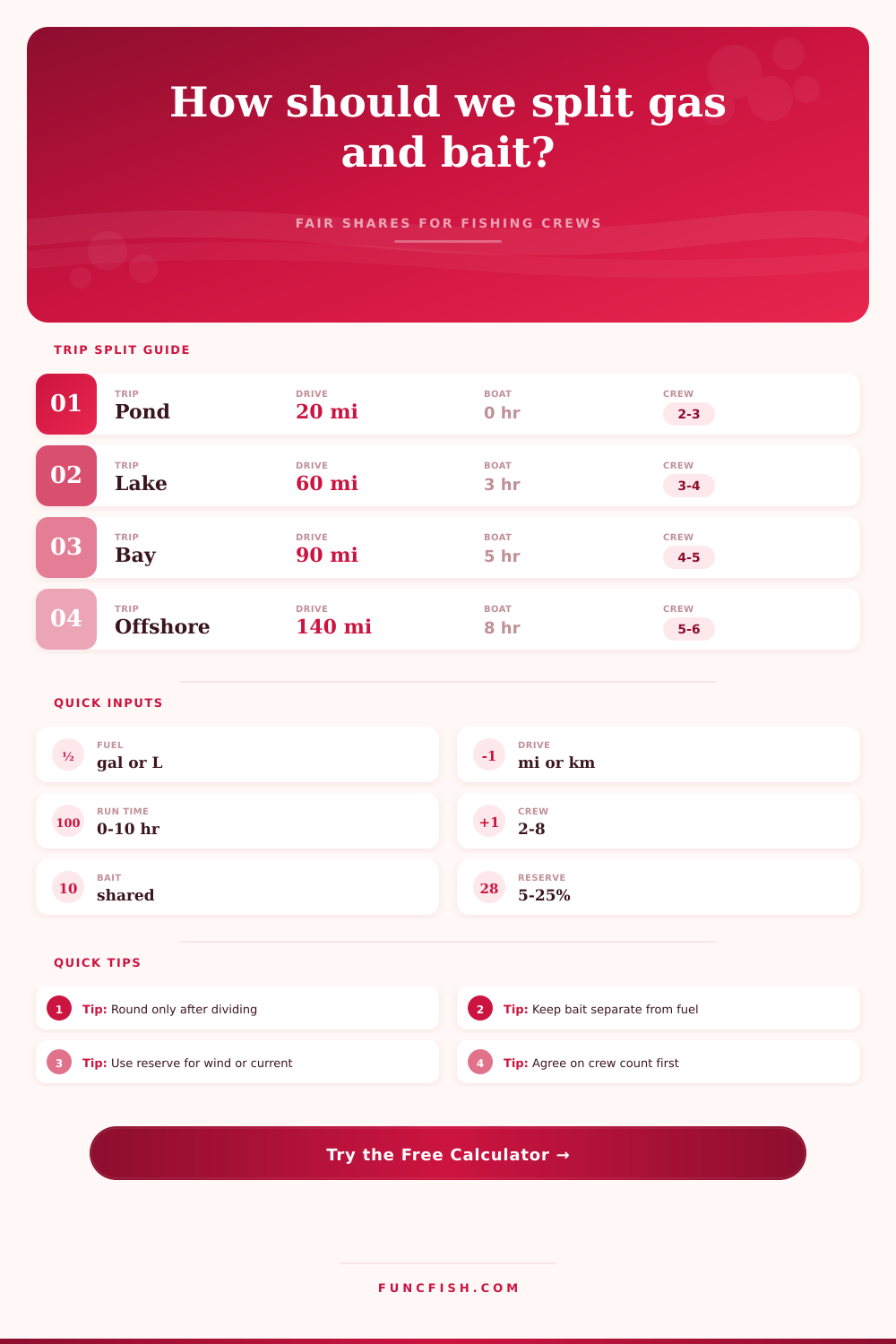
Fishing Gas and Bait Split Calculator
Divide tow fuel, boat fuel, bait, ice, chum, and shared trip supplies across the anglers who agreed to split the day.
📌Trip presets
⚙Shared trip inputs
📋Shared item grid
Round trip distance divided by vehicle efficiency.
Engine hours multiplied by burn rate and reserve.
Minnows, shrimp, worms, cut bait, or squid.
Cooler ice, bait ice, chum ice, and fish care.
Common on surf, bay, and offshore bottom trips.
Added fuel margin for current, chop, or detours.
Use the number of anglers who agreed to share.
Round the final share only after the full split.
📘Reference tables
| Fishing trip | Typical drive | Boat time | Common split note |
|---|---|---|---|
| Bank pond live bait | 10-40 mi / 16-64 km | 0 hr | Mostly bait and ice |
| Kayak creek float | 20-70 mi / 32-113 km | 0-1 hr | Low fuel, small bait pool |
| Bass boat reservoir | 40-110 mi / 64-177 km | 2-5 hr | Tow fuel matters |
| Walleye minnow drift | 50-140 mi / 80-225 km | 3-6 hr | Minnows and boat fuel |
| Inshore bay skiff | 60-160 mi / 97-257 km | 4-7 hr | Reserve for wind and tide |
| Offshore bottom trip | 90-220 mi / 145-354 km | 6-10 hr | Fuel reserve should be clear |
| Fuel setup | Imperial estimate | Metric estimate | Split use |
|---|---|---|---|
| Pickup without trailer | 18-25 mpg | 9.4-13.1 L/100 km | Light bank or kayak trips |
| Pickup towing skiff | 10-16 mpg | 14.7-23.5 L/100 km | Most ramp days |
| Small outboard | 1-3 gal/hr | 3.8-11.4 L/hr | Creeks and small lakes |
| Mid outboard | 4-8 gal/hr | 15.1-30.3 L/hr | Bass, bay, and walleye |
| Large outboard | 9-18 gal/hr | 34.1-68.1 L/hr | Saltwater runs |
| Twin offshore setup | 18-36 gal/hr | 68.1-136 L/hr | Long offshore crews |
| Bait pattern | Typical shared items | Calculator buffer | Fairness check |
|---|---|---|---|
| Mostly lures | Ice, scent, spare terminal | 0% | Do not load lure value into bait |
| Live bait buckets | Worms, shrimp, aerator ice | 5% | Share by anglers using bait |
| Minnow run | Minnows, bags, oxygen, ice | 8% | Count dead loss before launch |
| Cut bait and ice | Cut bait, cooler ice, gloves | 12% | Include prep items if shared |
| Chum-heavy saltwater | Chum block, bait, extra ice | 18% | Separate personal tackle |
| Offshore reserve box | Squid, sardines, chum, ice | 22% | Agree before buying extra |
| Split method | Best fit | Formula | When to avoid |
|---|---|---|---|
| Equal crew split | Friends sharing one plan | Total pool / crew | Some anglers brought their own bait |
| Fuel-only payback | Boat owner covered fuel | Fuel pool / crew | Bait was also shared |
| Bait-only side split | Bank or pier trips | Bait pool / crew | Long drive was shared |
| Two-part split | Mixed bait use | Fuel split plus bait users | Everyone used the same bait |
💡Split checks
Tip: Enter the fuel rate actually paid by the driver or skipper, then split after the reserve is applied. That keeps the reimbursement tied to the trip instead of a guess.
Tip: Keep personal tackle, lost lures, and rod repairs out of the shared bait line unless the crew agreed before the trip.
Plug in the supply cost for gas and bait, your burn rate, and the miles you drove into the fishing gas and bait split calculator. Let it do the math for you; no need to break out a calculator while standing at the gas pump. No need to count pennies when you could be casting, no more silent resentment from the crew.
Tow fuel is something most people don’t account for well when calculating how much money they spends at the pump. They only consider their engine running in the water and not what’s pulling that weight. Tow vehicles pull heavy load and drag down gas mileage a lot. What would normaly be getting 20 miles per gallon may go down to 12 while towing a boat with a full trailer. This is accounted for in the tool where you can change efficiency to match how much weight the vehicle are carrying.
How to Share Fishing Costs Fairly
Road fuel can easily become the biggest hidden expense of a weekend outing. Fueling a boat is different than your vehicle. It’s not about mileage; it’s about time. An idling outboard next to dock uses less fuel than one running at full speed offshore, but they both cost you money. The burn rate versus engine hours separation on the calculator allow you to know exactly what’s costing you time. At cruise speed, a mid-sized outboard may burns five gallons an hour. Multiply that by six hours on the water and you already have thirty gallons before even considering idling to catch fish. It adds up quickly.
There is things in life that has a negative side, like live bait. Live bait gets dead. Dead minnows do not catch walleye. They don’t catch walleye, you gotta have some extra space. The reference table on the page talks about a percentage to add to the cost of your bait as waste/mortality. It’s a little thing but it makes a difference. If there isn’t any buffer then the guy who buys the bait lose money each time a bucket runs dry. A waste margin built into total bait input will prevent that sting when he would of had to buy lunch instead of fish.
Crew dynamics are the other side of the equation. By agreeing to co-angler, you assume an equal split with angler(s) who agreed. Do not place personal tackle in common pool. Separate personal expenses. That’s cleaner. The calculator take the entire pool and divides it evenly between the anglers. No complicated argument later; just simple math.
Traveling offshore require advance planning. Wind and current can double your travel time. That’s why there is a reserve field in the calculator. Adding 10% or 20% will account for the extra chop we don’t anticipate, it’s less expensive to buy gas you won’t need than it is to sit waiting for a tow.
For a detailed breakdown of each column, check out the shared item grid which describes the reasoning behind each category. Fuel is for moving. Bait is for attracting. Ice is for preserving. They all serve different purposes based off their own cost structures.
It’s about fairness. When I say fairness, I don’t mean you pay the same number of cents as everyone else. I mean you pay for the fuel that you use and you pay for the bait that you buy in direct proportion to each other. So if 20 anglers go on a trip, then the calculator will divide it out by 20 and give you your share of the bait and your share of the fuel reimbursement. That transparency builds trust. You can look at it and know exactly how much went towards the bait shop and how much went towards the gas station. And there’s no guessing.
Establish an agreed upon number before leaving house Decide how many crew members is needed. Select how much of a bait buffer to have based off your own skill set Pick who will handle the reserve Allow the tool to do the work. This removes the hassle from the financial aspect of fishing. Once the money is sorted, all you have to worry about is whether the fish are biting. Which is the best way to begin any day on the water.