Running Ledger Weight Calculator
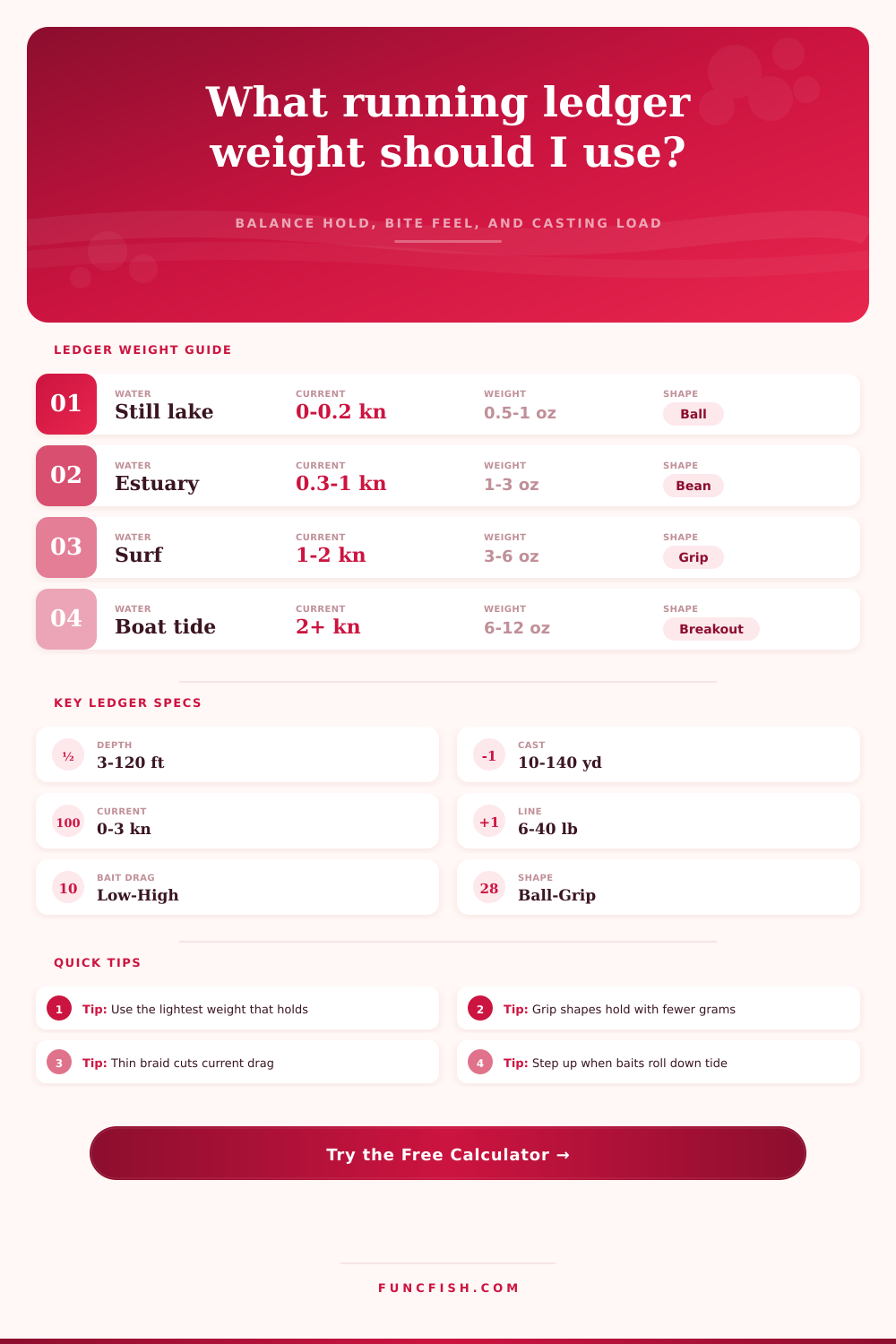
Estimate the sinker weight that lets a running ledger hold bottom without muting bites, based on current, line drag, bait profile, cast length, depth, and sinker shape.
📌Ledger presets
⚙Ledger conditions
Running ledger weight result
Formula breakdown
📋Material and shape grid
Ball Lead
Bean Lead
Egg Lead
No-Roll
Pear Bomb
Grip Lead
Breakout
Steel
📊Running ledger reference tables
| Current speed | Typical ledger weight | Best shape | Reading on the rig |
|---|---|---|---|
| 0 to 0.2 kn / 0 to 0.10 m/s | 0.25 to 1 oz / 7 to 28 g | Ball, bean | Weight rests cleanly with loose bite feel |
| 0.3 to 0.7 kn / 0.15 to 0.36 m/s | 1 to 2 oz / 28 to 56 g | Bean, egg | Line bow is visible but bait stays close |
| 0.8 to 1.4 kn / 0.41 to 0.72 m/s | 2 to 5 oz / 56 to 140 g | No-roll, grip | Bait may creep if line is thick |
| 1.5 to 2.2 kn / 0.77 to 1.13 m/s | 5 to 8 oz / 140 to 224 g | Grip, breakout | Use more hold shape before more weight |
| 2.3 to 3.0 kn / 1.18 to 1.54 m/s | 8 to 16 oz / 224 to 448 g | Breakout | Heavy tide calls for short traces and thin mainline |
| Target and bait | Bait drag class | Usual ledger range | Bite sensitivity note |
|---|---|---|---|
| Small coarse fish, maggot or corn | Very low | 0.25 to 1 oz / 7 to 28 g | Keep the running link as light as possible |
| Bream or tench, bread or pellet | Low | 0.5 to 1.5 oz / 14 to 42 g | Too much lead can mask lift bites |
| Flatfish, worm or strip bait | Medium | 1 to 4 oz / 28 to 112 g | Stable bait presentation beats excess distance |
| Barbel or carp, pellet or boilie | Medium | 1.5 to 4 oz / 42 to 112 g | Use no-roll shapes in steady river flow |
| Cod or bass, squid strip | High | 3 to 7 oz / 84 to 196 g | Strip baits flutter and add drag in tide |
| Ray or skate, oily slab bait | Very high | 5 to 16 oz / 140 to 448 g | Large slabs need hold, not just mass |
| Mainline class | Approx diameter | Drag behavior | Ledger adjustment |
|---|---|---|---|
| 6 to 10 lb braid | 0.10 to 0.14 mm | Cuts current well | Often allows one size lighter |
| 20 lb braid | 0.18 mm | Balanced shore and boat choice | Baseline for medium tide estimates |
| 40 lb braid | 0.30 mm | Stronger but catches flow | Add hold when depth or tide rises |
| 8 to 15 lb mono | 0.25 to 0.37 mm | More bow and stretch | Needs extra weight at range |
| 25 to 40 lb mono | 0.48 to 0.62 mm | High water resistance | Shape choice matters as much as ounces |
| Bottom type | Hold effect | Preferred sinker | Reason |
|---|---|---|---|
| Soft silt or mud | High suction | Ball, bean, pear | Too much grip can bury the ledger |
| Clean sand | Predictable | Bean, grip | Good contact without snagging |
| Fine gravel | Moderate hold | No-roll, pear | Flat faces settle between stones |
| Rock or kelp edges | Snag risk | Pear, steel | Use smoother shapes that free easier |
| Rolling surf wash | Unstable | Grip, breakout | Wires resist washback and side sweep |
💡Ledger checks
Tip: If a running ledger moves a few inches then settles, the weight is usually close. If it keeps creeping, switch to a better holding shape before jumping several ounces.
Tip: Long casts and thick mono create a bigger line bow, so a rig can need more sinker even when the current feels moderate at the rod tip.
But if your bait keeps sliding along the bottom of the river then you get frustrated. You throw it out there and let it sit, but nothing holds on sinker. It’s all about balance. Too light a weight and the current will take your bait. Too heavy a weight and you deaden your bite sensitivity and fail to detect those subtle taps. You want enough weight to hold the bottom with just as little as possible.
And that’s the whole point of ledger fishing. After you establish the details of your situation, the calculator do the math for you. It uses variables like current speed, line diameter, and water depth to calculate the correct sinker size. This size keep the rig in place while still maintaining bite feel.
How to Choose the Right Fishing Weight
But that is only part of the story. The look and feel of the bottom are not captured by numbers on a screen and cannot account for unanticipated changes in tides. Trusting the result require knowing what the inputs mean.
Think about the line. A light braided line slices through water. But a heavy line like mono will work more like a parachute. Forty-pound mono in a swift current will create so much drag that it can rips the sinker off. This is where the tool takes into account the line class and adjusts accordingly. You just have to select your line strength truthfully. If you don’t provide an honest line class, you will get a dangerously low weight recommendation. The line becomes part of the load, not just the bait. It too fights the water.
Drag is also called bait profile. How much drag does your bait have? There’s barely any from a little maggot, but a big wad of greasy mackerel is like a sail. You enter that into the calculator which then factors in the resistance. A fluttering strip of squid can double the effective weight you need to hold station. Fail to do so and you’re losing ground all day long.
The table of references shows you the connection between drag class and bait size. It helps you picture the resistance between a pellet and a cut bait.
Many anglers underestimate the importance of shape. Sure, a nice-looking ball sinker rolls over. But a flat no roll sinks in digging in on its face. Aggressive points pierce the sand like a grip lead. The tool assign the hold indices. A simple ball has a lower index than a breakout lead that resists sideways current action using its shape. Selecting the proper shape can often allow for lighter weights. Less weight mean greater bite transmission. It’s worth it to find the right balance between hold and weight.
Bottom type is everything Rock will snag a sinker or let it slide while silt grabs a sinker and doesn’t let go. Fishing over weed, a smooth egg sinker may drag across the top rather than burrowing into the weeds. These different types of friction gets accounted for with a bottom hold setting in the calculator. Clean sand provides less grip where soft mud increase the grip. This setting prevents you from under-leading on hard sand or over-leading on soft ground.
The problem? Most guys begin by going too heavy. It is because it’s safe. You want a little extra weight just in case. Then you add another ounce. Before you know it, you’ve got a mute your bites weight on the bottom.
The calculator suggests starting lighter. It recommends a weight for you and has a margin for how much you can hold. If the margin is high, maybe you can drop down a size. If it’s low, you’re right up against it. So use the alternative suggestion if things get worse. Start light and go up from there as needed.
A good ledger rig comes alive. There is a little bow in the line and no loop of slack. It feels like you are just barely moving the tip with the current. Any constant pull without resolution means you’re snagged or dragging. Change the shape or weight; change the line. Your senses confirm the results. The tool provides starting point for conversation.
Listen to what the water has to say. Fish is a conversation with the water.