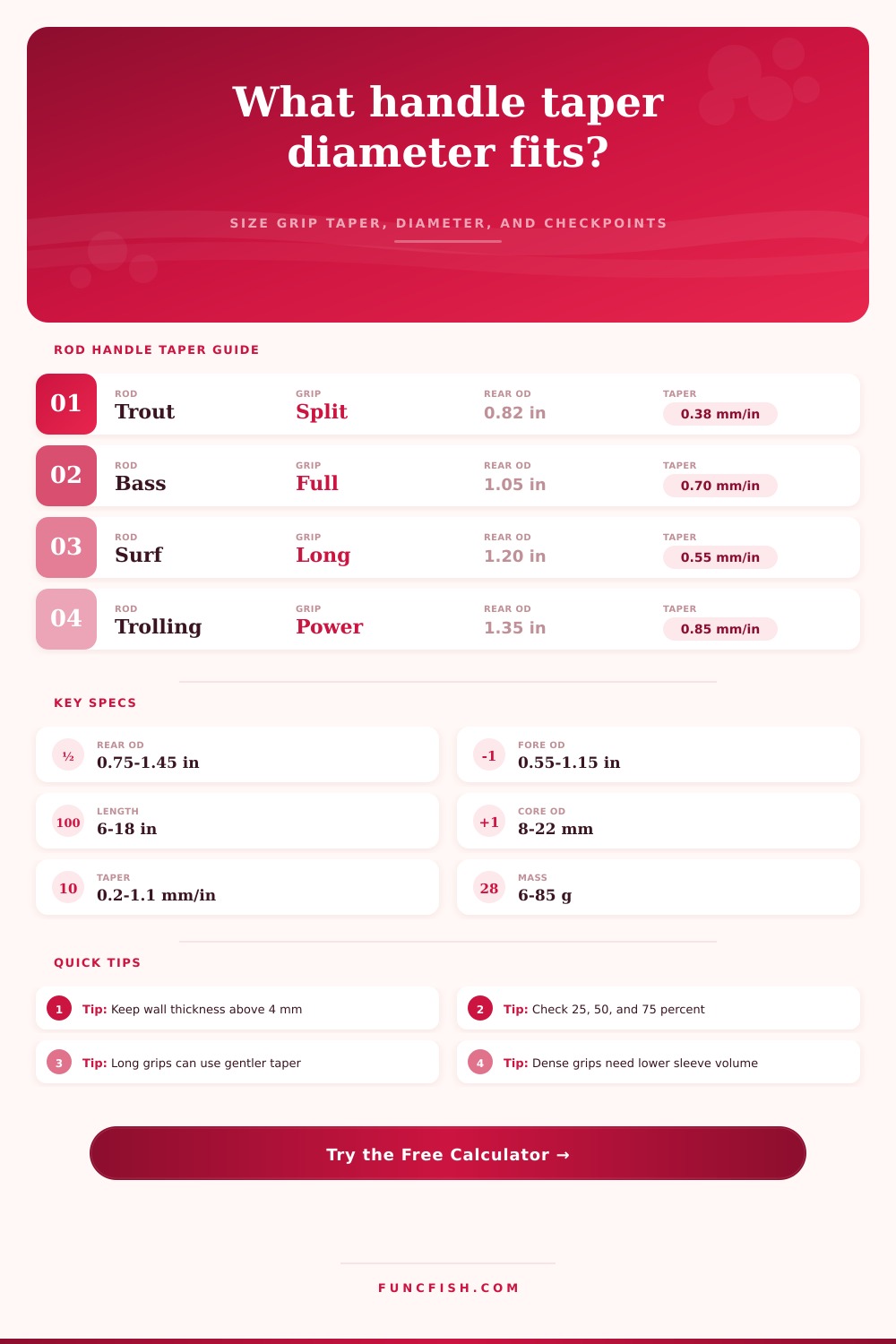
📌Rod handle presets
⚙Handle dimensions
Handle taper results
Formula breakdown
🧱Material comparison grid
Flor Cork Rings
EVA Foam
Carbon Sleeve
Rubberized Cork
Hypalon Foam
Textured Wrap
Hardwood Insert
Composite Foam
📋Rod application diameter ranges
| Rod application | Typical rear OD | Typical fore OD | Usual taper rate |
|---|---|---|---|
| Ultralight trout split grip | 19-23 mm / 0.75-0.91 in | 15-19 mm / 0.59-0.75 in | 0.25-0.55 mm per in |
| Bass spinning full grip | 25-29 mm / 0.98-1.14 in | 19-23 mm / 0.75-0.91 in | 0.45-0.85 mm per in |
| Bass casting power grip | 27-32 mm / 1.06-1.26 in | 20-25 mm / 0.79-0.98 in | 0.60-1.00 mm per in |
| Walleye jigging pencil grip | 22-26 mm / 0.87-1.02 in | 18-22 mm / 0.71-0.87 in | 0.30-0.65 mm per in |
| Kayak inshore utility grip | 26-31 mm / 1.02-1.22 in | 21-25 mm / 0.83-0.98 in | 0.45-0.80 mm per in |
| Fly rod western cork | 22-27 mm / 0.87-1.06 in | 18-23 mm / 0.71-0.91 in | 0.25-0.60 mm per in |
| Surf casting long rear grip | 29-36 mm / 1.14-1.42 in | 24-30 mm / 0.94-1.18 in | 0.35-0.70 mm per in |
| Offshore trolling fighting grip | 32-40 mm / 1.26-1.57 in | 25-32 mm / 0.98-1.26 in | 0.60-1.10 mm per in |
📐Taper profile reference
| Profile | Diameter curve | Best handle shape | Builder check |
|---|---|---|---|
| Linear cone | Even drop from rear to fore | Most full grips and sleeves | 25 and 75 percent are symmetrical |
| Soft rear taper | Rear stays fuller longer | Split grip and palm support | Check 25 percent before sanding |
| Faster fore taper | Fore end narrows quickly | Trigger and reel-seat transitions | Avoid a thin fore wall |
| Center palm swell | Midpoint gains controlled swell | Fly, finesse, and long casting grips | Measure the center after shaping |
| Nearly straight | Small diameter difference | Carbon tube and straight EVA | Watch comfort on large rear OD |
| Power butt taper | Strong rear with late drop | Catfish, musky, and trolling grips | Keep the rear end balanced |
📏Checkpoint interpretation table
| Station | What it controls | Common adjustment | Risk if missed |
|---|---|---|---|
| Rear end, 0 percent | Butt cap fit and hand stop | Sand last after cap mockup | Cap shoulder mismatch |
| 25 percent station | Lower palm purchase | Reduce high spots gradually | Grip feels blocky |
| 50 percent station | Main hand diameter | Match rod use target midpoint | Hand fatigue or loose feel |
| 75 percent station | Transition toward reel seat | Check wall above core diameter | Thin fore sleeve |
| Fore end, 100 percent | Seat ramp or winding check | Confirm finished trim part OD | Visible step at hardware |
🔧Core clearance and wall guide
| Material group | Minimum wall | Preferred wall | Diameter note |
|---|---|---|---|
| Cork rings | 3.5 mm / 0.14 in | 5-8 mm / 0.20-0.31 in | Thin edges chip while turning |
| EVA and Hypalon | 4.0 mm / 0.16 in | 6-10 mm / 0.24-0.39 in | Foam can collapse near the fore end |
| Carbon sleeve | 1.0 mm / 0.04 in | 1.5-3 mm / 0.06-0.12 in | Use arbor fit, not solid volume |
| Rubberized cork | 4.0 mm / 0.16 in | 6-9 mm / 0.24-0.35 in | Dense stock benefits from smaller OD |
| Hardwood insert | 3.0 mm / 0.12 in | 4-7 mm / 0.16-0.28 in | Seal end grain after boring |
| Composite foam | 3.5 mm / 0.14 in | 5-8 mm / 0.20-0.31 in | Stable for blended tapers |
💡Calculation checks
Tip: For a turned cork or foam grip, mark the 25, 50, and 75 percent stations on tape before shaping. Those three checks catch most uneven tapers before the final sanding pass.
Tip: If the calculated fore wall falls below the material guide, increase the fore diameter or shorten the taper instead of sanding the rear smaller to compensate.
Where do you hold a fishing rod? That’s called the handle. The handle joins you and the fish together.
Unfortunately it’s also the area many builders rush through. Whatever foam block or cork rings is on sale, they take them and hope they’ll fit right by chance. Most times they don’t as a poorly tapered grip simply feel like a brick in your hand. After only an hour of fishing your hand get tired. So having the right taper is essential. With the right taper, the rod become an extension of your arm. With a poor taper, it feels like a bulky tool you’re wrestling with.
How to Make a Good Fishing Rod Handle
Once you enter your measurements into the calculator, above, it do all the math for you (and spares you the guesswork regarding conversion factors and coefficients). But what’s really important, the heart of every handle design, is the taper rate. That’s the rate at which the diameter decreases from the butt cap at the back of the rod toward the reel seat. The steeper the taper, the more aggressive and firm the feel, making it a good fit for rods with heavy power that must transmits a lot of torque while avoiding handle compression. A gentler taper feels softer and more comfortabley, making it a good choice for ultralight trout rods where sensitivity matter as much as long-term comfort.
Everybody looks at the back diameter (because it’s right beside the butt cap), but few look at fore diameter. Fore diameter refers to where the handle turn into the reel seat. Too big, and your thumb bumps into the hardware. Too small, and the material wall gets weak and brittle in a bad location. The calculator examines those stations for you. It shows the diameter of each point at 25%, 50% and 75%. Those points is critical. The 50% point is generally where your hand rest when casting. If that is incorrect, everything else feel out of balance. You might not be able to explain why one rod feels awkward different than another until you discover the midpoint diameter was four millimeters larger then your hand size.
Density matters more than looks; cork is dense (and traditional) while EVA foam is light (and softer), but both will compact when pressed into. Cork maintains its shape, so a linear cone taper works wonders for cork handle. However, that same taper can feel mushy in an EVA foam handle because the center squish when a fish pull on it. Most folks don’t know that’s what they are missing: You can’t take a taper profile from one material and simply “copy” it over to another without taking into account how much denser or lighter the material is. So use the chart on the page as a guide, but realize it show common range(s) for each application.
Wall thickness is the silent failure point Builders will sand down a handle to achieve an ideal outer diameter, but they don’t stop until there’s a sheet of paper between them and the blank. If a cork ring come into contact with that paper-thin wall, it’ll chip right off. With foam, anything less than three-millimeters cause collapse. But the calculator estimates the sleeve mass, which help you keep the rod balanced. Keeping the nose up gives the rod a snappy action; a heavy rear grip pulls the nose downward, which forces your wrist to compensate. If the measured mass is too great for comfort, try a denser material on the backside or shave a bit off the front diameter.
You should of checked this earlier. Working with sandpaper is all about taking material away. Once you sand the wood, you cannot undo it, so do not try to add anything back by turning the handle. To get this right, always remember to measure first and then cut. Mark the quarter stations on your tape measure and check your mid-point regularly as well.
If it looks good on the screen it’ll feel good in your hands. A couple dozen millimeters of thoughtful planning on the butt end can make the difference between a great rod and just a decent one. Nail down the taper and everything else come together nicely.