Haywire Twist Wrap Turns Calculator
Estimate open haywire turns, closing barrel wraps, tag length, and wire leader safety margin for single-strand wire rigs.
📌Scenario presets
⚙Twist settings
Haywire twist estimate
Formula breakdown
📋Wire material comparison grid
#3 Light Wire
#5 Casting Wire
#8 Trolling Wire
#12 Heavy Wire
📐Wrap and wire reference tables
| Wire class | Nominal break | Diameter | Typical haywire turns | Typical barrel wraps |
|---|---|---|---|---|
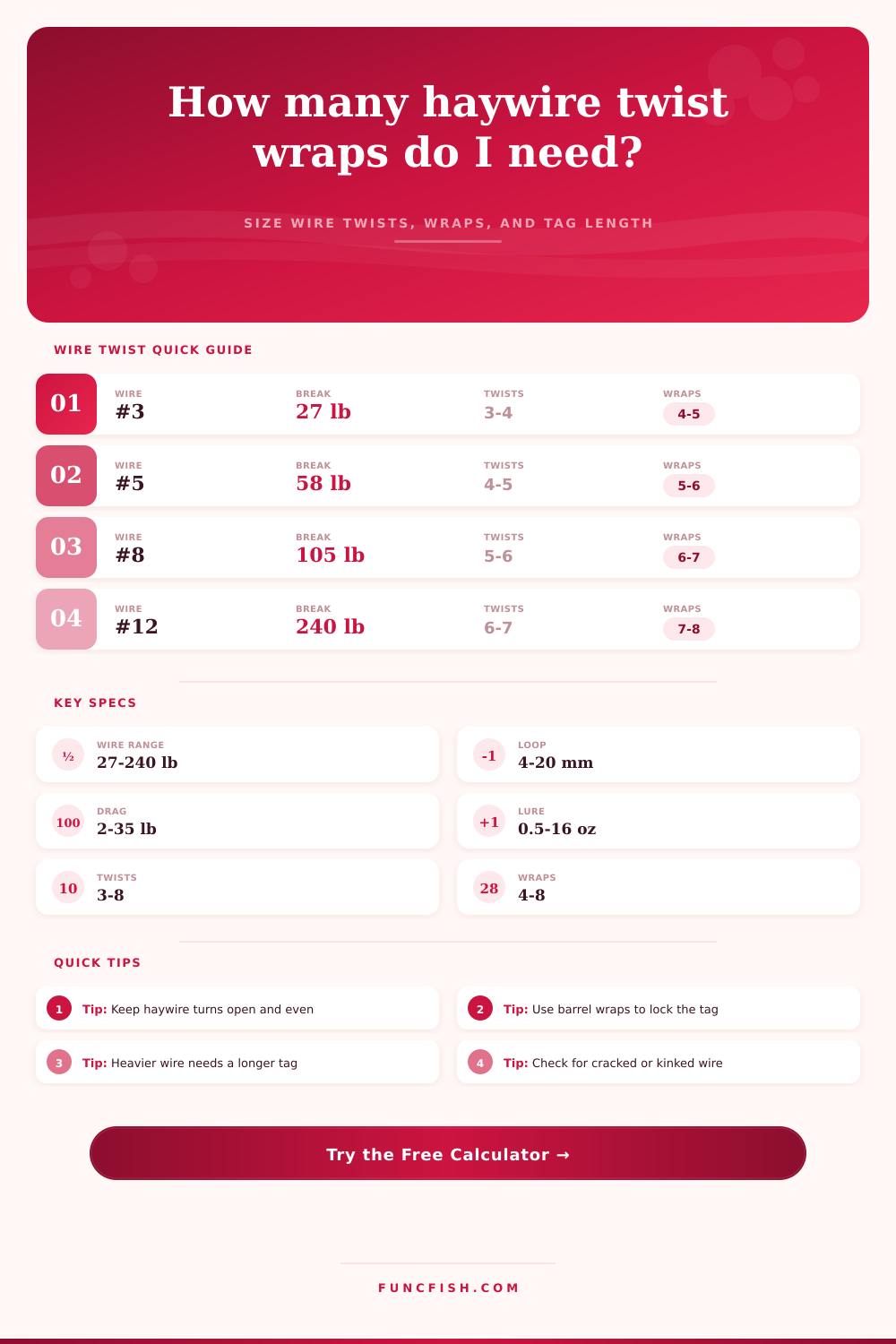
| #3 single strand | 27 lb / 12 kg | 0.012 in / 0.30 mm | 3-4 | 4-5 |
| #4 single strand | 44 lb / 20 kg | 0.014 in / 0.36 mm | 4 | 5 |
| #5 single strand | 58 lb / 26 kg | 0.016 in / 0.41 mm | 4-5 | 5-6 |
| #6 single strand | 69 lb / 31 kg | 0.018 in / 0.46 mm | 5 | 5-6 |
| #8 single strand | 105 lb / 48 kg | 0.024 in / 0.61 mm | 5-6 | 6-7 |
| #10 single strand | 174 lb / 79 kg | 0.029 in / 0.74 mm | 6 | 7 |
| #12 single strand | 240 lb / 109 kg | 0.035 in / 0.89 mm | 6-7 | 7-8 |
| Fishing scenario | Load behavior | Turn adjustment | Wrap adjustment | Rigging note |
|---|---|---|---|---|
| Casting lure | Moderate snap | +0 | +0 | Keep loop compact |
| Vertical jigging | Repeated pulses | +0.3 | +0 | Check for kink fatigue |
| Trolling lure | Steady pull | +0.4 | +0.4 | Use clean barrel wraps |
| High-speed trolling | Hard shock load | +0.9 | +0.8 | Longer tag is useful |
| Dead bait trace | Slow pressure | +0.2 | +0.3 | Avoid overworking wire |
| Assist hook bite wire | Short violent pulls | +0.8 | +0.5 | Use a small neat loop |
| Target fish | Common wire | Peak load input | Loop ID | Finish style |
|---|---|---|---|---|
| Spanish mackerel | #3-#4 / 27-44 lb | 3-6 lb | 4-7 mm | Compact |
| Bluefish | #4-#6 / 44-69 lb | 6-10 lb | 6-10 mm | Standard |
| King mackerel | #5-#8 / 58-105 lb | 8-16 lb | 8-14 mm | Standard |
| Barracuda | #6-#8 / 69-105 lb | 10-18 lb | 9-15 mm | Heavy drag |
| Wahoo | #8-#12 / 105-240 lb | 18-35 lb | 12-20 mm | Shock load |
| Musky or pike | #5-#8 / 58-105 lb | 6-14 lb | 8-16 mm | Standard |
| Wire behavior | Springback | Best wrap feel | Added reserve | Comparison note |
|---|---|---|---|---|
| Bright stainless | Medium | Firm hand pressure | Baseline | General tooth wire |
| Coffee stainless | Medium | Firm hand pressure | +2 mm | Lower glare finish |
| Tinned bronze | Low-medium | Smooth close wraps | +1 mm | Easy hand twisting |
| Extra hard wire | High | Use pliers early | +6 mm | Needs more tag |
| Softer wire | Low | Do not overwrap | -1 mm | Can fatigue faster |
| Spring titanium | Very high | Pre-bend carefully | +8 mm | Hardest to finish |
💡Twist checks
Tip: The first haywire section should look like two wires twisting around each other, not like one wire wrapped tightly around the other. Tight barrel wraps belong at the finish only.
Tip: After finishing, flex the loop lightly and inspect the first bend. A sharp kink, cracked coating, or uneven tag wrap is a better reason to retie than to add more turns.
A brittle snap are the sound of a breaking wire echoing off the rod guides. That’s the signal for the end of a pricey day. You know what it means. The fish got you. Your line was too light. Your leader wire was to small.
Wrong on both counts. Truth is seldom so cut-and-dried. In most instances, the damage came well before the tackle hit the water. In those instances, the twist (where the wire was manually twisted into the snap) are where the failure occurred.
How to Use the Knot Calculator
It is one of the oldest tricks in the book, but it is poorly understood. A haywire knot appear to be nothing more than two strands twisting around each other before being wrapped tight. Yet there’s a fine balance between feel and physics required to get it right.
So how does it work? Just enter a few simple variables: the weight of your lure, the expected drag load, and the type of wire (gauge). The calculator will do the rest.
It’s all about getting the right amount of wraps in the barrel and also leaving an appropriate number of turns open. Too few turns and the knot won’t hold up to the load; too many turns and you have a big ole fat wad of wire that hangs up in the weeds or place extra stress on the wire at the bend point.
That’s where the calculator comes into play. By understanding the unique characteristics of each type of wire and its gauge, you can make adjustments to compensate for those properties. The heavier the wire, the longer the tag should be. Stainless steel behaves different than tinned bronze regarding spring back. Those differences is accounted for. Getting the ratio just right ensures your knot stays strong but doesn’t compromise the strength of the wire at any one point.
What material is being used? Consider the type of material too. A thin, lightweight wire (i.e., a size 3 single strand) can be easily twisted and, if overused, will fatigue faster. Conversely, it takes some effort to bend heavier wires (i.e., a size 12).
The tool comes with charts that detail this difference. For example, they demonstrate where a lighter wire may only require three or four open turns whereas a heavier trolling wire may require six or seven. That’s important when considering scale. Just because a knot holds on a king mackerel spoon doesn’t mean it will hold onto a wahoo rig unless adjusted accordingly.
Fortunately, the calculator automaticly accounts for these changes depending on your selected situation. This is most useful with the scenario presets, though.
Fishing isn’t static. When you cast a lure out and hit the water or get a hit, there is a sudden hard shock load on the line. When you vertical jig there will be repeated pulsing pressure as you move up through the water column that will fatigue the wire over time. With trolling it’s going to have constant high drag loads and test the strength of the wraps over time. All these scenarios alter the way the knot should be finished. And that is what the tool does with those little extra adjustments to the turn count based off those forces. So if you’re doing something like a high speed troll it knows that’s different from a deadbait trace and makes those adjustments. Pick the style closest to what you do and the math adjusts for you.
Many people mess up this knot by focusing only on their final few barrel wraps and never pay attention to those open turns at the beginning. Those open turns are the first things under any load. If the turns are too tight or not even, the knot will fail early. Using the calculator allows you to see where to start. It’s a goal post for how much open you should of had in there before you start making your closing wraps. Then it tells you how much margin you have based on your drag setting.
That’s nice because if it says you don’t have much, it’s telling you you’re on the verge of breaking out with the load you think you’ll be putting on the line. It’s better to switch to a heavier gauge than to risk a break.
Also notice the recommended tag length. People often cut their tags too short and don’t have any room left for the final wraps to lock the knot closed. The tag length in the calculator allows for a reserve so you have enough wire to complete cleanly.
For example, if your lure has an eye that you want to create a loop with then it takes some of the tag length to twist around the loop. The bigger the loop the more wire you’ll need to twist around. This is another small but important thing to consider when tying knots in low light on a moving boat.
So in conclusion, you’re looking for an even knot with a feel that says it’s solid. And the open part shouldn’t look like a ball of string but rather a tidy little twist. The last few wraps ought to be snug and compact. After getting the feel of it twisting along, this calculator becomes your friend. It makes the unseen variables less variable.
You’ll still need patience and good hands to tie a proper knot. But now you don’t have to worry about whether you turned it too many times or too few or how much wire to wrap around the twist. The math is solved. Now all you’ve got to do is trust the process and let the wire take care of business.
You don’t want that sharp snap at the end of the line. This is the best insurance you’ve got against that.