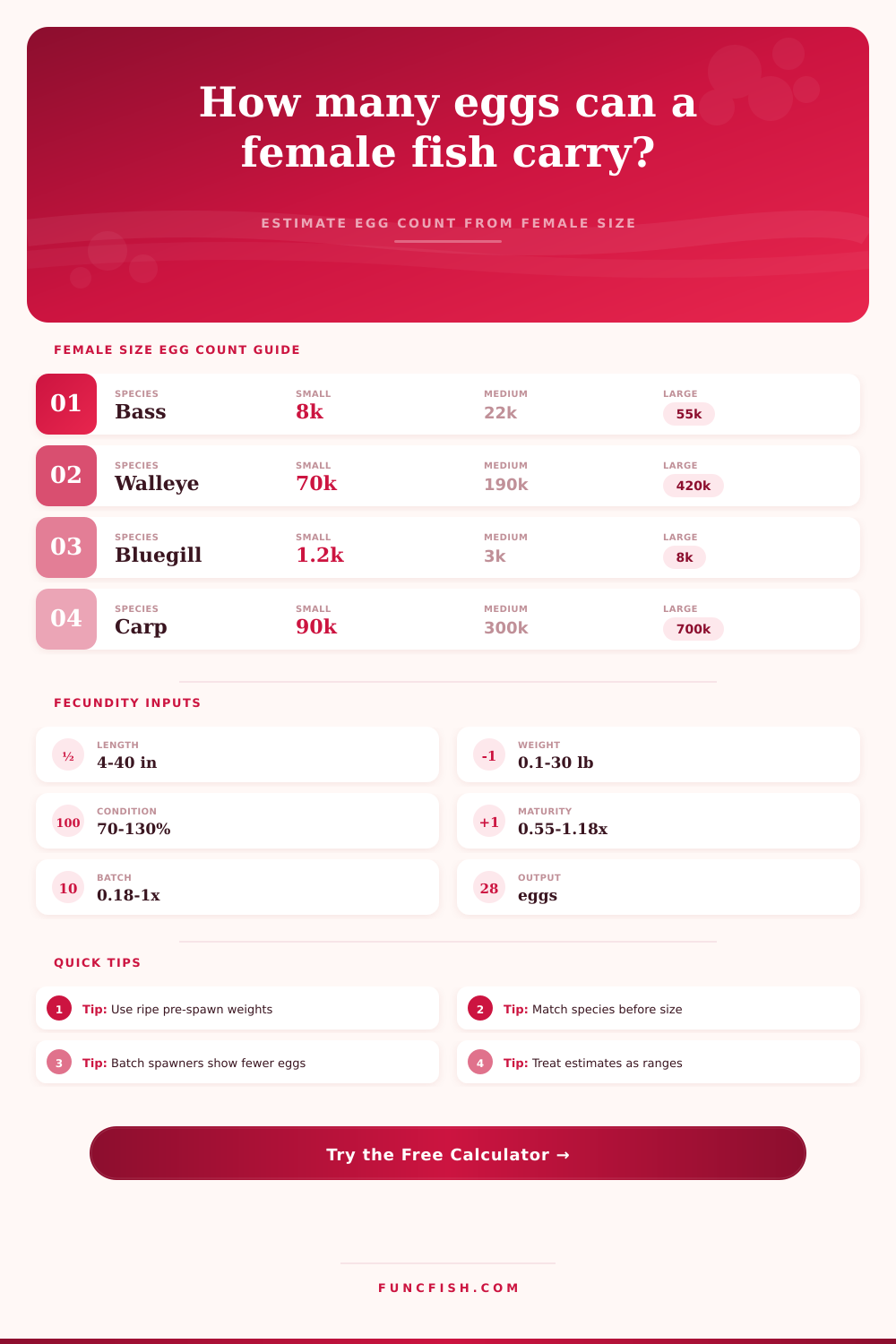
Fish Egg Count by Female Size Calculator
Estimate female fish egg count from species, length, weight, condition, maturity stage, spawn timing, egg diameter, and batch-spawning strategy.
📌Female size presets
⚙Female size and spawning inputs
Female fecundity estimate
Formula breakdown
🐟Species comparison grid
Largemouth Bass
Walleye
Salmonids
Broadcast Fish
Sunfish
Catfish
Pike
Carp
📊Fecundity reference tables
| Species group | Length formula | Eggs per kg | Typical egg diameter | Best use |
|---|---|---|---|---|
| Largemouth bass | 0.19 x cm^3.15 | 13,000 | 1.6 mm | Nest-count and brood estimates |
| Bluegill | 0.42 x cm^3.00 | 18,000 | 1.0 mm | Colony sunfish checks |
| Walleye | 0.31 x cm^3.35 | 70,000 | 1.8 mm | Lake and river spawning females |
| Rainbow trout | 0.13 x cm^3.00 | 1,800 | 4.5 mm | Large-egg salmonid estimates |
| Chinook salmon | 0.0015 x cm^3.25 | 650 | 6.5 mm | Single-spawn salmon hens |
| Striped bass | 0.75 x cm^3.25 | 180,000 | 1.3 mm | High-fecundity broadcast females |
| Female size class | Bass example | Walleye example | Carp example | Interpretation |
|---|---|---|---|---|
| Small mature | 10,000-18,000 | 55,000-100,000 | 70,000-150,000 | Often first or young mature output |
| Average mature | 18,000-35,000 | 120,000-260,000 | 180,000-420,000 | Typical prime-season female |
| Large mature | 35,000-65,000 | 260,000-520,000 | 420,000-900,000 | Large females dominate egg production |
| Exceptional | 65,000+ | 520,000+ | 900,000+ | Needs local validation or sampling |
| Spawn timing | Timing factor | What it means | Field signal | Calculator effect |
|---|---|---|---|---|
| Ripe pre-spawn | 1.00 | Full visible ovary | Round abdomen, loose ripe eggs | Current eggs near seasonal count |
| First batch | 0.95 | First release near ready | Hydrated leading eggs | Batch share stays high |
| Mid-season batch | 0.72 | Some eggs already released | Mixed egg sizes | Visible batch decreases |
| Late-season batch | 0.48 | Remaining eggs are lower | Softer abdomen | Current estimate reduced |
| Mostly spent | 0.10 | Most eggs released | Loose, thin belly | Shows residual eggs only |
| Batch strategy | Visible batch share | Common groups | Use when | Range caution |
|---|---|---|---|---|
| Single clutch or event | 1.00 | Salmon, pike, many nesters | Most eggs mature together | Size and condition dominate |
| Two main batches | 0.55 | Some bass and perch cases | Two clear cohorts are visible | Current eggs lower than seasonal |
| Three batches | 0.38 | Warmwater repeat spawners | Several ovary cohorts appear | Batch stage matters strongly |
| Serial batch spawner | 0.22 | Carp and long-season spawners | Eggs mature over a long window | Use seasonal result for total |
| Guarded nest with partial loss | 0.82 | Nest-building species | Some eggs are retained or lost | Use for active nest snapshots |
💡Egg-count calculation tips
Tip: For a biological estimate, length and weight should agree. If the fish is unusually thin, the condition factor should reduce the result even when length is large.
Tip: Compare the current visible eggs card with the seasonal potential card. A big gap usually means the selected species is a batch spawner or the female is already partly spent.
Before spawning, the female fish develop a definite roundness. To the biologist, it’s a sign of reproductive potential; to most anglers, it’s a big fish, a possible trophy.
But how many eggs does she carries? That’s what determines if there will be fish in that river or lake in five years. If we get this egg number wrong, we makes the wrong decision about harvest regulations and stocking. And you’ll know something about health of the overall ecosystem.
How to Count Fish Eggs
After you input your measurements, the calculator do all the math for you. You don’t have to remember all of those crazy biological numbers. It give you some serious understanding of what these inputs mean.
The obvious ones is length and weight. But then there’s this thing called condition factor. That’s the hidden key. If a fish is long but thin, she has stretched out her resources. She may appear large, but her egg production will be less then that of a shorter but fatter female of same species. Many folks makes the mistake of thinking big = output. Often, it’s density = survival.
But there’s another level here: maturity stage. You can’t compare the egg production from a prime aged, length-for-length female with that of a first-timer. With more years to develop, the mature female are going to be larger in gonad size compared to her overall body size. Biology doesn’t work that way (it’s exponential). That’s why big females matters so much to how populations change. They’re not only laying more eggs but those eggs is more likely to survive because they have more energy reserves or spawn in a better location.
But there’s another element to it: timing. Not all fish drops all their eggs at once. Carp, for instance, lay eggs in small groups over several weeks. Bass might be nesting guards and dropping multiple batches over several days. By sampling a fish mid-season, her visible egg count might be only a fraction of her seasonal potential. The tool addresses that as well, allowing users to choose between batch strategy and spawn timing. That distinction is key to making an accurate assessment.
There’s another factor (egg size), but this is subtle. Larger eggs mean there is fewer eggs in a given mass of gonads. That’s why salmonid eggs are so big; they’re packed with nutrients, since young fish must fend for themselves upon hatch. On the other hand, broadcast spawners such as striped bass lays very small eggs in vast quantities, since sheer numbers will assure that some will survive. The calculator use these characteristics of each species to adjust the estimate. One size does not fit all. It is a personalized solution that recognizes evolutionary strategy.
Most common errors occurs with spent females. A female’s weight decrease after spawning and her abdomen collapses once she’s given up her eggs. So if you’re calculating fecundity from a fish that has already spawned, it will significantly underestimate her initial potential. You should of known this. The best baseline would be either pre-spawn or ripe females. Since residual data is not potential data, make every effort to collect pre-spawn or ripe females if you need to do this.
Those are ballpark estimates, not hard numbers. Nature is funny that way. Water temp, environmental pressures and food availability will tweak the number in the end. Actualy, it’s quite moddern. But having a realistic estimate helps you think about it the right way.
It’s one thing to have a vague sense of there being lots of fish. It’s another to have a real measure of reproductive success. Once you understand the numbers behind the spawn you begin to see the water differently. You stop just looking for fish and start seeing the future of the fishery.
You’ll recieve better data if you use this method.