Water Column Stratification Calculator
Estimate thermocline depth, fishable oxygen limits, and the most likely target species depth band from lake profile measurements.
📌Scenario presets
⚙Water profile inputs
Water column forecast
Full breakdown
📋Profile method reference grid
Weighted thermometer
Sonar temp trend
Castable sonar
Oxygen probe
📊Stratification strength table
| Index range | Layer condition | Typical fishing read | Check first |
|---|---|---|---|
| 0-24 | Mixed or weak | Fish can roam vertically | Wind and bait depth |
| 25-49 | Forming layer | Edges can hold bait | Clarity and shade line |
| 50-74 | Stable thermocline | Fish often stack above it | Oxygen below layer |
| 75-100 | Strong separation | Deep water may be unfishable | Bottom oxygen reading |
| Species | Preferred temp | Oxygen floor | Stratified target zone |
|---|---|---|---|
| Largemouth bass | 68-78°F | 4.0 mg/L | Above weedline or thermocline |
| Smallmouth bass | 62-72°F | 5.0 mg/L | Breaks near cool edge |
| Walleye | 55-68°F | 5.0 mg/L | Upper cold edge in low light |
| Rainbow trout | 50-62°F | 6.0 mg/L | Cool layer with good oxygen |
| Kokanee salmon | 48-58°F | 6.0 mg/L | Deep cool oxygen band |
| Striped bass | 58-70°F | 5.0 mg/L | Bait schools above oxygen edge |
| Northern pike | 55-66°F | 4.5 mg/L | Cool weedline or basin edge |
| Channel catfish | 70-82°F | 3.0 mg/L | Warm layer near oxygen break |
| Profile method | Depth spacing | Best signal | Calculator adjustment |
|---|---|---|---|
| Weighted thermometer | 3-5 ft | Direct temperature drop | Moderate confidence |
| Sonar temp trend | 5-10 ft | Bait and suspended arcs | Wider depth band |
| Castable sonar | 3-6 ft | Bank-accessible profile | Medium confidence |
| Dissolved oxygen probe | 2-4 ft | Fishable lower edge | Highest confidence |
| Logger string | 1-3 ft | Exact gradient position | Narrower layer width |
| Season pattern | Surface cue | Likely layer | Fishing implication |
|---|---|---|---|
| Spring warming | Rising upper 50s | Weak or forming | Fish use shallow warmth |
| Early summer | Upper 60s to 70s | Developing thermocline | Breaklines start to matter |
| Stable summer | Mid 70s plus | Strong thermal split | Oxygen becomes decisive |
| Fall cooling | Falling 60s | Breaking or mixed | Fish may scatter vertically |
| Winter inverse | Cold surface | Warmest water deeper | Look for stable basin water |
💡Profile checks
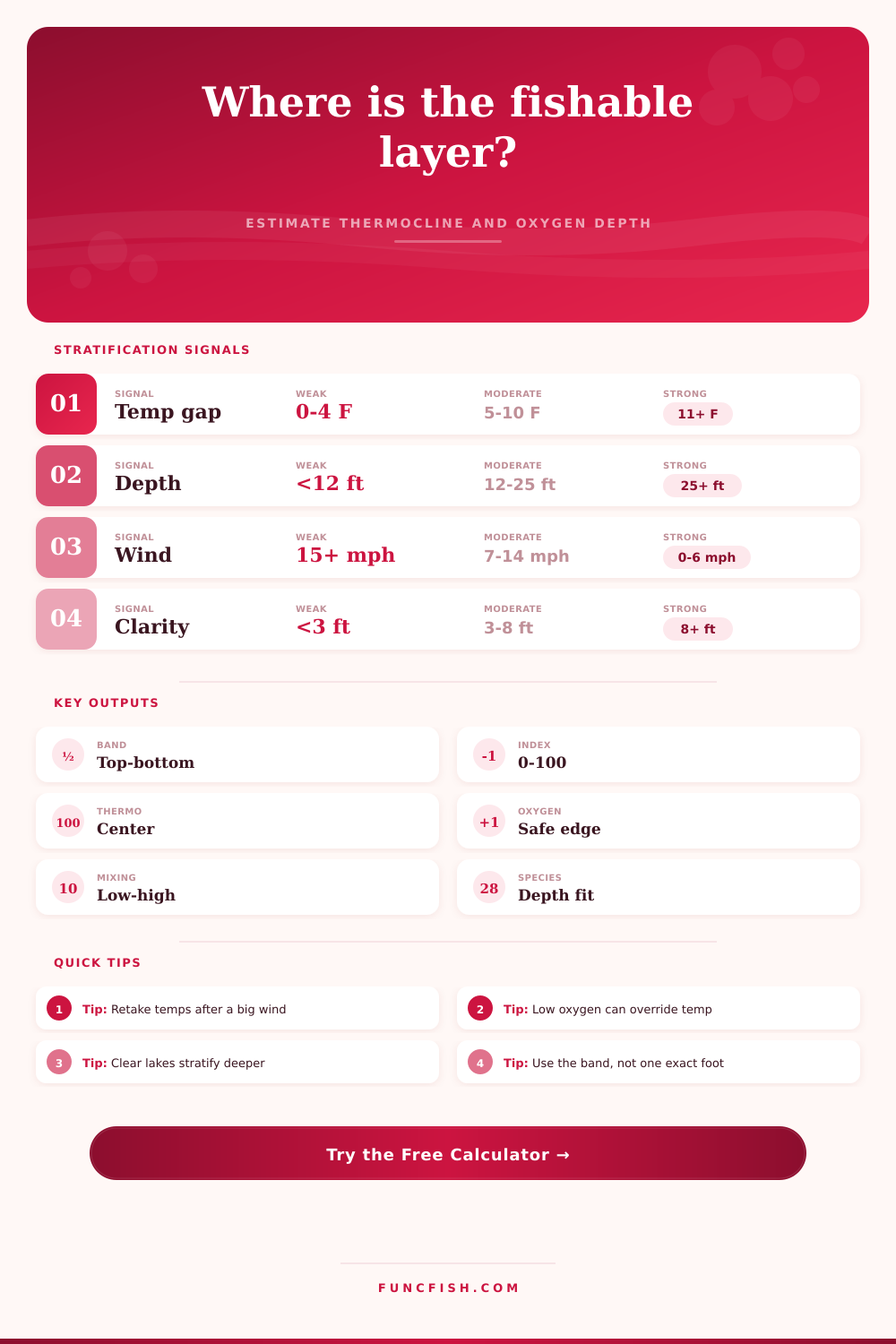
Tip: Retake the surface and bottom temperatures after sustained wind. A hard mixing event can erase yesterday's thermocline and move baitfish quickly.
Tip: Treat dissolved oxygen as the lower boundary. If temperature looks perfect below the oxygen edge, most game fish still will not hold there for long.
It’s July. It is mid-summer. You’re sitting on a dock looking at what looks like an inviting stretch of water without any fish. It’s hot, your sonar reveals the fish are thirty feet deep and there isn’t a peep from the shallows.
Summer stratification sets in. A clear line in the water separate the lake into separate layers, which is something most anglers don’t even see. If you don’t know why those fish is down there, you’ll be casting to the right spot with the wrong lure.
How to Read Summer Fish Layers
Read between the lines in the water. You plug in your temperatures and the calculator does the work for you (above). You won’t need conversion charts or coefficient guesses anymore. Raw temp readings from your boat gets spit out as a reasonable fishing depth band. But the numbers aren’t the whole tale. That’s really the art of the stratification deal, knowing what they’re telling us about the fish we pursue.
Remember that this isn’t simply about heat; it’s about density. Warm water is lighter than cold water, so it floats on top of cooler water. So cold water are denser and therefore falls to bottom. Between the two layers there’s a layer known as thermocline which has a rapid change in temperature within a relatively short distance. And that is where its name comes from; the thermocline is floor for cold-water species and the ceiling for warm-water species.
The other factor is wind. Wind mixes the layers, redistributes the oxygen, and chums up the water. On a calm day, these layers will settle back into place. It’ll make the thermocline sharp and clear. On a big windy day, it can take hours to change the whole profile if you’ve been fishing a good thermocline for the last few days. Most folks think of the lake as a static thing so they fail to recognize when the wind goes up and the whole profile has shifted. That’s what makes the lake dynamic.
The calculator accounts for wind speed as well so it can guess at amount of mixing going on. If you put a high number in for wind, then the stratification index will go down. This means the layers starts to blend together. This widens the zone where you might catch them and also gives the fish some freedom to move around verticaly more easily.
The bottom layer is governed by oxygen. Dissolved oxygen is consumed as organic matter breaks down on the bottom. In a strongly stratified lake, it’s trapped below the thermocline where it’s depleted. Even if the water is a perfect temperature for fish, they won’t be able to stay down there long. Bottom oxygen readings is included in the tool to set the safe edge. If you have low bottom oxygen, even though the thermocline may run deep, the fishable band gets pushed shallow. It’s not just about physics but also biology, you need to respect both.
These changes affect different species differently. For instance, trout and kokanee like to hug the cold side for the cool water and higher oxygen content; however, when the bottom runs out of oxygen, they’ll move up. Walleyes likes that edge between day and night, so they’ll position perfectly on the change with their noses down in it. And bass tend to hang just above the temperature change and use it as a way to ambush baitfish. So you have to understand that you’re not just targeting the fish, you’re also targeting where the bait is. This is laid out in the reference table on the page by species to help you find which one might be your target and what habitat to expect them in.
As such, fall turnover also makes everything even. Cooler air temperatures cool the water at surface, making it denser and causing it to sink and mix with deeper water. As a result, the layers break apart, oxygen saturates the column and fish is forced to disperse. That’s why when fishing during this period, you’ll find less emphasis on precise depth targeting and more focus on finding concentrations of bait. In fact, the stratification index drops on the calculator as surface temps decreases. This indicates that the vertical barrier is starting to break down.
Stratification isn’t something that can be learned by memorizing charts. It’s more of an observational skill where you watch the water while learning about the forces in play. Use the chart to set a starting point and make adjustments from there based off what you’re seeing. Feel the wind, look at your sonar, and understand what all this means.
Make no mistake… The lake tells you things if you know how to read it. Instead of just reading the depth, start reading the water. Begin to see the depth as layers, both visible and invisible, that change constantly. If you do, you’ll find yourself catching them a lot more often. They’re always there. They’re just waiting in their comfort zone.