Algae Bloom Oxygen Crash Risk Calculator
Estimate the chance of a night or pre-dawn dissolved oxygen crash from bloom density, temperature, depth, fish load, mixing, and aeration.
📌Scenario presets
⚙Bloom and water settings
Oxygen crash forecast
Full breakdown
📋Risk factor reference grid
Bloom Density
Secchi Depth
Warm Water
Mixing Relief
📊Crash risk reference tables
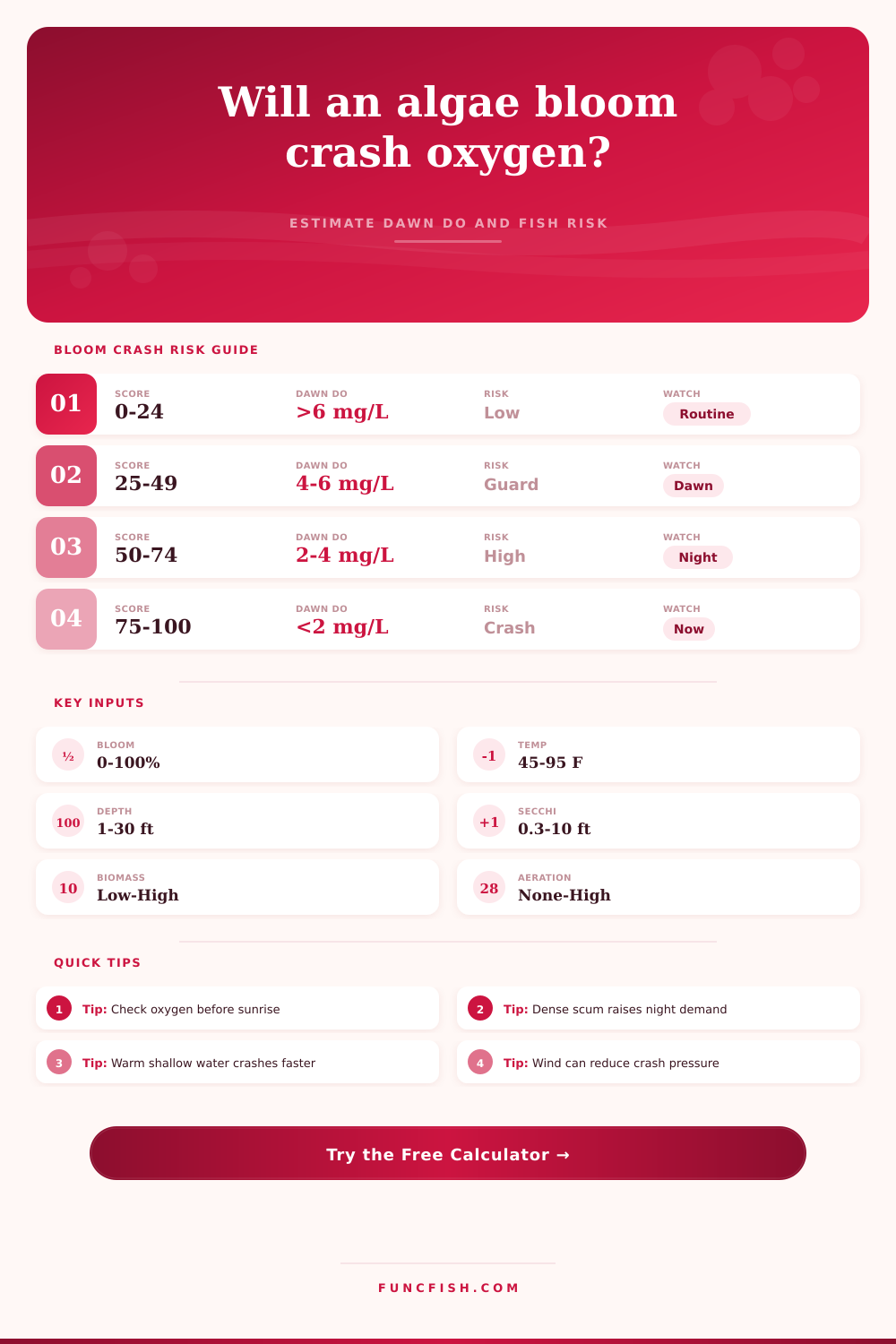
| Risk score | Estimated dawn DO | Crash status | Monitoring priority |
|---|---|---|---|
| 0 to 24 | Above 6 mg/L | Low | Normal checks |
| 25 to 49 | 4 to 6 mg/L | Guarded | Pre-dawn reading |
| 50 to 74 | 2 to 4 mg/L | High | Night and dawn checks |
| 75 to 100 | Below 2 mg/L | Severe | Immediate oxygen watch |
| Water temperature | Oxygen saturation | Crash sensitivity | Calculator effect |
|---|---|---|---|
| 50°F / 10°C | About 11.3 mg/L | Lower | More oxygen capacity |
| 68°F / 20°C | About 9.1 mg/L | Moderate | Baseline warmwater range |
| 82°F / 28°C | About 7.8 mg/L | High | Less capacity, faster respiration |
| 90°F / 32°C | About 7.3 mg/L | Very high | Hot water penalty added |
| Fish group | Stress line | Severe line | Risk note |
|---|---|---|---|
| Trout / salmonids | 6 mg/L | 4 mg/L | Least tolerant of warm low DO |
| Bass / bluegill | 4 mg/L | 2 mg/L | Common pond watch level |
| Catfish | 3 mg/L | 1.5 mg/L | Tolerant, but heavy loads crash hard |
| Koi / ornamental carp | 5 mg/L | 3 mg/L | Watch crowding and warm nights |
| Tilapia | 3 mg/L | 1.5 mg/L | Warm tolerant, oxygen demand can be high |
| Minnows / baitfish | 5 mg/L | 3 mg/L | Small fish show stress early |
| Condition | Risk shift | Most important hour | Calculator cue |
|---|---|---|---|
| Calm cloudy night | Large increase | 3 AM to sunrise | Higher weather sag |
| Windy night | Decrease | Before sunrise | Mixing relief added |
| Recent weed dieback | Large increase | All night | Plant respiration spike |
| After storm / turnover | Variable increase | Late night | Mixing plus organic pulse |
| High emergency aeration | Decrease | Lowest just before sunrise | Aeration relief applied |
💡Practical checks
Tip: A dense bloom can show high dissolved oxygen during the afternoon and still crash before sunrise. Use the calculator as a night-risk screen, then confirm with an actual dissolved oxygen meter whenever fish are valuable or already piping near the surface.
Tip: The fastest risk jump usually comes from a warm, calm, cloudy night after several bright bloom-building days. Recalculate with the calm cloudy setting when weather changes near dusk.
When that green, thick pond water rolls around you know something is about to happen that you don’t like. During the day, those green plants (algae) are little factories producing oxygen. But once it gets dark, the photosynthesis cease. And while the bacteria, the fish and the algae are still breathing, they’re pulling oxygen from the water. Before the sun rise, the dissolved oxygen levels can plummet to numbers that look more like a swamp then a healthy fishery. It’s the silent crash that occurs in the predawn hours.
There are several variables here, and knowing them will help you believe what the calculator spits out. First there’s bloom density, the most readily visible clue. A heavy scum layer on the surface means that not only does no light get through, but you’ve got an enormous biomass sitting there. It needs oxygen, and when that water is warm, it need it in huge numbers. Not only do you start with a smaller reservoir (warm water contains less oxygen), but this creates a double penalty for the angler since he sees his high afternoon oxygen levels and thinks all is well.
Why Oxygen Drops at Night
This is where depth becomes an important factor. In shallow ponds, because of their smaller volumes and rapid heating rate, they are much more susceptible to sudden drops in oxygen level. A deep lake will stratify, maintaining oxygen-rich layers while separating them from those at the bottom. A shallow farm pond mixes it all together into a volatile soup. Add in a heavy bloom and you’ve got yourself a pressure cooker. As the graph indicates, rising temperatures and lowering depths increases the potential for disaster. You’re already flirting with dangerous territory if your pond is warm and <4 ft deep.
Another wrinkle is fish load. Some species, such as catfish or tilapia, may tolerate lower oxygen levels better than others, like koi or trout, which won’t do well at all. That being said, high stocking densities will further raise the total metabolic demand. Not only are the fish breathing, but the algae and decomposing organic matter are too. They’re all competing for same scarce resource. The tool moves the stress line depending on what type of fish you choose. It’s important because something that stresses bass out may kill trout flat-out. Knowing where your specific fish is positioned allows you to decide how urgent your action should be.
The weather will swing the scale one way or another overnight. Windy nights mix up the deeper waters with oxygen from the surface and can be the saving grace for your fish. Calm, cloudy nights trap that lower oxygen at the level where your fish reside. Calm air no longer mixes naturaly, and clouds keep that algae from recieveing a final burst of photosynthesis. Assuming the worst is what you need to do when you see an overcast sky and still air in the prediction. The calculator considers all of these factors and adjusts the risk score based off whether there is wind to help or if you are stuck with a still night.
You can actualy control aeration as a countermeasure. Run your fountains/pumps at night if possible. This can be the difference between a fish kill and a healthy dawn. The tool also provides aeration; how much does active pumping help offset natural drawdown? If no, you’re going by the wind, you’re going by luck. If yes, you’re managing the environment. Keep the water quality such that the fish don’t spend energy just trying to breathe. Good water = good health & stability = good growth.
The golden hour is the key moment right before dawn. That’s when O2 reserves are absolutely depleted and most of the crashes occur. If you’re able to check your water in the pre-dawn hours, that’s the real data. But let’s face it, who’s up at 3 am? This calculator provides a proxy. Based off your inputs, it estimates where the levels will fall… giving you a heads-up ahead of time so you know what to expect when things go sideways. This isn’t a perfect science by any means, but it’s much better than guesswork.
Start with one of the presets (koi basin, farm pond, etc.) to establish a starting point. Then adjust to match your actual conditions. The tool makes you consider that the pond is more than a bucket of water. It’s a system, and you begin to look at how weather, fish, temperature and depth work together instead of the green color by itself. And that perspective change, that’s where you save the fish. You’re no longer responding to the crisis; now you’re expecting the crisis.
Sure, the nights will continue to come and so will the algae growth. But if you see the potential for trouble better, then you can monitor and plan for aeration to stay out in front of it. Low oxygen may be an early warning sign, but that shouldn’t of meant bad news.