Degree Day Accumulation Calculator
Estimate fish thermal units from water temperature, species base threshold, upper cap, warming or cooling trend, and habitat exposure to time spawning, egg hatch, or fry emergence.
📌Fish timing presets
⚙Thermal accumulation inputs
Use measured water temperature when possible. This tool estimates timing pressure; local genetics, oxygen, photoperiod, flow, and fish condition can shift actual behavior.
Degree day result
Calculation breakdown
📊Thermal timing grid
Progress
Water warmth
Forecast
Fishing cue
📋Reference tables
| Species / event | Base temp | Upper cap | Typical target | Fishing use |
|---|---|---|---|---|
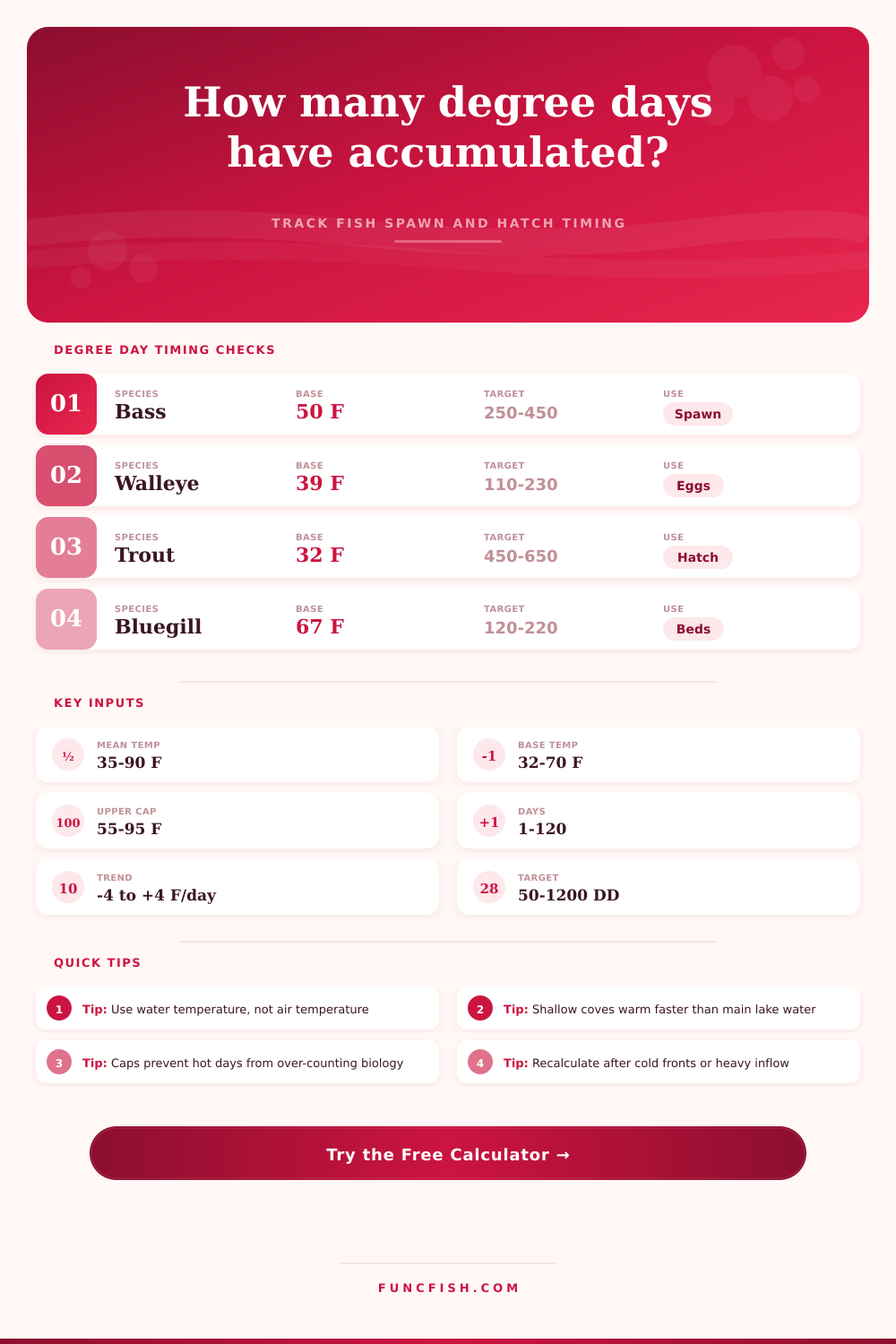
| Largemouth bass spawn | 50 F / 10.0 C | 86 F / 30.0 C | 250-450 FDD | Locate warming banks and bed waves |
| Smallmouth bass spawn | 48 F / 8.9 C | 82 F / 27.8 C | 220-380 FDD | Time rock flat staging and nest guarding |
| Walleye egg hatch | 39 F / 3.9 C | 68 F / 20.0 C | 110-230 FDD | Estimate fry timing after river spawning |
| Trout / salmon egg hatch | 32 F / 0.0 C | 58 F / 14.4 C | 450-900 FDD | Track hatchery, redd, and fry emergence windows |
| Bluegill bed cycle | 67 F / 19.4 C | 90 F / 32.2 C | 120-220 FDD | Follow colony waves around stable warm weather |
| Habitat exposure | Mean correction | Trend effect | Best use | Caution |
|---|---|---|---|---|
| North bank / sun-facing shallows | +1.8 F | Faster warm-up | Early bass and bluegill checks | Can cool quickly after wind shift |
| Protected dark bottom | +2.4 F | High daily swing | First bedding pockets and carp marshes | Afternoon readings may overstate dawn conditions |
| Open mixed water | 0 F | Neutral | Main lake reference | May lag shoreline behavior |
| Cold inflow influence | -2.8 F | Delayed growth | Creeks, tailwater edges, snowmelt pulses | Short warm afternoons may not advance eggs much |
| Deep edge / delayed warming | -1.6 F | Stable but slow | Staging fish near breaks | Shallow nest sites may run ahead |
| Method | Formula idea | When to use | Effect | Watch item |
|---|---|---|---|---|
| Simple average above base | Mean - base | Stable hatchery or pond logs | Direct and easy to audit | Over-counts very hot days |
| Average with upper cap | Min(mean, cap) - base | Warmwater fish during heat | Prevents unrealistic biology gains | Needs a sensible species cap |
| Swing-adjusted shallow water | Mean plus swing factor, then cap | Sun pockets, coves, marshes | Credits shallow afternoon warming | Can overstate windy or cloudy days |
| Conservative cold-front screen | Reduced trend and swing gain | Fronts, cold rain, unstable spring | Slows target arrival | Recheck after two stable days |
| Day | Mean temp | Adjusted temp | Daily DD | Cumulative DD | Stage note |
|---|
💡Field tips
Temperature tip: log water temperature at the same depth and time each day. A noon shoreline reading can run several degrees warmer than the egg, nest, or staging zone.
Timing tip: treat degree days as a cue, then confirm with fish behavior, clarity, flow, moon phase, and stable weather before changing locations or harvest plans.
This time of year you might hear folks say the bass is spawning at fifty-degree water. It’s traditional in the springtime to think that way, but it isn’t necessarily true or even accurate. Bass will spawn when they’re ready; temperature serves as a trigger. And it’s a cumulative measure, not a one-time deal.
So what? Well, this mean we should care less about temperature each morning than how many degree days have built up. Rather than opening your phones weather app, we want to pay attention to degree days instead.
Use Degree Days to Find Bass
To do so, you’ll need the degree day calculator (above), which does all of the work for us after plugging in some site specific information. No guessing required… no conversion or coefficient calculations necessary.
That’s where people gets off track. The most overlooked piece about how fish react is something most guides don’t understand. Yesterday was 70 and today is 40; a fish doesn’t care. What it cares about is the total usable heat. That’s what degree days are all about.
Subtract the base threshold from mean water temp and then add those numbers together day after day. Fish are dormant below the base. Add zero. Above the biological cap; further development doesn’t speed up. If it be above the biological cap, you cap the gain.
Here is a table with typical species base thresholds. The page has more reference tables. Notice how different the metabolic rate of each species are. Trout require far more degree days to hatch than say walleye. But they are the inputs, and they need to be considered.
Missed the first couple of weeks in spring? Your opening balance will matter. Tell it you started when it was 80-degrees out, and you’ve told it the season is well underway.
On top of that, there is daily swing. Marsh pockets and shallow coves warm quicker than main lake basins do. Even at the same high temp, the daily average are higher. And yes, the calculator accounts for that with habitat profile selection. A darker bottom, north-facing bank may get a correction of almost two degrees. Sounds small, but over a three week projection it adds up to dozens of degree days. And that makes the difference between finding guarded beds and empty ones.
The prediction gets complicated because of trends. In other words, if you’re facing a cold front roll-in, a simple average won’t cut it. The tool’s conservative approach screen for that kind of instability. It dials back the projected accumulation to reflect reality versus optimism. Stable warm days promotes egg hatching. Hot days in the middle of a cooling trend don’t have that effect. Biology is stubborn, and it won’t give in until it sees some consistency.
Measured water temperature, not air, should always be used. In late spring especially, when stratification breaks down, air can spike to seventy while the bottom water remain in the forties.
When the tool spits out a number, scan down to the stage cue. That’s going to give you an estimate of the fish’s position in the cycle. But remember, that’s not set in stone; a hard rain can push the window back several days. Recent rain can change oxygen content. Local genetics can affect things different. Recent cooling can also move it around. A big rain event washes away sediment and lowers water temperatures which can reset the biological clock just enough.
It may say you have what you’re looking for on paper, but the fish won’t be up there if the water is cold and dirty. The calculation will help you narrow it down, then go out and verify with your eyes. See if any male bass are already getting ready to bed up in the shallows. Find some fry coming off from areas like river mouths where walleye hold.
It’s a different way of thinking that makes weather part of the strategy. Instead of responding to what happened yesterday, you anticipate what will happen this week. Rather than chasing past results, you go after tomorrow’s behavior.
It takes discipline to do the math, to enter your findings, but the payoff is confidence. Instead of wondering why the fish aren’t biting, you know where they ought to be.
Focus on the trend. Keep one finger on the thermometer and the other eye on the prediction. Eventually, the water will tell you the truth.