Crawfish Abundance by Season Calculator
Estimate crawfish activity, expected trap catch, likely depth band, and seasonal timing from month, species group, water temperature, rain, oxygen, cover, and habitat quality.
🏷Abundance labels
📌Seasonal abundance presets
⚙Habitat and season inputs
Seasonal abundance estimate
Calculation breakdown
🧬Species comparison grid
Red Swamp
White River
Northern Virile
Signal Craw
📊Reference tables
| Season phase | Typical cue | Abundance effect | Trap note |
|---|---|---|---|
| Winter holdover | Cold water, low metabolism | Low to moderate, concentrated in refuge | Longer soaks help compare sites |
| Spring expansion | Warming water and fresh flooded edge | High when oxygen and cover are good | Shallow sets often improve |
| Early summer molt period | Warm stable water and vegetation | Moderate to peak unless oxygen falls | Even spacing reduces crowding bias |
| Late summer stress | Heat, low oxygen, dense algae | Patchy, often shallow at night | Check oxygen before comparing CPUE |
| Fall pulse | Cooling water and rain movement | Moderate to high in swamp and ditch habitat | Recent rain can lift short-term catch |
| Species group | Best temp band | Season tendency | Common abundance habitat |
|---|---|---|---|
| Red swamp crawfish | 64 to 82 F | Spring peak with fall rebound | Mud, grass, ditches, shallow flats |
| White river crawfish | 60 to 78 F | Floodplain spring and early summer | Soft sloughs, bayous, flooded edges |
| Northern or virile crawfish | 55 to 72 F | Late spring through summer | Rock, wood, lake shore, firm bottom |
| Signal crawfish | 50 to 66 F | Cool spring and early summer | Cobble stream, bank holes, riffle margins |
| Rusty crawfish | 56 to 74 F | Late spring and summer | Rocky lakes, riprap, clear reservoirs |
| Condition | Low range | Productive range | Stress range |
|---|---|---|---|
| Dissolved oxygen | Under 3 mg/L suppresses catch | 5 to 8 mg/L supports steady activity | Overnight crashes can move crawfish |
| Recent rain | 0 to 0.2 in has little pulse effect | 0.5 to 2.5 in can expand edge habitat | Flood scouring can scatter catch |
| Cover density | Bare bottom exposes crawfish | Moderate cover balances refuge and bait access | Choked vegetation can block trap entry |
| Water clarity | Clear water can reduce daylight movement | Stained water often improves confidence | Algae bloom can signal oxygen risk |
| Trap effort | Use case | Confidence cue | Comparison note |
|---|---|---|---|
| 1 to 4 trap-nights | Quick scouting | Very sensitive to placement | Treat CPUE as a rough signal |
| 5 to 12 trap-nights | Small pond or ditch check | Good first comparison | Keep soak hours similar |
| 13 to 30 trap-nights | Shoreline or slough survey | Better seasonal read | Spread traps across depth and cover |
| 31 plus trap-nights | Broad habitat comparison | Stable CPUE estimate | Separate habitats before averaging |
💡Calculation tips
Match effort: Compare abundance only when trap-night count, soak hours, bait age, and shoreline spacing are similar enough to avoid effort bias.
Read pulses carefully: A moderate rain or slow rise can boost crawfish movement, while a fresh flood or oxygen crash can make trap catch patchy.
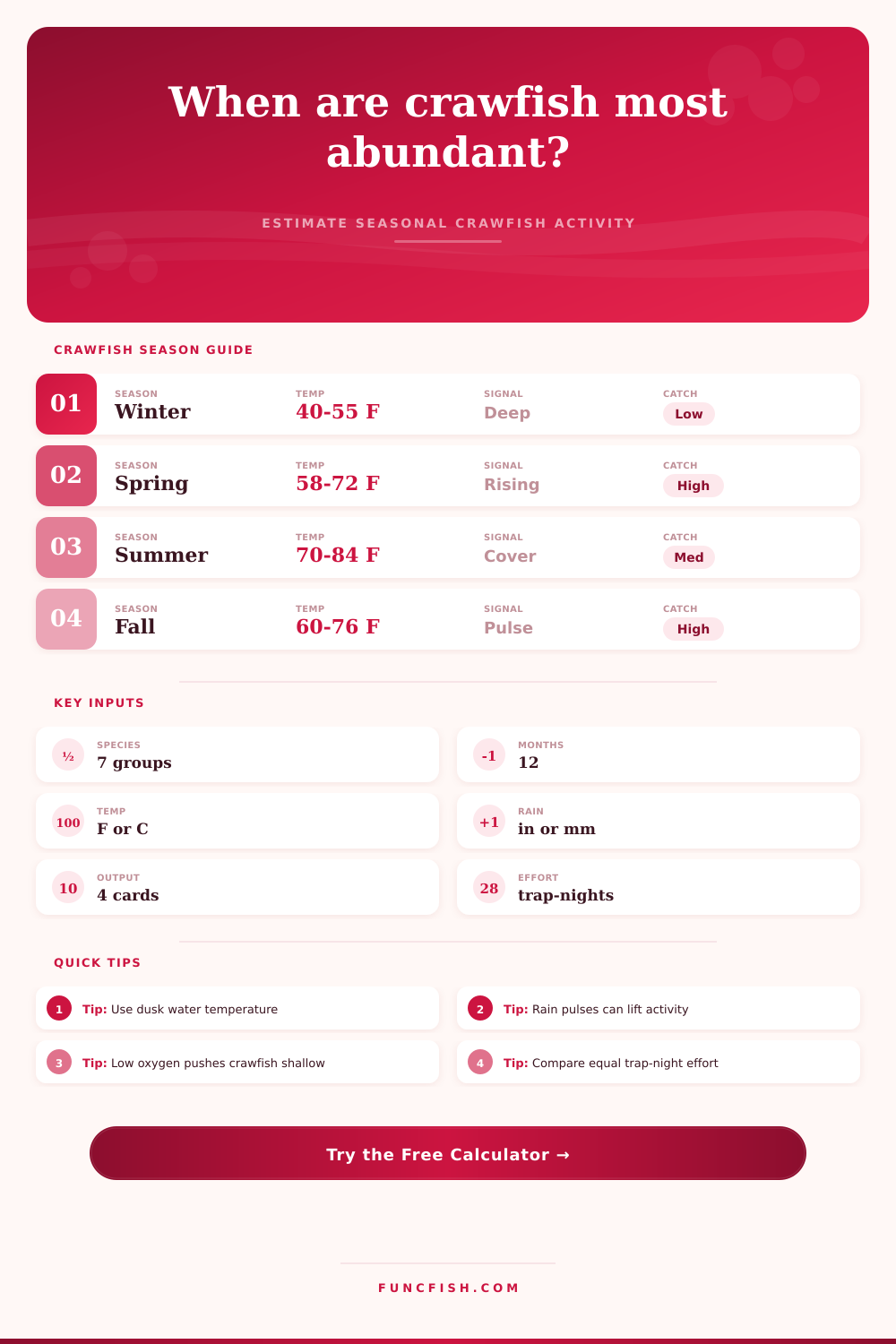
A heavy trap in April might be light in July. It’s not your bad luck, it’s biology! What happens? Species, rain, temperature, and oxygen levels affects how many crawfish is out there. Knowing what affects them allow you to make an educated guess as to when to be fishing. We built a calculator on this page that estimates based off those conditions; however, knowing the inputs will help you use the calculator effectivey.
Crawfish metabolism revolves around temperature. In springtime, they’re most active when temperatures ranges from sixty to seventy degrees. That’s when the water is right and those craws are moving to the bait; they’re hungry. But that window gets pretty small. As the days get hot and push the water temperature over eighty degrees, it stress the crawfish out. If the oxygen goes down, the crawfish tuck back up under a piece of cover or bury themselves deeper into the muck. It seems like heat would of mean more activity, but it can be the opposite as you won’t catch nothing.
Why Crawfish Catch Changes With Weather
The crawfish also respond to rainfall. Expanding bayou edges or flooding grass will create new foraging ground that opens up when it rains, even if just a little bit. It’s like putting some fresh paint on the wall and you get a bump in the activity as they check it out. You can use the rainfall and water level table as a reference to see this in action. A slow rising water is great fishing, but a fast flood can knock off cover and scatter those crawfish too. The tool balances the rain pattern with bottom type. A soft muddy bottom with grass makes it good to have a slow rise. Clear water over a rocky bottom, maybe not so much.
Their depth varies by season, as they move to shallow flats in the spring and retreat to deeper water in the winter and summer. Crawfish live in deep water in winter. They conserv energy by staying in cold water. They go shallow in the spring to feed and mate. And they frequently slide back into the shade of the bank or down into deep water channels again to avoid the heat later in the summer. So if you’re fishing in shallow water in a heat wave in July, don’t expect to catch anything.
The calculator figures out where the fish will be at any depth you enter and determines the optimal depth. It also estimates number of fish caught based off how many days the traps were out and how long each trap was soaked. Sometimes August is not like April.
What’s the game plan? Species-specific
Different species inhabit different water types and respond to temperature differently. For instance, red swamp crawfish like flooded vegetation along the edges of muddy ditches or rice fields. Their best times are fall and spring. White river crawfish has a similar but more delayed pattern and favor flooded sloughs and flats. Northern virile and signal crawfish is coolwater species that favor clear lakes and streams with rock. They peak earlier in the year. Trying a preset optimized for red swamp crawfish in the Ozarks won’t yield accurate results. Match the species to the habitat.
You don’t necessarily have to memorize all those temperature thresholds, either. Instead, simply grasp relationship between the variables. Let the tool work out the math for you. Simply look at the water. Is it clear or stained? Is there a lot of oxygen? Did it recently rain and flush the edges? Plug in what you’re willing to put into the equation, and let the tool spit out the rest. Stop the guesswork and begin the know-how.
It’s still possible that a light trap could be fruitless; however, you’ll know it had nothing to do with your ability, but instead the conditions of the water. That information can prove very useful.