Fish Depth Preference by Temp Calculator
Estimate where a target species is most likely to hold by matching surface temperature, deep temperature, lake profile, oxygen, clarity, and activity level.
📌Scenario presets
⚙Temperature and depth inputs
Temperature-based depth preference
Formula breakdown
🌡Species temperature grid
Largemouth bass
Walleye
Rainbow trout
Catfish
Crappie
Pike
Striped bass
Salmon
📊Reference tables
| Species group | Prime temperature | Usable temperature | Common depth move |
|---|---|---|---|
| Largemouth bass | 66-74°F / 19-23°C | 50-86°F / 10-30°C | Edges, shade, cover breaks |
| Smallmouth bass | 62-70°F / 17-21°C | 48-80°F / 9-27°C | Rock breaks and suspended bait |
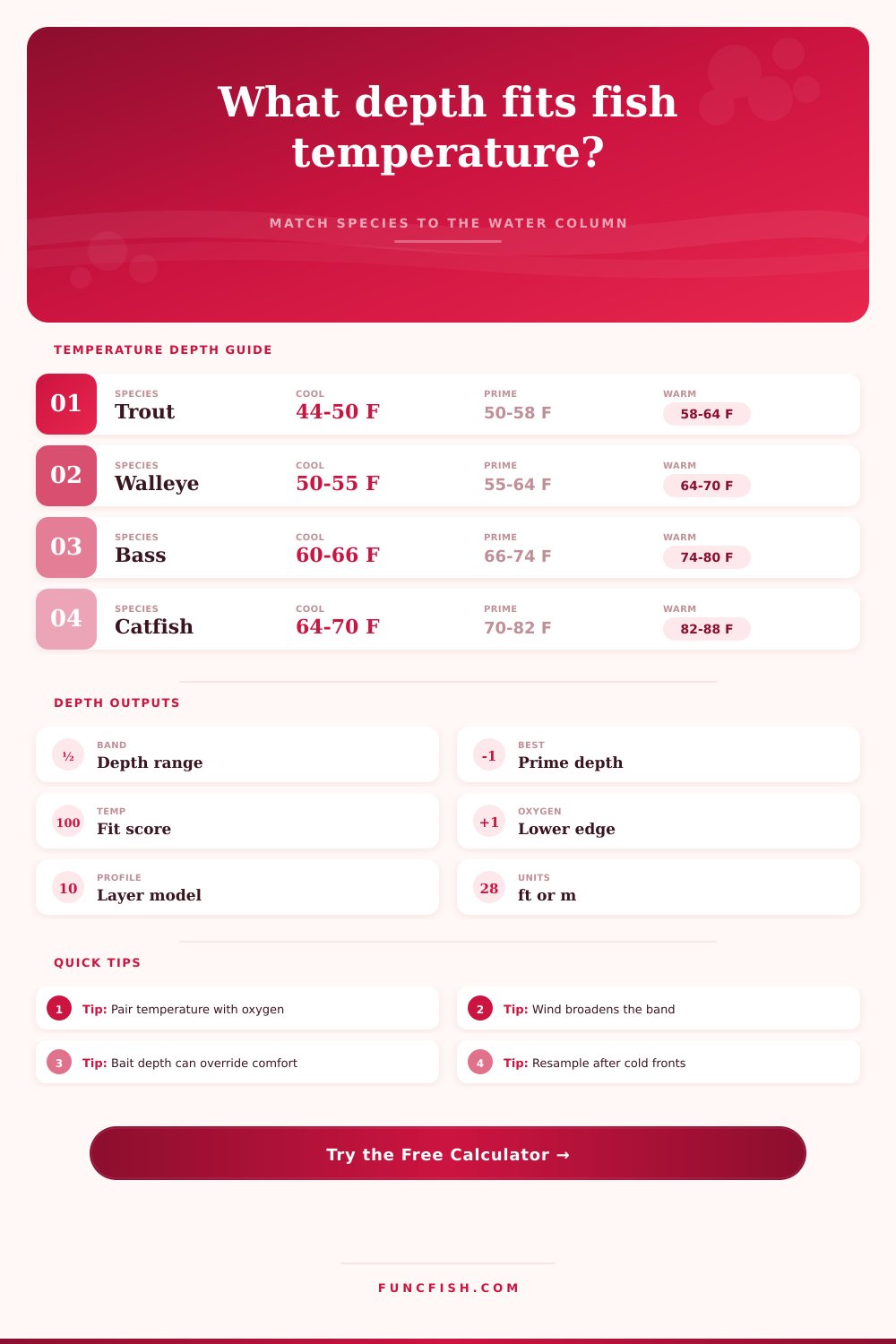
| Walleye | 55-64°F / 13-18°C | 42-76°F / 6-24°C | Dim light below warm water |
| Rainbow trout | 50-58°F / 10-14°C | 38-68°F / 3-20°C | Cold oxygenated layer |
| Crappie | 58-70°F / 14-21°C | 45-82°F / 7-28°C | Suspended brush or basin edge |
| Channel catfish | 70-82°F / 21-28°C | 52-90°F / 11-32°C | Warm channel above low oxygen |
| Waterbody profile | Layer behavior | Depth tendency | Calculation effect |
|---|---|---|---|
| Shallow pond | Often mixed, oxygen can sag | Short, cover-tied moves | Caps the band above soft bottom |
| Natural lake | Moderate summer layering | Weeds, breaks, basin edges | Balanced thermocline placement |
| Clear reservoir | Deep, sharp temperature break | Longer vertical search | Pushes prime depth deeper |
| River pool | Current softens stratification | Hole heads and current edges | Broadens warm-water band |
| Quarry pit | Steep and clear cold layer | Sharp ledges, suspended fish | Raises confidence in depth profile |
| Large basin | Wind and bait drive roaming | Open-water suspended lanes | Weights bait-school activity higher |
| Activity pattern | Depth shift | Band width | Best use |
|---|---|---|---|
| Dawn / dusk feeding | Shallower | Medium | Fish sliding up from comfort water |
| Bright midday | Deeper | Narrow | Clear water and pressured fish |
| Overcast roam | Slightly shallower | Wide | Cover edges and flats |
| Night feeding | Shallow side | Medium | Warm species and low light |
| Post-front slow | Stable/deeper | Narrow | Suspended or cover-tight fish |
| Following bait schools | Bait depth bias | Wide | Open water fish marks |
| Oxygen condition | Typical warning | Depth effect | Species sensitivity |
|---|---|---|---|
| Healthy deep oxygen | 5+ mg/L through deep layer | Lower edge stays open | Good for trout, walleye, bass |
| Moderate deep drop | 3-5 mg/L near bottom | Band lifts above deep water | Warm species tolerate more |
| Low below thermocline | Under species minimum | Hard lower boundary | Cold species lose options first |
| Algae sag risk | Overnight oxygen decline | Morning band can be shallower | Ponds and fertile lakes |
| Cold inflow refuge | Cool water with oxygen | Adds a local holding lane | Trout, salmon, pike, walleye |
💡Calculation checks
Tip: A perfect temperature can still be unfishable if oxygen is below the species minimum. Treat the oxygen lower edge as a hard boundary when deep oxygen is low.
Tip: Use the preferred band as a starting lane, then refine with sonar marks, bait depth, and actual bite depth because wind can mix the profile quickly.
It’s early in the morning; you grab thermometer and the map, but it doesn’t seem like anyone want to play along. It’s not because you’re trying too hard. More times then not, it’s because you haven’t connected depth with temperature.
When you realize how vertical fish regulates their body temperature, they become less random. Once you figure out which temperature they prefer and where in the water column that temperature reside, you’ve already located the fish without a lure in the water.
Why Fish Choose Specific Depths
The math is complicated and logic behind it can be a maze. That’s why we created the calculator above. It runs numbers for you and converts raw surface and deep temperatures into an understandable depth range. You do not need to guess or use complicated water column layering.
It is a simple concept that we all know but easily forget. Each fish has an optimal temperature zone where it is most active with its mouth open. Largemouth bass is generally between 66-74 degrees Fahrenheit for their optimal window. Walleye like it cool as well, generally staying in the low-sixties to mid fifties. Trout require the coldest of the cold, rich with oxygen.
In July, when surface temps reach eighty degrees, a bass isn’t going to want to lay on the bottom where the bottom is still fifty degrees. It’ll be looking for shade or the layer where water temperature are the same as what their internal thermostat tell them. It’s all about finding that match.
But it’s not as simple as just temperature. There’s another silent controller called oxygen. A lack of oxygen will kills fish even in comfy water. Late-summer stratification in lakes can result in perfect cooling water at depth, but it may be completely depleted of dissolved oxygen.
That’s why the calculator includes an oxygen boundary so you know what depth range the fish can physically inhabit. When your bottom oxygen fall to less than three parts per million, that desired depth band become very small indeed. It forces the fish up and sometimes into a thin layer just above the dead-zone. This forms a hard ceiling below which they shouldn’t go and thus represents a waste of time fishing lifeless deep water. Ignore this boundary at your own risk.
Finally, light and clarity are major factors in vertical positioning as well. Fish on a lake with crystal clear water have much more line of sight over predators and bait than those on very murky water body. That makes them skittish in the bright sunlight, so they move out deeper into the low-light comfort zone. To compensate for that, the tool narrows the depth band in midday in clearer conditions.
On a stained water body, you may find the same fish holding much closer to bank due to the cover it gives them. Then add wind into the mix, which mixes up surface layer, breaks down the thermocline and lets fish roam free. A good breeze will tend to flatten out the temperature profile, making the entire water column accessible. The resulting depth band then become a search area rather than a promise.
Thermal preference is often trumped by where the bait is located. For example, a big school of baitfish might suspend in thirty feet of water regardless of whether it’s ‘hot’ enough or ‘cold’ enough for predator species to be there. It doesn’t matter; it’s just too convenient an offering to pass up.
That’s why it’s so important to understand the local food web. When targeting walleye, find the bait first. When targeting bass, look for the cover. The temperature patterns provided by the calculator provide the starting point; now it’s up to your eyes (and sonar) to confirm the location.
But people make common mistakes; like thinking fish is always hugging the bottom, or just going by surface temperature. That’s not true. Fish go shallow in the spring to spawn even when it’s cold. They wander far off that bottom contour in the fall as the water cools. Those seasonally based presets accounts for those behaviors in the calculator.
But this isn’t a crystal ball. This is a place to start. It could of weed out the bad depth areas so you can focus your efforts where it counts, the good stuff. When you respect the oxygen floor and the thermal layer, you no longer fish everywhere. You fish somewhere. And that focused effort is what makes a dry day turn into a limit.