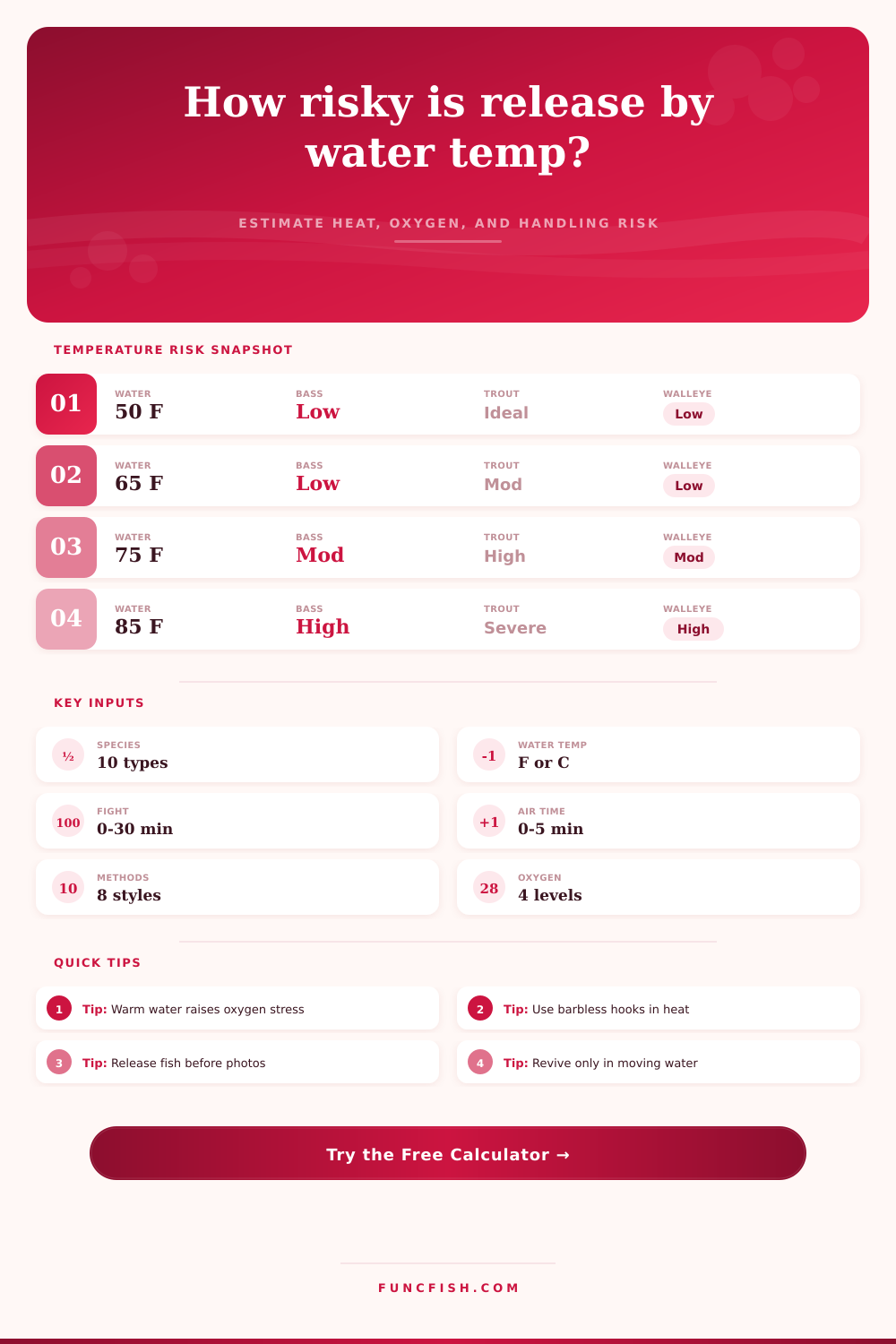
Release Mortality by Water Temp Calculator
Estimate catch-and-release mortality from water temperature, species tolerance, oxygen conditions, fight time, hook location, and release method.
📌Water temperature presets
⚙Release mortality inputs
Temperature release estimate
Calculation breakdown
🎣Species and gear grid
Warm Bass
Trout
Walleye
Striped Bass
📊Temperature and release references
| Species group | Preferred range | Heat caution | High stress zone | Release emphasis |
|---|---|---|---|---|
| Black bass | 60-78 F / 16-26 C | 80 F / 27 C | 86 F / 30 C | Short fight, fast unhook |
| Trout | 48-62 F / 9-17 C | 66 F / 19 C | 70 F / 21 C | Keep submerged |
| Walleye | 55-70 F / 13-21 C | 74 F / 23 C | 80 F / 27 C | Limit warm livewell time |
| Pike and musky | 55-72 F / 13-22 C | 75 F / 24 C | 80 F / 27 C | Oversize net, no long pose |
| Striped bass | 55-68 F / 13-20 C | 72 F / 22 C | 78 F / 26 C | Water-supported release |
| Redfish | 65-82 F / 18-28 C | 85 F / 29 C | 90 F / 32 C | Current-facing revival |
| Release method | Best use | Heat effect | Hooking effect | Mortality modifier |
|---|---|---|---|---|
| Barbless single hook | Artificial lures and flies | Lowest handling time | Easy lip removal | 0.72x |
| Circle hook | Bait and soaking rigs | Reduces deep hook rate | Often jaw corner | 0.78x |
| Rubber net in water | Large fish control | Protects slime layer | Stable unhooking | 0.82x |
| Treble lure | Crankbaits, topwater | More handling in heat | Multiple contact points | 1.22x |
| Natural bait hook | Bottom fishing | Watch deep-hooking | Higher tissue damage | 1.35x |
| Livewell recovery | Tournament holds | Aeration dependent | Delayed release stress | 1.10x |
| Water condition | Oxygen signal | Temperature concern | Risk adjustment | Release target |
|---|---|---|---|---|
| Strong flow | High mixing | Lower than still water | -10% | Head into current |
| Normal oxygen | No distress signs | Use species range | Baseline | Gentle boat-side release |
| Still warm water | Low mixing | Heat stacks quickly | +18% | Minimize fight time |
| Low oxygen signs | Gasping, algae, stagnation | High stress multiplier | +35% | Avoid extra handling |
| Species | Typical release size | Good hot-water gear | Extra watch point | Recovery cue |
|---|---|---|---|---|
| Largemouth bass | 12-22 in / 30-56 cm | Single hook plastics | Livewell heat | Hard tail kick |
| Rainbow trout | 8-20 in / 20-51 cm | Barbless fly or spoon | Warm air exposure | Holds upright |
| Walleye | 14-28 in / 36-71 cm | Single jig hook | Deep warm structure | Downward swim |
| Muskellunge | 32-52 in / 81-132 cm | Heavy rod, big net | Long fight duration | Steady gill motion |
| Striped bass | 18-36 in / 46-91 cm | Inline circle hook | Hot low-salinity water | Powerful kick |
| Redfish | 16-35 in / 41-89 cm | Circle or single jig | Shallow marsh heat | Maintains balance |
💡Calculation tips
Temperature stack: Heat risk compounds with low oxygen, long fights, and air exposure. A small handling delay in 82 F water can matter more than the same delay in spring water.
Gear choice: Use gear heavy enough to shorten the fight, then pair it with a low-damage hook and in-water handling so the fish can ventilate immediately.
Anglers love catching fish. And they’re excited about landing them. Few consider possibility of surviving after being caught.
Survival isn’t a threat posed by the hook. Instead, it’s function of water temperature. Physiological shock kill fish when their body temperatures changes wildly. For example, this happens after they are pulled out of sixty degree water and dropped back into eighty five degree water. The shock will result in death of the fish within hours.
How to Keep Fish Alive
The calculator above do that math for you. It takes environmental factors and converts them into an estimated chance of death. This helps you make informed choices based off the water.
So what is the problem? Oxygen solubility. Dissolved oxygen levels is lower in warm water different than cold water. A springtime largemouth bass in the same water will hold up to a lengthy battle and recover. A summertime largemouth bass in the same heat are operating on the brink of its temperature limit. It fight defensively, causing lactic acid to build up. Combine that with the lack of available oxygen in the water and it become a recipe for disaster.
That’s where the tool comes into play. You enter the water temperature and oxygen conditions independently. If you’re fishing a stagnant pond, you have a greater chance at running into danger then if you were fishing in fast moving tailwater. Both might has the same temperature but different oxygen levels.
Another overlooked variable are handling times. Anglers frequently take pictures of their fish with fingers around its mouth. That’s five seconds the fish is out of water and held by lip. To the fish it is being exposed to suffocating air. Dried out gills will begin to lose there ability to function. And holding the fish outside of the water begins to damage the protective slime coat.
The calculator factors in how long they was out of the water as well as the way they were released back into the water. Using a rubberized net and keeping the fish in the water during unhooking can drops the mortality risk significantly. Unhooking them while keeping them in the water reduce the mortality rate. This simple behavioral modification can increase survival consideraby.
Not all fish is alike. Different species tolerate different temperatures. Temperature is not like any other factor. All trout are sensitive to temperature. They’re coldwater specialists with narrow temperature range. Over 68 degrees? Danger! Seventies? It is most often fatal, even for an experienced angler. Walleyes and bass is tougher creatures, but still have there own tipping point(s). Each one’s danger zone and sweet spot can be found on the reference table.
If you catch trout in warm water, pay attention to handling time. Many people don’t realize how important gear selection are. Barbless hooks is better for survival and saving time. Barbless hooks aren’t for just conservation types. Pliers and strange angles is needed when removing a barbed hook. That adds stress and extra handling time. Barbs out, twist it out. Ten seconds in hot water makes the difference between life and death.
Trebles are nice because they catch fish. But you hurt them multiple times trying to get them off. It’s smart to use single hooks in the heat of the battle.
“Catch and release is a privilege. Good habits are required. Expensive gear does not matter; biology does. Failing to understand fish biology means you are just killing them efficienty. The calculator is the measure of the risk but it’s your responsibility. Pay attention to water temperature. Pay attention to the weather. Maintain the fish in the water. Release the fish before setting the hook if the conditions are poor. Catching the fish next year is the objective.”