Release Mortality by Fight Time Calculator
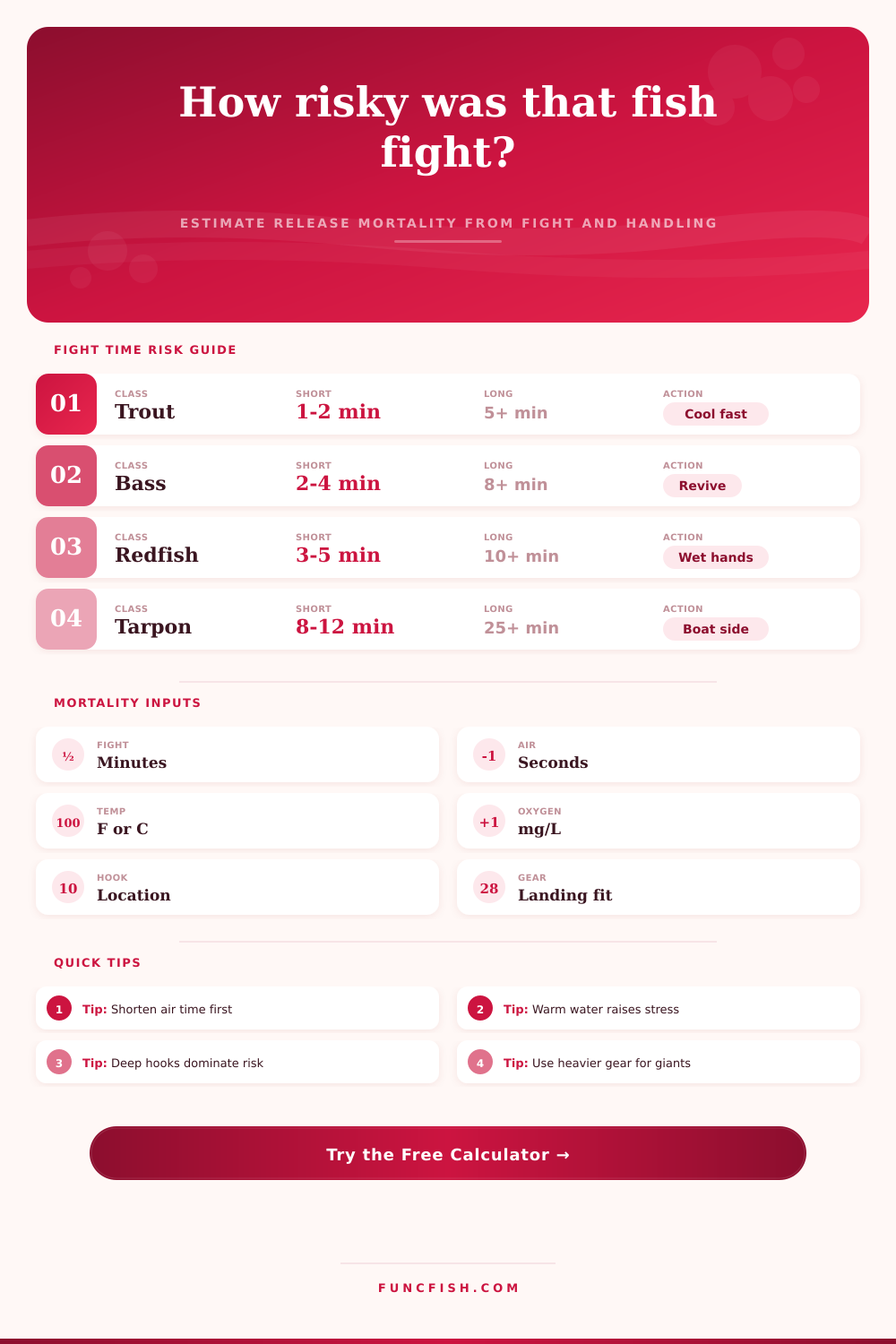
Estimate post-release mortality risk from fight duration, species tolerance, water conditions, hook placement, gear match, landing support, and air exposure.
📍Fishing presets
⚙Release conditions
Estimated release outcome
Calculation breakdown
🎣Species and gear stress grid
Low heat tolerance, high oxygen demand, and fast air exposure penalty.
Good resilience when lip hooked, but warm shallow water compounds stress.
Handles short fights well; dry deck contact and low oxygen raise risk.
Long battles demand boat-side release and strong swimming balance.
Matched rod, drag, and line shorten the fight without crushing the fish.
Fun fights can become costly when duration stretches beyond recovery time.
Hook trauma can outweigh fight time; cutting line may reduce removal damage.
Rubber mesh and in-water handling reduce slime loss and air exposure.
📊Species reference table
| Species group | Typical comfort temp | Oxygen concern | Fight sensitivity | Common risk trigger |
|---|---|---|---|---|
| Rainbow trout | 50-62°F / 10-17°C | Below 6.5 mg/L | High | Warm water plus air exposure |
| Largemouth bass | 64-78°F / 18-26°C | Below 4.5 mg/L | Moderate | Deep hook, summer shallows |
| Walleye | 56-68°F / 13-20°C | Below 5.0 mg/L | Moderate-high | Long fight in warm water |
| Striped bass | 55-70°F / 13-21°C | Below 5.5 mg/L | High | Warm saltwater, surf landing |
| Redfish | 65-82°F / 18-28°C | Below 4.5 mg/L | Moderate | Dry handling, low tide oxygen |
| Tarpon | 72-84°F / 22-29°C | Below 5.0 mg/L | High | Prolonged fight and imbalance |
⏱Fight time bands
| Fish class | Low stress fight | Watch zone | High stress fight | Immediate release cue |
|---|---|---|---|---|
| Coldwater trout | Under 2 min | 2-5 min | Over 5 min | Keep in current and skip air photos |
| Freshwater bass | Under 4 min | 4-8 min | Over 8 min | Return when upright and kicking |
| Inshore slot fish | Under 5 min | 5-10 min | Over 10 min | Revive facing current or tide |
| Large pelagics | Under 12 min | 12-25 min | Over 25 min | Unhook boat-side when possible |
| Muskie and pike | Under 4 min | 4-9 min | Over 9 min | Support horizontally in the water |
🧪Gear and handling modifiers
| Modifier | Lower risk choice | Higher risk choice | Model effect | What it changes |
|---|---|---|---|---|
| Tackle match | Balanced rod and drag | Undersized line | 0.82x to 1.22x | Fight fatigue |
| Hook style | Barbless single hook | Multiple trebles | 0.88x to 1.15x | Removal time and tissue damage |
| Landing surface | Wet rubber net | Dry deck or sand | 0.76x to 1.30x | Slime loss and extra air time |
| Hook location | Lip hooked | Gill or swallowed | 1.00x to 1.90x | Bleeding and organ injury |
| Release vigor | Strong upright kick | Rolling or imbalance | 0.86x to 1.55x | Recovery and predation window |
🌡Water condition modifiers
| Condition | Low stress range | Caution range | High stress range | Calculator use |
|---|---|---|---|---|
| Temperature vs species | Within comfort band | 2-5°F above top | More than 5°F high | Raises metabolic load |
| Dissolved oxygen | Above species concern | Near concern line | Below concern line | Reduces recovery margin |
| Current or surf | Gentle water release | Moderate push | Heavy sweep or waves | Adds landing stress |
| Cold water or ice | Slow, wet handling | Sub-freezing air | Frozen gills or eyes | Air exposure matters |
| Large fish size | Near common length | Above mature average | Trophy or oversized | Extends recovery need |
💡Release calculation tips
Reduce the biggest driver: If the result flags air exposure or handling, changing photo and unhooking routine usually improves the estimate faster than changing tackle.
Read the result as a range: A field estimate is best used to compare choices. Deep hooks, bleeding, predators, and local study results can make actual mortality higher.
A huge bass eats your bait, you reel him in, the battle is long and tiring but exciting as hell. Then you land the brute, snap a quick pic and let him go. He swims off. A few minutes later he’s floating on his side gasping for air then goes down to bottom. Death after release.
What happened? Is it something we did or didn’t do one time? No, not usually. It’s the sum total of environment, handling and stress which tire a fish beyond repair. People figure if we just take care with the hook that’s all there is. That’s where they are wrong. The time he’s fought, the water he’s been in, the air he breathes, those are silent killers and collectively remove energy from the fish at a rate that he cannot replace.
Why Fish Die After Release
You can plug those numbers into the calculator (above) and it runs the math for you. And it rolls all the factors together that most of us think about as separate. Obviously there’s the fight time. But what good is that number if we don’t know anything else? Two minutes fighting a trout in sixty degree water? Pleasant afternoon. Two minutes fighting a tarpon in ninety degree air temperature? Potential death sentence. This tool show how species tolerance interacts with thermal conditions.
Trout and steelhead are coldwater species. They have high oxygen demand and narrow temperature ranges. So you’re shrinking their margin for error by warming the water and dropping the oxygen. It is a small thing. The other key variable is hook location. For most species, having a lip hook is not a big deal. Having a gill wound or deep hook cause major trauma… Internal bleeding. Since internal trauma cannot be seen until it’s too late, the calculator gives this a lot of weight. Many anglers attempt to recover a swallowed hook, but this does more tearing than just leaving it alone. Often times cutting your line off and allowing the hook to corrode away is the nicest thing you can do. It minimizes the tissue damage and speeds up the release, which was the entire point to begin with.
As important as the actual fight is what happens after. A fish’s slime coat is its best defense against bacterial infections and parasites. Setting the fish down on a rough boat deck, or touching it with dry hands, remove that slime coat and compromises the fish’s immune system. This is clear from the reference table on the page, which shows how water handling and wet rubber nets greatly reduce risk.
Even the tackle you use has an impact. An ultralight setup can make a short fight into a marathon and push the fish into fatigue well before landing it. Match your reel and line to the size of fish. Keep the fight efficient and less taxing.
The wild card is water conditions. Warm water means lower dissolved oxygen. This is a double threat to stressed fish because it reduces their ability to recover from the adrenaline surge of the fight. The calculator factors this in with the risk score, taking into account both temperature and oxygen input. There is no substitute for intuition along with checking a thermometer and an oxygen meter. Cut the fight time in half if the water seems warm and stagnant.
It doesn’t recover overnight. That swimming off fish isn’t out of the woods yet. Disoriented fish are dinner for predators. Lack of ability to hold balance or roll over tell me they’re really stressed. So you support them in the current until they find their feet again and you becomes the difference between life and death. The tool gives you an idea of how well they’ll fare based off strength upon release, which also reminds us that the release is just the start of the recovery.
At its core though, conservation is simply a series of better decisions. More than anything, people want to tell their story, take their photo, and show respect for the resource. Small things like matching your gear, reducing air time, using barbless hooks can make an enormous difference. The calculator measures these decisions but it’s the thought process that really matters. Every second out of the water counts. Every touch should of been wet.
You consider death after release and realize that the environment you place the fish into limits his/her recovery potential. You keep it cool, keep it in the water and let it go when he/she is strong enough to swim off on his/her own. This is how we keep the fishery healthy for the next generation.