Delayed Mortality Estimator
Estimate post-release mortality risk from fish condition, species sensitivity, gear, temperature, depth, fight time, and air exposure.
📌Delayed mortality presets
⚙Catch and release inputs
Estimated delayed mortality results
🐟Species and gear risk grid
📊Species sensitivity reference
| Species group | Baseline | Most sensitive trigger | Lower-risk release target |
|---|---|---|---|
| Hardy warmwater fish | 6% | Hot water plus livewell time | Air under 45 sec, lip-hooked |
| Moderate warmwater fish | 8% | Deep hook or heavy bleeding | Single hook, short fight |
| Coldwater trout or salmon | 12% | Warm water and air exposure | Wet handling, fast release |
| Deep reef species | 18% | Depth and barotrauma signs | Descending device when appropriate |
| Toothy predator | 10% | Treble removal and jaw support | Long tools, in-water release |
| Large catfish or sturgeon | 9% | Long fights and rough handling | Support belly, revive upright |
| Pelagic offshore fish | 14% | Exhaustion after long fight | Keep moving water over gills |
| Fragile small fish | 16% | Scale loss and dry hands | Rubber mesh or water release |
🪝Gear and hook adjustment table
| Gear style | Multiplier | Typical issue | Best matching use |
|---|---|---|---|
| Single barbless lure or fly | 0.75x | Lowest removal damage | Trout, bass, panfish |
| Single barbed lure | 1.00x | Normal removal time | General casting |
| Circle hook bait rig | 0.85x | Lower gut-hook rate | Bait fishing |
| J-hook bait rig | 1.55x | Deep-hook probability | Active strike detection |
| Treble-hook lure | 1.35x | Multiple punctures | Predators, plugs, spoons |
| Trolling multi-hook lure | 1.25x | Jaw tearing under load | Offshore or big water |
| Heavy wire leader setup | 1.12x | Longer tool work | Pike, muskie, toothy fish |
| Ultralight finesse tackle | 1.18x | Longer fight time | Clear water light line |
🌡Temperature, depth, and oxygen table
| Condition band | Imperial | Metric | Estimator effect |
|---|---|---|---|
| Cool stable water | 45-62°F | 7-17°C | Small temperature penalty |
| Warm stress zone | 75-82°F | 24-28°C | Moderate oxygen penalty |
| High heat zone | 83°F+ | 28°C+ | Strong mortality penalty |
| Shallow capture | 0-30 ft | 0-9 m | Low barotrauma effect |
| Mid-depth capture | 31-60 ft | 9-18 m | Moderate pressure effect |
| Deep capture | 61-120 ft | 19-37 m | High pressure effect |
| Extreme depth | 120 ft+ | 37 m+ | Very high pressure effect |
⏱Fight, air, and release condition table
| Observation | Low stress | Moderate stress | High stress |
|---|---|---|---|
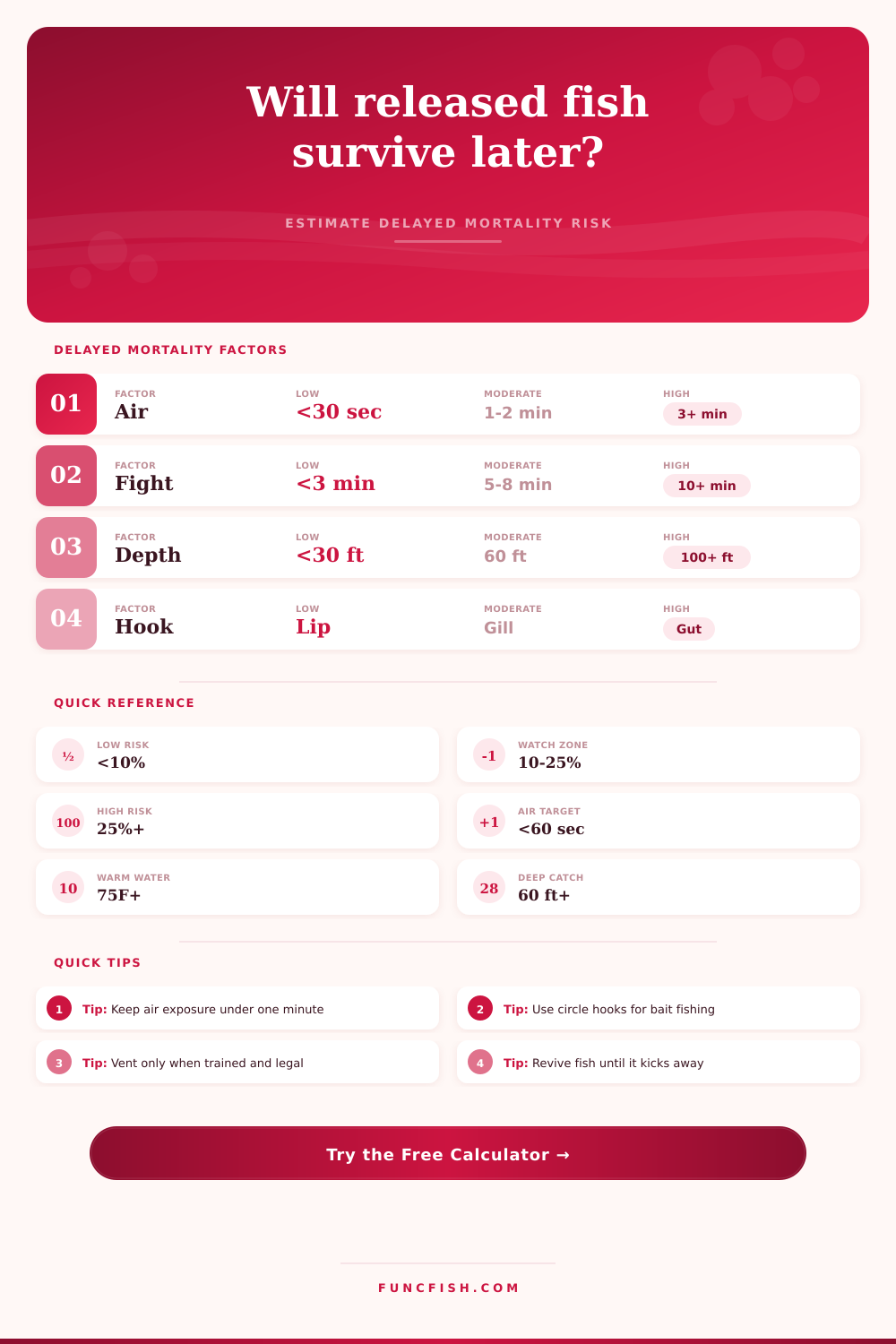
| Fight time | Under 3 min | 4-8 min | 10+ min |
| Air exposure | Under 30 sec | 45-90 sec | 2+ min |
| Bleeding | None visible | Mouth bleeding | Gill or heavy flow |
| Handling | Wet hands or rubber net | Short deck contact | Dropped or dragged |
| Release response | Strong kick | Slow upright swim | Rolling or sinking |
💡Estimator tips
“Watch the fish swim off. It looks good. It regains its calm and is soon gone in the water. It’s alive, right? That fish could still turn on its side and die in another day or two. Or maybe it will never fully regain its strength after being exhausted in the next 24 hours. But you’re happy because you let him go, and that seems like enough.
“That’s where the true expense of catch and release comes into play. What we perceive as a successful release might actualy be a delayed failure. It shows the gap between reality and perception, as many of those released fish don’t make it through the week after their capture. If most fishermen measure success based off the instant splash, then they think they are home free once the fish goes straight back down and upright into the water. But what about later?
The Hidden Truth About Catch and Release
“The proof is long term.” The effects of the fight cause stress hormones to spike, and lactic acid builds up in the muscles. Rough handling can damage gills, or expose them to air as well. All these thing don’t necessarily kill fish on the deck. They kill the fish in the water hours or even days later.
A few main factors cause that result. Water temperature is number one. Warmer water increases a fish’s metabolism and has less dissolved oxygen. So a fish may survive a brief fight in sixty degree water, but it may perish doing the same amount of exercise in eighty degree water. Physical stress is added to thermal stress, and summer fishing makes it an uphill battle. The page features a calculator for both temperature and species, so you don’t have to guess what heat will do to survival rates.
The environment isn’t the only consideration; so is hook type. A circle hook stays in the corner of the mouth and doesn’t cause nearly as much tissue damage as a standard J-hook. However, a J-hook frequently penetrate the throat. Gut hooking is disastrous to survivability odds. It is not just about the pain. It’s about the infection risk and how difficult the hook is to remove. It’s because removing a J-hook will be painful, increase infection risk, and take up precious time while the fish’s life fades away. And if you’re spending more than 30 seconds extracting a fish from your grip, the clock is ticking.
Lures with treble hooks are also a frequent offender. Multiple entry points create multiple holes which are all open wounds. The more holes you make, the harder it is to heal underwater.
Air = Silent Killer: Gills don’t function when they’re out of water. It takes only seconds for oxygen uptake to stop and minutes for gill tissue to begin dying. Fish aren’t designed to survive in the air… It kills them. Anglers frequently remove fish from the water to snap a quick picture on the bank or in the boat. This one-minute window can increase death risk from tiny to severe. Keep the fish in the water. Use wet hands if necessary to handle it. Your dry hands will remove the protective slime coat, which is the fish’s first line of defense against parasites and other bacteria. Open that door and you invite infection.
There’s also a wrinkle; depth. Fish come up from deeper water with their air-filled swim bladder adjusted to the higher pressure. That bladder will then expand if brought rapidly to the surface. So fish can float belly up. This is barotrauma. Looks dead. Sometimes is dead. You could of used descending devices which work but are not always practical nor legal. But if you’re fishing deep lakes or deep reefs; consider the pressure change. The page has a good reference table laying this out by depth band.
What you do with the fish is up to you Put him in a rubber net; cradle him by the belly. Don’t drag him up on the gunwale. Hold him upright in the water if he’s tired. Give him water over his gills. Don’t pull him along until he kicks off on his own. Don’t assist him in swimming. Wait for him to let you know when he’s good to go. This small act of patience makes the difference. It is the difference between a dead fish on the bottom and one that swims back down to live another day and spawn again.
Based off those numbers, the estimator gives you a risk percentage. A low is good. A high is a warning. It tells you to do something different. Perhaps use a barbless hook. Maybe don’t fight a fish in hot water as much. Or maybe don’t hold it in the boat as long.
Because at the end of the day it’s not about catching. It’s about letting go. And when that fish kicks away, know that it may be struggling yet. Ease up on the stress. Cut short the fight. Keep ’em wet. Let the water do the work. Give it a chance. Watch the fish swim off. Are they really swimming?