Fish Trimming Loss Calculator
Estimate usable trimmed fish, processing loss, portions, and whole-fish needs from species shape, received condition, cut style, trim standard, storage condition, and serving target.
📌Trimming presets
⚙Fish and trim inputs
Trimming results
Calculation breakdown
🐟Species yield grid
Bass
Trout
Walleye
Salmon
Cod
Snapper
Tuna
Halibut
📊Reference tables
| Species profile | Skin-on fillet | Skinless boneless | Typical trim concern |
|---|---|---|---|
| Bass or similar game fish | 43% | 38% | Rib cage and belly flap |
| Trout or char | 47% | 42% | Pin bones and soft belly |
| Walleye or perch family | 49% | 44% | Y-bone removal |
| Salmon or steelhead | 60% | 55% | Pin bones and collar waste |
| Cod or pollock | 51% | 46% | Belly flap and pin bones |
| Snapper or sea bream | 45% | 40% | Heavy scales and spines |
| Catfish | 43% | 39% | Skin and rib trim |
| Tuna or bonito | 64% | 60% | Bloodline removal |
| Panfish or crappie | 38% | 33% | Small frames and rib cages |
| Halibut or large flatfish | 56% | 50% | Skin and edge trim |
| Final cut style | Yield logic | Best matched species | Result interpretation |
|---|---|---|---|
| Skin-on fillets | Fillet yield before skin removal | Trout, salmon, walleye, snapper | Higher weight, more skin retained |
| Skinless boneless fillets | Skin-on yield less skin and pin trim | Bass, cod, catfish, panfish | Lower weight, cleaner portions |
| Steaks or cross cuts | Head and gut loss with bone retained | Salmon, tuna, halibut | More yield but bone-in servings |
| Whole dressed fish | Guts, scales, and gills removed | Trout, snapper, small bass | Highest retained weight |
| Trimmed loins | Prime center sections only | Tuna, cod, halibut, salmon | Lower yield, even thick pieces |
| Entered condition | Calculator conversion | What was already removed | When to use it |
|---|---|---|---|
| Whole round fish | Input weight equals round equivalent | Nothing | Fresh catch before cleaning |
| Gutted fish | Input divided by dressed-with-head factor | Viscera only | Fish cleaned at the water |
| Headed and gutted fish | Input divided by headed-gutted factor | Head and viscera | Market fish or offshore prep |
| Skin-on fillets | Input divided by species skin-on yield | Head, guts, and frame | Final skinning or pin-bone trim |
| Market loins or pieces | Input divided by species loin yield | Major bones and offcuts | Tuna loins, cod loins, thick portions |
| Serving plan | Imperial portion | Metric portion | Planning note |
|---|---|---|---|
| Tasting plate | 3 to 4 oz | 85 to 115 g | Use when fish is one of several items |
| Standard main | 5 to 7 oz | 140 to 200 g | Good default for trimmed fillets |
| Fish fry or tacos | 6 to 8 oz | 170 to 225 g | Round up for seconds and uneven pieces |
| Steak-style serving | 8 to 10 oz | 225 to 285 g | Bone-in cuts need heavier portions |
💡Trim planning tips
For mixed fish sizes: use the species profile for the smaller fish in the batch when most pieces are panfish-sized or thin-bodied.
For boneless portions: choose careful boneless or heavy bloodline trim before setting target servings, because the yield change is larger than most serving-size tweaks.
First, you have a fish that appears large on the counter, then a plate of trimmings that seem larger than what’s left for filleting. That’s where kitchen managers (and home cooks) either throw away protein or take a financial hit. By plugging in the cut and species you want and bypassing the guesswork about conversions and coefficients, the calculator above do the math for you.
Knowing the number isn’t half as important than understanding how that number came into being. The yield isn’t some static value, either. Instead, it change based on how long it is stored. It also depends on the preparation method, such as whether you removed guts and head, and anatomy, such as if it is a whole round fish.
How to Plan Your Fish Cooking
You’re penalized heavily for having a whole round fish: much of their overall weight are in their heads, their viscera, and their scales. But if you purchase your fish pre-processed. Scaled and gutted; you get a bit of a boost based off the starting line. However, even then, there’s the frame waiting to go. This tool take all this into account, and it tapers the yield estimate according to where along the processing spectrum you enter weight of what you have.
This is key: If you use a whole-fish yield calculation with trimmed fillet, you’ll dramatically overestimate your waste and underestimate your usable meat. Most people think they’re interchangeable, but your bass isn’t going to have same distribution of fat or bones as a salmon; it’s not the same species. A salmon’s body shape lend itself better to being filleted, so there are usually fewer unusable pieces per pound of fish. The trim percentage will be higher on something like cod or bass. These fish include complicated ribs in their bellies and other flap-like shapes underneath that require trimming before cooking.
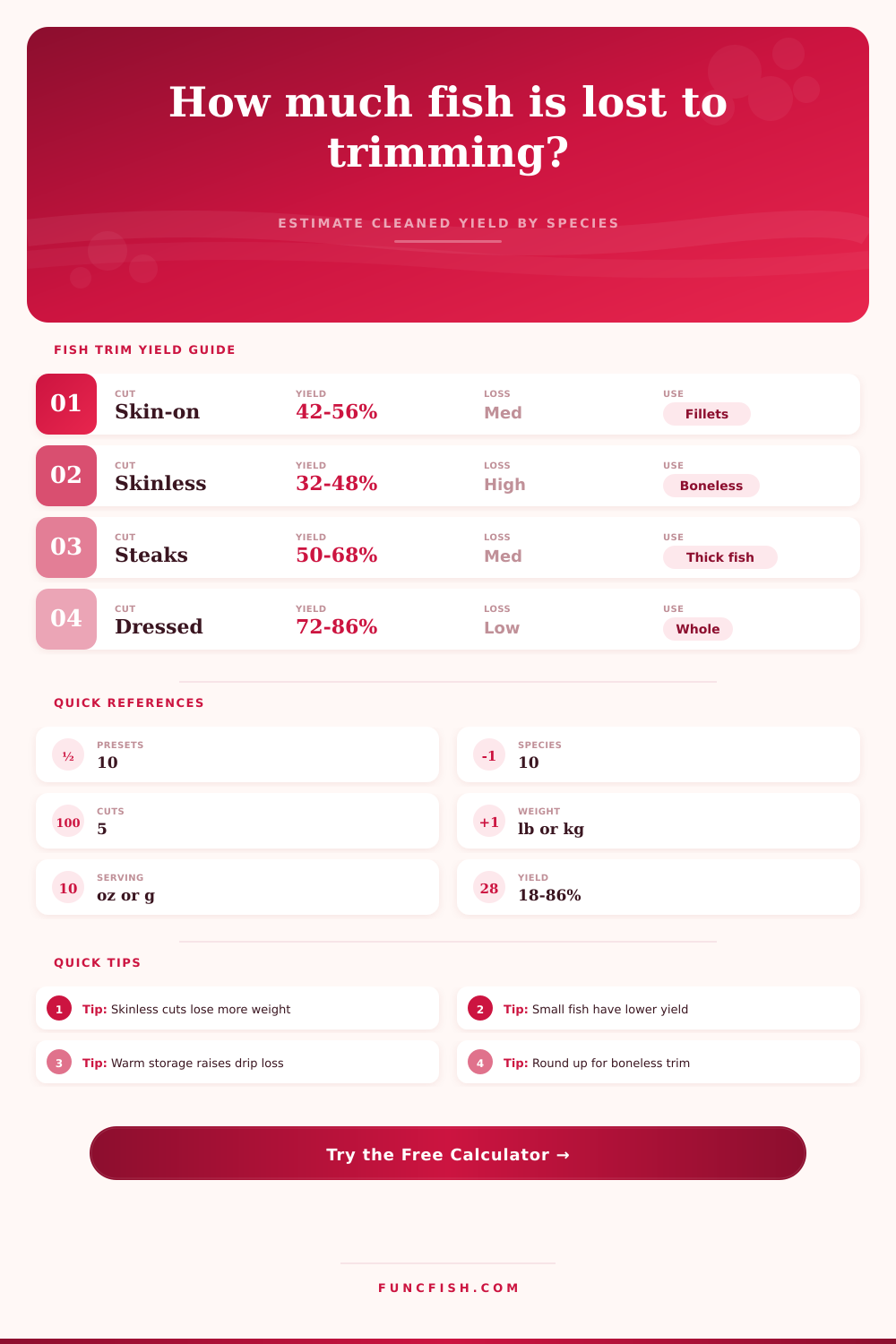
That’s where the reference table on the page comes into play. It spells it out. A tuna loin will get you up to about sixty percent of the starting weight after filleting and stripping away any skins. This is versus maybe just thirty-eight percent if you were trying to make a skinless boneless fillet from a bass, for instance.
When you’re thinking through portion sizes, don’t lump every fish together and assume they’re all equal blocks of meat. There’s also variable loss in cut style, and skin-on keeps some of that weight (good if you want to leave the skin on for flavor or texture). But skinning remove a lot of density. Those pesky pin bones get lost in there too, and it’s hard to remove them cleanly without taking a little bit of meat along for the ride. You end up losing A LOT more yield when you skin your fish then if you left the skin on.
So for example, if you’re cutting steaks off a thicker piece of fish, you’ll retain the bone but not the head/tail-end part. Each cut style involve a tradeoff between yield and convenience. The calculator accounts for this by using certain reduction factors on final output. This helps you guess exactly how many ounces of edible meat you can expect once you’ve finished cutting.
How fish are stored is a silent but costly factor in reducing loss. Also, a warm fish lose weight through drip loss before it is cleaned. As water weight is lost, it evaporates or drips out, leaving you with less of the final product instead of adding to the trim pile. Keeping the fish on ice ensures greater integrity in holding the weight so that more of it is preserved for actual cutting process. The tool includes storage condition as a variable to account for the fact that warmer or thawed fish will yield less than cold fish from catch to counter.
For a group, though, it’s exactly the opposite. You start not from the fish but from the number of people you’re feeding, and work backward toward how many pounds of uncut fish you’ll need to buy. Add some margin for the one or two bad fillet, plus the need to trim out odd-sized pieces here and there, and you have your purchase weight. With a bit of a cushion built into that weight, you won’t come up short. The calculator will tell you the total round weight required to get your desired number of servings, taking into account every piece of waste produced during preparation.
Ultimately, it is about taking care of the fish and not going beyond their biological limits; you cannot strip away the organs, skin, and bones to get more meat. And that’s the key: understanding and accepting that you’ll send a substantial amount (typically most of) your purchased weight to the trash or compost heap so you can plan accordingly and not be disappointed.
That’s where the mind-shift comes into play. The tool gives you the data, but it’s the mindset that saves cash and keeps food waste down at home. Now you’re walking into it knowing exactly what you’re buying, not just what you hope to find.