Smoking Temperature Schedule Calculator
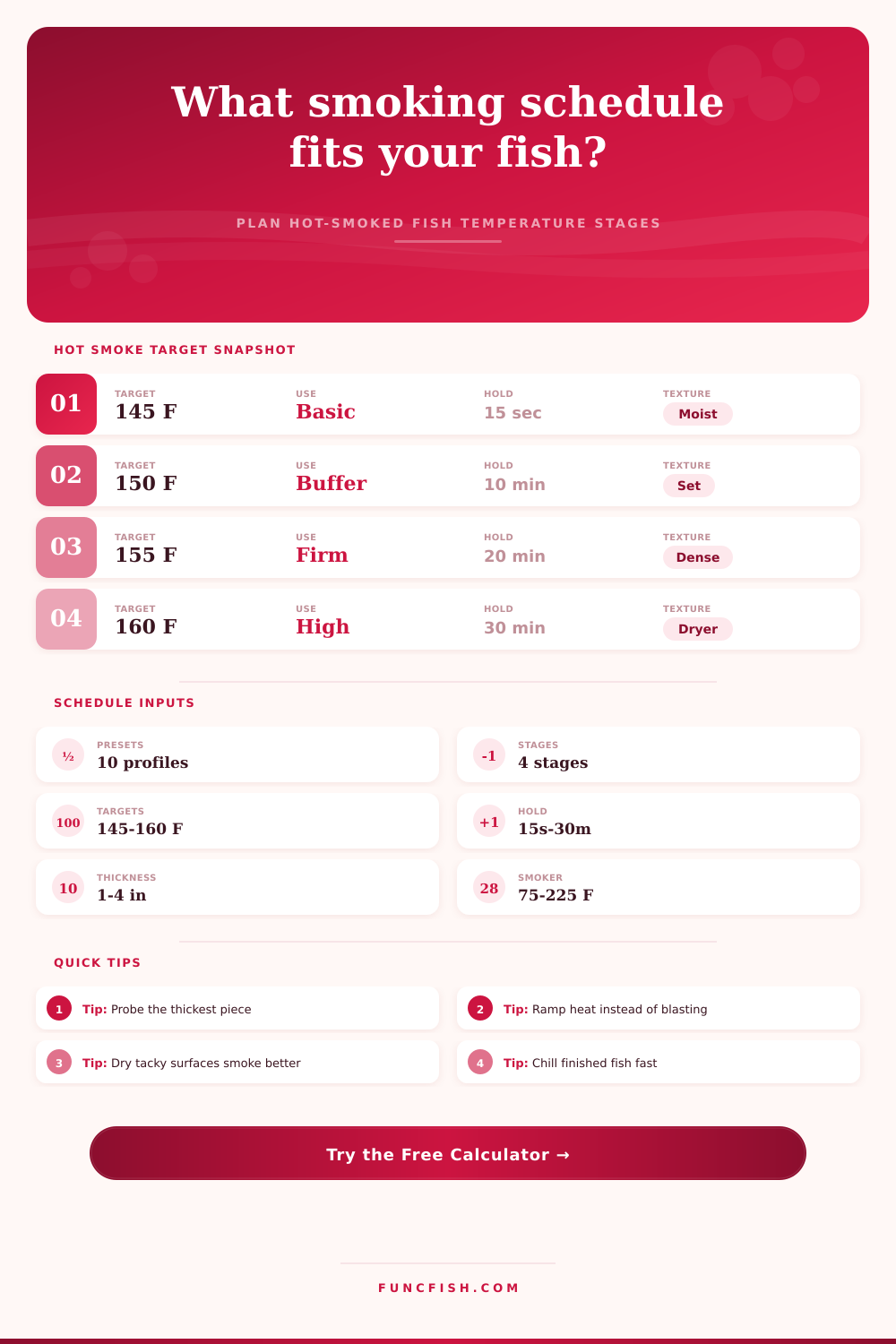
Build a staged hot-smoked fish schedule from species, cut thickness, smoker style, surface dryness, starting temperature, airflow, target internal temperature, and final hold time.
📌Fish smoking presets
⚙Schedule inputs
This calculator plans a hot-smoking temperature schedule for fish. Use a calibrated probe thermometer and local food-safety requirements for the final product.
Smoking temperature schedule results
Stage plan
Calculation breakdown
🧪Species and smoke material grid
Salmon + Alder
Trout + Apple
Whitefish + Maple
Mackerel + Oak
Cod + Cherry
Catfish + Pecan
Snapper + Blend
Sardine + Hickory
🌡Temperature stage reference
| Stage | Typical smoker range | Primary purpose | Watch point |
|---|---|---|---|
| Pellicle dry | 75-95°F / 24-35°C | Surface tack and smoke adhesion | Keep fish cool enough for the plan |
| Low smoke | 110-130°F / 43-54°C | Build smoke color without squeezing moisture | Avoid wet white albumin on salmonids |
| Color set | 140-165°F / 60-74°C | Raise internal temperature steadily | Rotate racks if smoker has hot zones |
| Finish and hold | 175-225°F / 79-107°C | Reach target internal and hold | Probe the thickest piece, not the rack edge |
🐟Species schedule reference
| Species | Oil level | Typical thickness | Schedule note |
|---|---|---|---|
| Salmon | High | 1-2 in / 2.5-5 cm | Benefits from slow ramp and lighter early heat |
| Trout | Medium | 0.75-1.5 in / 2-4 cm | Whole fish need center-cavity probe checks |
| Whitefish | Medium-low | 1-2 in / 2.5-5 cm | Firm texture tolerates moderate color stage |
| Mackerel | Very high | 0.75-1.25 in / 2-3 cm | Shorter smoke window prevents harsh flavor |
| Cod | Low | 1-2.5 in / 2.5-6 cm | Use gentle ramp because lean flakes dry quickly |
| Catfish | Medium | 0.5-1.25 in / 1-3 cm | Small strips finish fast and need spacing |
🪵Smoke material comparison
| Material | Intensity | Best fish match | Schedule effect |
|---|---|---|---|
| Alder | Light | Salmon, trout, whitefish | Long smoke window stays mild |
| Apple | Mild | Trout, cod, snapper | Good for gentle early stage smoke |
| Cherry | Medium | Cod, catfish, snapper | Adds color without aggressive heat |
| Maple | Gentle | Whitefish, trout, catfish | Balanced for longer schedules |
| Oak | Firm | Mackerel, tuna, striped bass | Reduce smoke contact on lean fish |
| Hickory | Strong | Oily fish, small fish racks | Shorter smoke window avoids bitterness |
🔧Smoker behavior matching table
| Smoker type | Recovery | Moisture tendency | Calculator adjustment |
|---|---|---|---|
| Pellet grill | Steady | Medium dry | Baseline stage lengths |
| Electric cabinet | Slow | Humid | Adds color-set time |
| Charcoal kettle | Variable | Dry zones | Adds buffer and rotation warning |
| Offset smoker | Manual | Dry heat | Shortens dry stage, extends finish watch |
| Kamado | Strong | Moist insulated | Reduces recovery penalty |
| Smokehouse | Controlled | Even airflow | Reduces batch-load penalty |
💡Practical schedule tips
Probe placement: Use the thickest fish section as the schedule anchor. Thin tails and rack edges can finish much earlier than the center pieces.
Ramp control: If the surface turns wet or chalky early, lower the next stage and extend the color-set time instead of jumping straight to high heat.
There’s a lot to smoking fish beyond turning on a smoker and going for it. There are three variables: time, heat, moisture. The variables must be balanced with each other and there’s not much room for error. Too much heat and you’ll squeeze out all the moisture before smoke can ever reach meat. Time it poorly and you’ll have a fish that’s dry and tastes like burnt wood.
What does this mean? Well, the calculator above will do all of the math for you. All you need to do is enter the specifics of your smoker type and cut. Then no more guessing at recovery rates or other factors based off how much a charcoal kettle differs from a pellet grill.
How to Smoke Fish Perfectly
The novice’s first variable are thickness. Rarely is a fillet uniform. The center of belly will take twice as long to cook than the tail end. Probing the thin edge will result in pulling the fish too soon and the center will be raw. Probing the thick part will cause the tail to turn to dust. Your schedule needs to be anchored on the slowest cooking piece. In other words, measure the thickest section with your probe. Let one data point set the entire timeline. It’s a small discipline but makes difference between a lesson and a meal.
Heat isn’t everything. Dryness on the outside matter too. Smoke doesn’t stick to wet fish. The molecules don’t hold onto a slick surface. That means your smoked fish turn out bland and pale as though cooked inside a cardboard box. To create this tacky skin before lighting up your fire is non-negotiable. The dried layer of skin behave like glue for the smoke particles. So the tool considers what is happening during the first stage of drying. Is it dry? Tacky? Or wet? Rushing through drying can be fatal to good flavour regardless of how many wood chips you throw at it. Hunger aside, you’re fighting against physics.
Where personality comes into play are with the wood choice. Alder is the classic Northwest standard for salmon. It is mild enough to give way to the fish, yet not overpower it. On the opposite end of the spectrum is hickory. It is strong and assertive. It is better paired with a tougher cut that can absorbs a heavier hand or a fish like mackerel with more oil. Pairing a delicate whitefish with a strong wood smoke is like pouring hot sauce on a scallop. It is not wrong, but it is an aggressive move that takes some confidence.
On the page, there is a reference table that spells all this out. You must match the intensity of the wood to how much oil is in the fish. Oily fish can handle a stronger smoke, but lean fish will dry out quickly and need a gentler smoke.
It also depends on how the smoker behave. Pellet grills are a reliable and consistent source of heat. Charcoal kettles behave like a wild animal with each shift in the breeze. Adjusting your stages accordingly to the heat source prevents burning the outside and waiting forever for the inside to catch up. The calculator takes this into account by adding a heat loss penalty depending on your type of smoker. Units that cool off faster gets more buffer time.
Most folks miss this. They all think all smokers work alike and they can’t understand why one batch turned out better then the other. The tempo isn’t set by the ultimate temperature but by the heat source itself.
And don’t skimp on hold time. By law, you’ve got to get it up to one hundred forty-five degrees. Then you let it stay there long enough to even out the heat. The goal is to also pasteurize the fish so that the edges are as safe and set as the middle will be. If you pull the fish just as soon as your probe registers the magic number, it’s going to be mushy and unpleasant to eat. Ten or twenty minutes after pulling it off the smoker when it’s firm to the touch is far superior. It is meat versus mush.
Fish smoking isn’t so much a cooking method as it is a matter of controlling it. You must manage a gentle transfer of taste and temperature without going too hard on either. Learn from the tool. Establish a baseline. And then rely on what you’re feeling to close the deal. A perfectly smoked fish will never taste like anything but itself. Fire should enhance it, not hide it.