Salt Cod Rehydration Time Calculator
Estimate soak time, water-change count, desalting progress, finished weight, and planning buffer for dried salted cod, pollock, ling, saithe, and similar firm whitefish.
📌Salt cod presets
⚙Rehydration inputs
This calculator estimates cold-water desalting time from cut thickness, dryness, salt cure strength, water volume, water-change rhythm, and piece crowding.
Salt cod rehydration estimate
Calculation breakdown
🧂Salted fish material grid
Atlantic cod
Pacific cod
Pollock
Saithe
Ling
Haddock
Klippfisk
Mixed tray
📊Reference tables
| Cut format | Typical thickness | Base soak range | Change rhythm | Best soak cue |
|---|---|---|---|---|
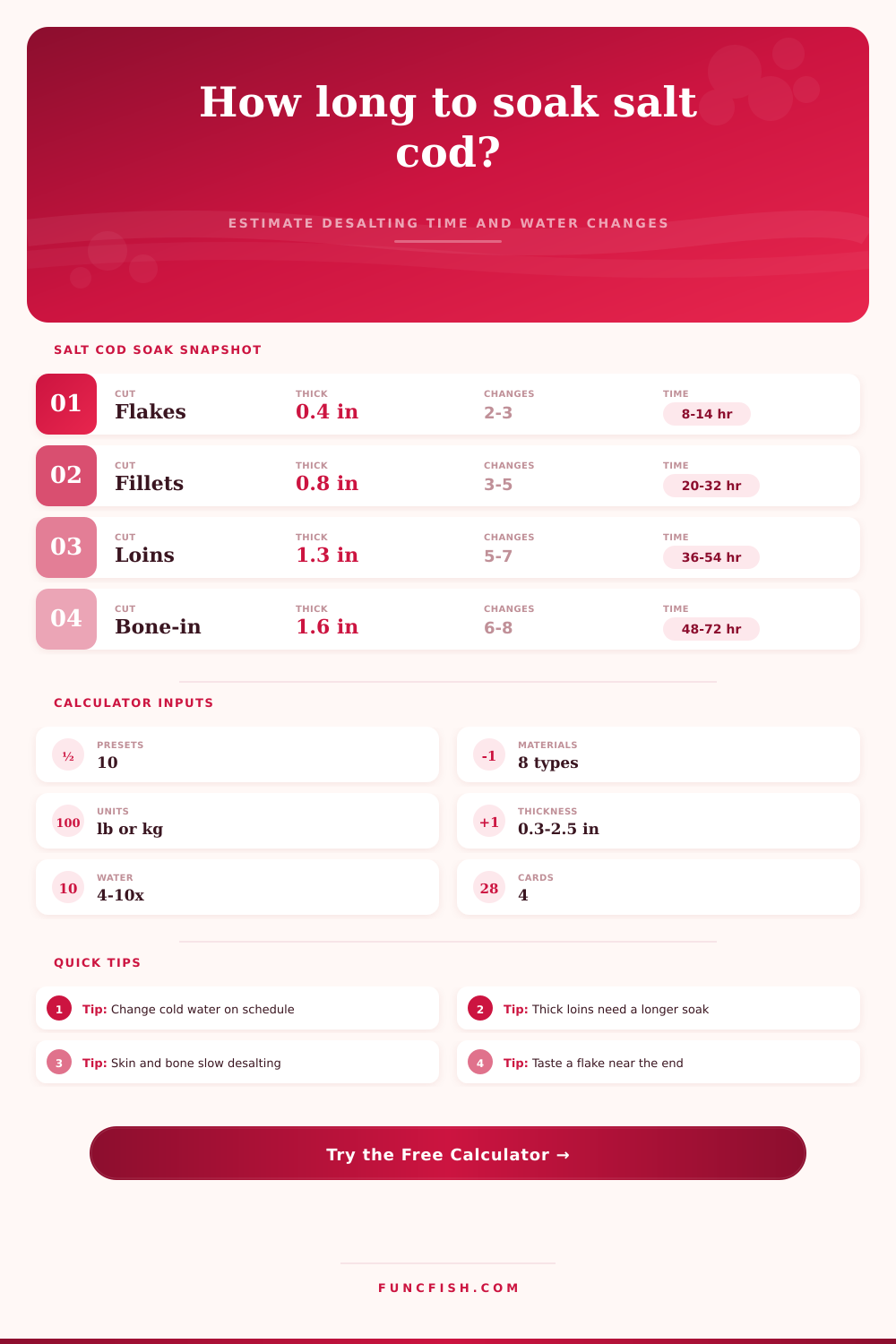
| Flaked or shredded | 0.25-0.5 in / 0.6-1.3 cm | 6-14 hr | Every 3-5 hr | Small pieces soften quickly |
| Thin fillets | 0.4-0.7 in / 1.0-1.8 cm | 12-24 hr | Every 5-8 hr | Center is flexible |
| Portion pieces | 0.7-1.1 in / 1.8-2.8 cm | 20-36 hr | Every 6-8 hr | Salt level tastes balanced |
| Thick loins | 1.1-1.6 in / 2.8-4.1 cm | 32-56 hr | Every 6-10 hr | Core flakes without chalkiness |
| Bone-in slabs | 1.3-2.2 in / 3.3-5.6 cm | 44-78 hr | Every 6-10 hr | Bone side is no longer rigid |
| Water setup | Volume ratio | Desalting effect | Texture effect | When to use |
|---|---|---|---|---|
| Compact bowl | 3-4 qt/lb / 6-8 L/kg | Slower | Firmer finish | Small refrigerator space |
| Standard tub | 5-7 qt/lb / 10-15 L/kg | Balanced | Even rehydration | Most fillets and portions |
| Wide tray | 7-9 qt/lb / 15-19 L/kg | Faster | Less salty edges | Thick loins |
| Very large bath | 9-12 qt/lb / 19-25 L/kg | Fastest | Can soften surface | Heavy cure or short schedule |
| Species or material | Density feel | Soak multiplier | Yield multiplier | Planning note |
|---|---|---|---|---|
| Atlantic cod loin | Firm, large flake | 1.00 | 1.42x | Good baseline |
| Pacific cod fillet | Lighter flake | 0.94 | 1.36x | Watch soft edges |
| Pollock or haddock | Lean, thinner flake | 0.90-0.92 | 1.32-1.34x | Shorter final checks |
| Ling or tusk | Dense slab | 1.12 | 1.40x | Needs core testing |
| Klippfisk block | Very dry and stiff | 1.22 | 1.50x | Add buffer time |
| Temperature zone | Imperial | Metric | Speed adjustment | Use note |
|---|---|---|---|---|
| Very cold fridge | 33-35 F | 1-2 C | +8% time | Best for long soaks |
| Cold fridge | 36-40 F | 2-4 C | Baseline | Standard calculator zone |
| Upper fridge | 41-44 F | 5-7 C | -5% time | Change water reliably |
| Too warm for planning | 45-50 F | 7-10 C | Not preferred | Use colder water setup |
💡Rehydration tips
Tip: Use the thickest piece for timing and keep smaller pieces in the same cold-water schedule unless they become fragile first.
Tip: Near the final quarter of the soak, test a center flake; the calculator estimates timing, but actual cure strength varies by producer.
So you bought some salt cod, which in reality resembles driftwood, and now you realize too late that rehydrating it require a patience most home cooks lack. Now you also know that re-hydrating it has less to do with cooking than with chemistry. This is something most home cooks don’t plan ahead for.
What you thought was a cooked piece of fish because the outside seems softened is still hard and salty in the middle. That’s when the surface tricks you, and its inside shocks your dinner.
How to Soak Salt Cod
To do that properly, to make guesswork into a schedule, use the tool above. It wants to know things like how dense the flesh is (a thick, bone-in loin differs from a thin fillet), and how thick your cut will be. Both begin life as rock-hard blocks but behave different.
The calculator takes that into account to guess how long you’ll have to soak your fish. It also tells you how frequently you should swap out the water to leach out the excess salt. And it even provides an estimate of yield, since dried cod swells dramaticly when it soaks up some moisture. So you learn that a pound of dry fish could yield almost two pounds of cooked product, and you can buy the right amount from the start.
Another variable people tend to overlook is water volume. When you put the fish in a tiny bowl barely big enough to hold them, there is not much room for the water. All the salt that leaches out stays right where it happened and doesn’t wash away. Instead it diffuses back into the fish. What you want is a cold water reservoir big enough that it can dilute the salt. That way you pull the salt out efficiently and keep the gradient steep by changing the water periodically.
The charts on the page shows what happens to rate of change as water volume changes. A wider tray with lots of water will work faster than a narrow one that holds less. The calculator takes this into account when adjusting the time it predicts.
There’s another factor that quietly goes into play: Temperature. Ideally, you’d like the water to be on the chilly side, about forty degrees Fahrenheit. It may sound counterintuitive, but warm water can speed things up; but it risks starting the cooking process before the desalting is finished. This results in mushy edges and a tough center.
The calculator takes into account a typical fridge temp, though it will adjust downward (if you’re storing the fish in a very cold cellar) or upward (if your kitchen tends toward the warmer end of the range). It is a small variable, but one that keeps the texture just firm enough to stay intact when it comes time to flake.
Not all fish soak up water in the same way. Cod (at least the Atlantic variety) is the benchmark, followed by lean pollock, which has less meat and tends to fall apart easily, then dense ling, which retains moisture in an odd way. Because it’s all about how the meat fits together, the multipliers are built into the calculator, ensuring that no matter what block of fish you get home with, you won’t over-soften tender fillet or under-soften stubborn blocks of meat. The details close the loop between textbook science and real-world grocery store chaos.
But how do you know when? There’s an art to it. The calculator will tell you that you’re ready, but only your nose and tongue can be the ultimate judge. About halfway through what it estimates to be cooking time, take a tiny flake out of the middle and taste it. Is it still aggressively salty or does it have a pleasant savory quality to it? Then yes, you’re good to go. No? Back into the water it goes for another pass.
That’s where the senses come in, and that’s why this is an iterative process: where math meets the senses. The calculator takes you to the ballpark but your palate tells you if you’re home.
There’s a reward to patience when rehydrating salt cod. With knowledge of which factors, species, thickness, water volume; you take out the worry of the night before, of will it be ready, and replace it with confidence in your schedule. Your extra hour of planning becomes worth its weight in peace of mind. And when at last the fish flaked tender, and perfectly seasoned, you remember that none of the hard work came from the stove; it all came from the wait.