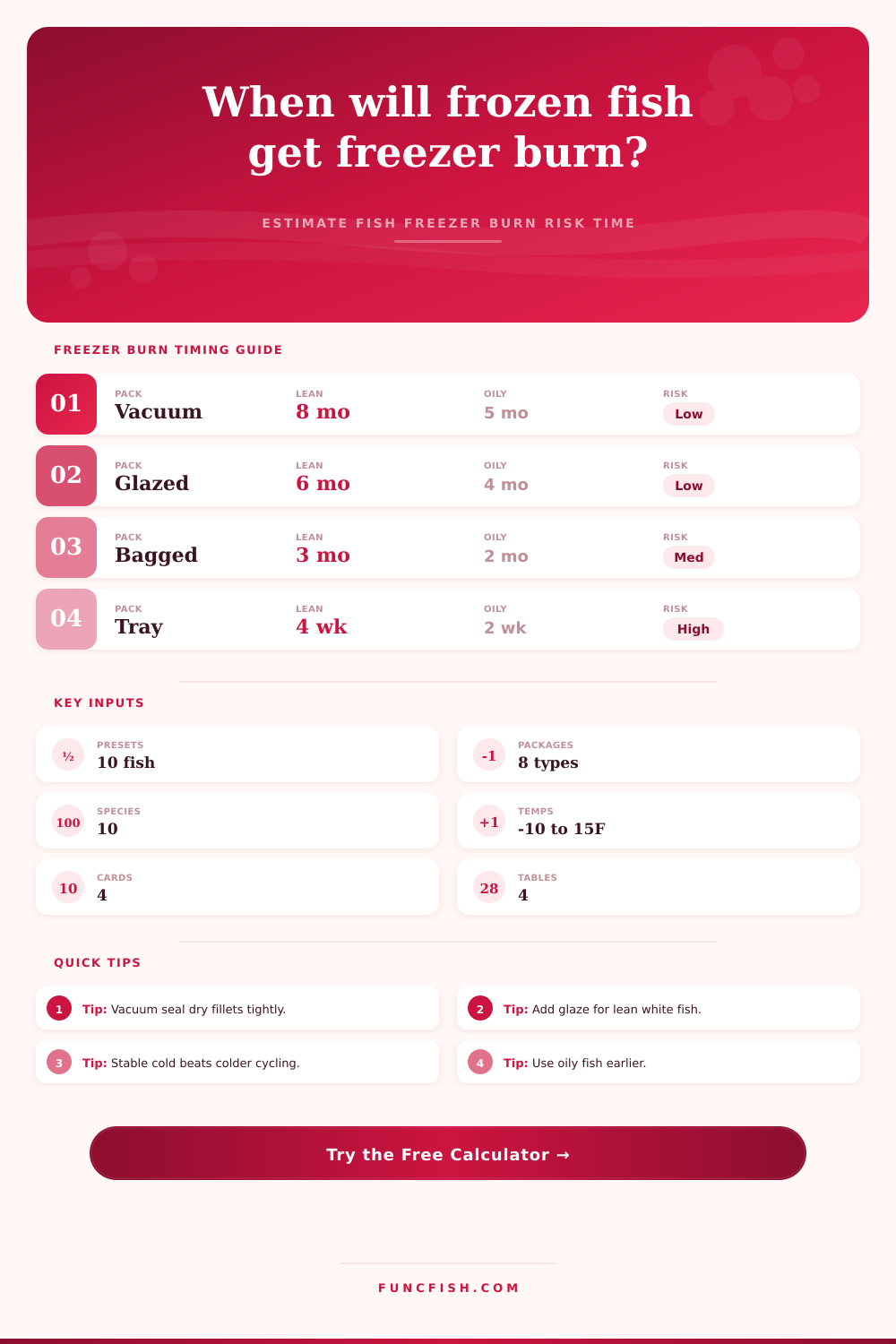
Freezer Burn Risk Time Calculator
Estimate how long frozen fish is likely to hold quality before freezer burn becomes likely, using species fat level, packaging barrier, glaze, freezer temperature, portion geometry, and thaw-refreeze handling.
📌Freezer storage presets
Pick a realistic starting point, then adjust the package, temperature, portion thickness, glaze, and handling details for your own freezer.
⚙Fish, package, and freezer inputs
Freezer burn risk estimate
Calculation breakdown
🧪Material and species grid
Vacuum pouch + salmon
Glazed bag + cod
Double bag + trout
Paper bag + walleye
Loose bag + catfish
Rigid tub + shellfish
Tray wrap + panfish
Block freeze + halibut
📊Freezer burn reference tables
| Packaging material | Barrier score | Best use | Notes |
|---|---|---|---|
| Chamber vacuum heavy pouch | 96 | Premium storage | Low air and strong vapor barrier. |
| Vacuum sealed barrier pouch | 92 | Fillets and loins | Best all-around home option. |
| Water glazed freezer bag | 84 | Lean white fish | Glaze protects exposed surface. |
| Double freezer bag | 68 | Short to mid storage | Press air out before sealing. |
| Tray or store wrap only | 22 | Very short storage | High air exposure and dehydration. |
| Species group | Oil level | Base days | Freezer burn sensitivity |
|---|---|---|---|
| Salmon or steelhead | High | 150 | Oil oxidation plus surface drying. |
| Cod or pollock | Low | 210 | Lean flesh tolerates longer storage. |
| Mackerel or bluefish | Very high | 105 | Use early even when well packed. |
| Halibut or flounder | Low | 195 | Dense portions reward tight wrapping. |
| Shrimp or scallop | Low | 165 | Glazing helps prevent surface frost. |
| Freezer average | Metric | Storage factor | Quality effect |
|---|---|---|---|
| -10 F | -23 C | 1.18x | Excellent if stable. |
| 0 F | -18 C | 1.00x | Standard baseline. |
| 5 F | -15 C | 0.82x | Noticeably shorter window. |
| 10 F | -12 C | 0.66x | Frequent frost and drying risk. |
| 15 F | -9 C | 0.50x | Short storage only. |
| Burn index | Status | Expected signs | Action |
|---|---|---|---|
| 0-40 | Low | Normal frozen surface | Keep stored cold. |
| 41-70 | Moderate | Frost pockets or dry edges | Use soon for best quality. |
| 71-100 | High | Dry patches and pale areas | Cook in moist preparations. |
| 100+ | Past window | Strong dehydration likely | Check quality before table use. |
💡Freezer storage tips
Freezer burn: Freezer burn show up as duller or paler patches on surface of frozen fish. In the case of freezer-burned fillets, it’s like they’re covered with a layer of chalk. It looks bad and it’s a quality disaster. But it doesn’t make the food unsafe to consume; it is a quality disaster rather then a safety issue.
There are calculators out there that will tell you how high (or low) the risk is based off your packaging information and the fish species involved. You no longer have to guess at conversions or coefficients. This is about packaging. It’s not just about temperature. A frost free upright that run constantly is not as good as a zero degree Fahrenheit chest freezer. But typically more critical to success are the packaging barrier between you and cold air.
How to Stop Freezer Burn
Losing moisture causes dryness, which leads to freezer burn, while oxygen causes oxidation. Packaging protects from both. Loose bags with zippers don’t do as well as vacuum sealed bag. The lack of air in a vacuum bag doesn’t pull moisture out of the fish. However, air pockets in a loose bag act like sponges that pulls moisture out of the fish and turn it into frost on the bag. The weight is a big deal because it’s the feel of the fish and it help preserve the texture. The vacuum pack forces the plastic to conform to shape of the fillet, so there is no air in the package to suck the moisture out of the fish.
Freezing time depend on the fat content of the fish. Dehydration (causing protein toughness) happens with lean fish such as cod. Oxidation (causing fats to go rancid) happen with fatty fish such as salmon. Rancid mackerel won’t have white spots, but it will taste bad. For the oily species, you are fighting water loss and fat breakdown. This is why quality window can be shorter.
One low-tech fix is glazing. To help retain moisture (especially for lean fish), you want to form a hard ice coating on outside of the fish by freezing it quickly after dipping it into some water. The ice forms an outer seal, which stops sublimation by having the ice evaporate instead of the fish. For lean white fish, this sacrificial layer extend their shelf life by many months in regular freezer bag. Not much work for a big payback.
Freezer handling habits impact your freezer environment. Each door opening bring warm moist air into the freezer to cling to the fish. When the compressor encounters this water vapor, it turn it into frost inside the freezer, which speeds up drying if the fish are not well packaged. If you frequently open the freezer, you should of pack them better. More frequent access reduces the storage window.
The calculator provides a warning light. A risk index. The higher the index score, the more likely the texture of your fish is going to be off, though not necessarily toxic. If you see a high index, just know that your fish is going to be bland and somewhat chewy. Freeze-burned fish is still edible (blend it in a chowder or bake it with some heavy sauce). But don’t attempt to pan-sear it; it will fall apart.
How do those barrier scores convert to practical, at-home storage time? Check out the table below: It’s more of a guideline than a hard-and-fast rule, since different freezers hold their coolness differently. But use this as a meal-planning tool: Eat the oilier fish first, save the vacuum-sealed steak for last.
To preserve that environment, don’t leave the freezer door open. You want to keep the moisture in and let the air out so it tastes fresh. Actually, you should keeps it closed to make sure fish stays good. Naturaly, this makes a big differance.