Sashimi Grade Freeze Time Calculator
Estimate parasite-destruction freezer time for raw-service fish lots using FDA-style temperature schedules, thickest-piece geometry, packaging depth, freezer class, and batch handling margin.
📌Raw-service presets
⚙Fish lot and freezer inputs
This calculator estimates freezer scheduling for parasite control. "Sashimi grade" is not a universal grade; supplier documentation, continuous freezer records, and local food-safety rules still decide whether a lot is acceptable.
Sashimi freeze schedule result
Calculation breakdown
🧊Species and material data grid
Wild Salmon
Yellowtail
Mackerel
Flatfish
Snapper
Cod
Scallop
Tuna
📋Reference tables
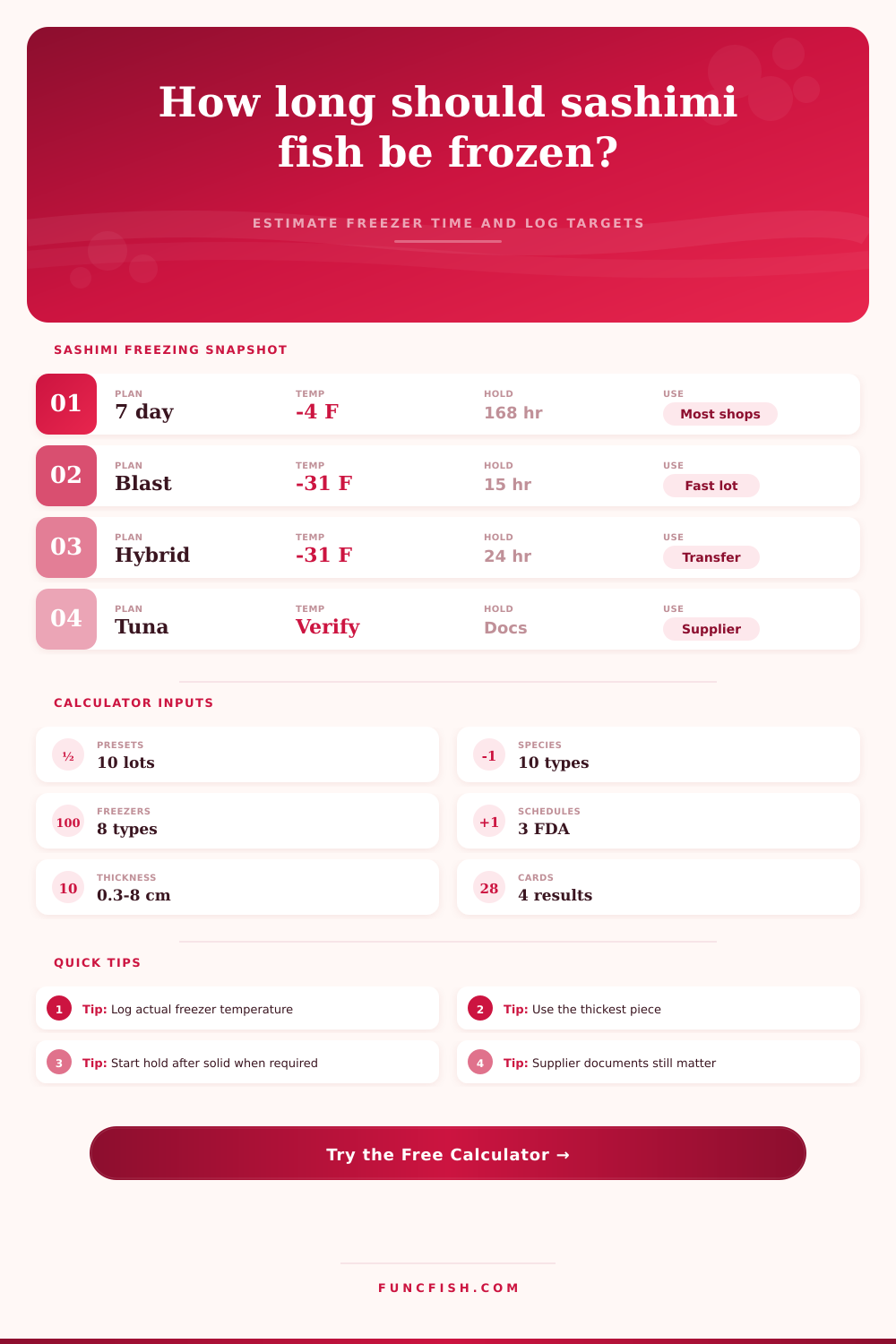
| Control schedule | Ambient freezer target | Hold clock | Calculator use |
|---|---|---|---|
| Seven-day freezer hold | -4 F / -20 C or colder | 168 hours total | Default for storage freezers that can verify temperature continuously. |
| Deep-freeze rapid hold | -31 F / -35 C or colder | 15 hours after fish is solid | Best for true blast or ultra-low equipment with fast pull-down. |
| Hybrid deep then storage | -31 F / -35 C until solid, then -4 F / -20 C | 24 hours after transfer | Useful when the product is frozen hard in a deep freezer, then finished in storage. |
| Freezer type | Typical verified range | Pull-down speed | Best schedule match |
|---|---|---|---|
| Home upright freezer | 0 to -10 F / -18 to -23 C | Slow | Usually not adequate unless records prove -4 F or colder. |
| Home chest freezer | -5 to -20 F / -21 to -29 C | Slow to moderate | Seven-day schedule after verifying the warmest point. |
| Restaurant reach-in | 0 to -10 F / -18 to -23 C | Moderate | Seven-day schedule only with stable temperature logging. |
| Walk-in storage freezer | -5 to -15 F / -21 to -26 C | Moderate | Seven-day lot hold with spacing and batch records. |
| Blast or plate freezer | -31 F / -35 C or colder | Fast | Deep-freeze or hybrid schedule when solid condition is verified. |
| Cut or packaging style | Thermal concern | Thickness input | Calculation adjustment |
|---|---|---|---|
| Thin sashimi sheets | Fast core freeze, high surface exposure | Single sheet thickness | 0.55 geometry factor |
| Portion pieces | Moderate cooling path | Thickest piece | 0.90 geometry factor |
| Loin block | Slow center cooling | True center depth | 1.18 geometry factor |
| Vacuum pouch | Plastic and purge slow airflow contact | Total pouch depth | 1.28 geometry factor |
| Stacked case | Package center may lag badly | Full stack depth | 1.70 geometry factor |
| Species group | Raw-service concern | Extra log check | Calculator note |
|---|---|---|---|
| Wild salmon, trout, cod | Parasites likely enough to require controls | Freeze record and lot ID | Use a full validated parasite-destruction schedule. |
| Mackerel, herring, sardine | Parasites plus histamine handling concern | Receiving temperature and freeze log | Freezing does not reverse prior histamine abuse. |
| Yellowtail, snapper, bream | Marine parasite control depends on source | Supplier letter or in-house freezing | Use documented lot-by-lot raw-service approval. |
| Farmed salmon or tuna | May qualify through source controls | Supplier guarantee and chain records | Freezing may still be used as a conservative control. |
💡Freezing calculation tips
Use measured coldest-safe records. A freezer setpoint is not a food-safety record. Use logged air temperature at the warmest loaded position, and restart the clock after excursions above the selected schedule threshold.
Measure the slowest package. Enter the thickest piece or full stack depth. A tidy single layer can freeze many hours faster than the same fish packed tightly in a box.
“Sashimi grade” isn’t an official designation applied to the fish at its point of origin. Don’t think of it as USDA Prime steak. Rather, “sashimi grade” most often shows a judgment call by the kitchen’s management, typically the chef, once the fish land in the door. The criteria for making this call include smell, feel, and the type of protocol used to kill parasites during processing.
Why does this matter? Health codes do not accept opinions; they are only concerned with data. That means the length of time that fish spent at any given temperature can make all the difference between a safe dinner versus a code-violation nightmare. Looks don’t matter: health codes is concerned with data and temperature history, not just how fresh the fish looks.
Why “Sashimi Grade” Is Not Official
That’s where the physics of cold and the biology of fat come into play. Fat is a very slow conductor of heat. Even at -20C, freezing a 1-inch chunk of fatty fluke on a slab take time. But freezing that same chunk of wild salmon as a solid loaf, or “block”, even a thin one, are far slower. The interior will lag well behind the edges. And if you begin the regulatory clock while the interior is still far away from target temp, then you’re simply taking a chance.
The calculator above does the math for you: just enter your freezer type, fish species, and thickness, and the calculator crunches out the answer. It eliminates the need to memorize obscure heat transfer coefficients. It converts abstract physical properties into something real and useful. In other words, it enables you to know precisely when the clock begins running, for regulatory purposes.
For storage freezers, the safe, standard option is to set a freezer to minus twenty degrees Celsius and go with a seven day hold. That’s what most kitchen do. That plan presumes that the freezer maintains that temperature all of the time. It also presumes that whatever is being stored will reach that temperature all the way through its volume.
If you’re using a blast freezer, that changes the rules. Will it freeze faster? Sure, as long as you confirm that the product has become solid before beginning the final hold period. Packaging depth becomes one of the hidden factors here. Portions on a rack, laid out in a single layer, will freeze fairly rapidly. But take those same portions and pack them into a box. The surrounding fish and the cardboard provides a thermal buffer. You must now consider the height of that stack, rather than simply the thickness of each fillet.
So how careful? That depends on species. Mackerel and wild salmon carry a higher risk of parasites. This is not true for tuna or farmed versions of those fish. The calculator accounts for those biological facts. Weighting factors differently according to risk and fat-content.
It is not just about time, but also about substance. A fatty belly strip insulates itself more than a lean snapper fillet, meaning the cold takes longer to penetrate the core. Thus it takes longer for the cold to reach its center. And if you don’t account for that variation, you underfreeze. It is a serious, yet quiet, safety failure.
Documentation is the boring stuff that keeps the doors open. Health inspectors don’t care if your heart was in the right place. What matters are your logs. It doesn’t matter if you were aiming for -20, it matters where the warmest spot on the freezer is, and what the temperature reads there. Where did the fish become solid? How do you know you didn’t leave the door open and let the clock stop? How do you prove to the inspector that the fish weren’t still cooking because of a defrost cycle? The log is the proof, and the calculator is the target.
In most places, without the log the fish are considered raw and cannot be served.
A data point on trust: Serving raw fish is risky business. That’s because it requires trust, in your equipment, your process, your supplier. Those points of trust is connected by the freezing process. Through measured and controlled action, a biological hazard becomes a safe ingredient. Get the time right and the bridge holds. Accurate thermal data combined with strict logging practices remove guess work from the equation and bring in the reliability of safety. Now the quality of the fish can stand out without being hidden by the risk of failing to follow rules.