Fish Freezing Glaze Water Calculator
Estimate glaze water to prepare, retained ice glaze, final frozen weight, pass volume, and coverage thickness for frozen fish, shrimp, fillets, steaks, and whole fish.
1Quick presets
Pick a production case, then tune the batch weight, target glaze, pass count, temperatures, and method capture for your freezer line.
2Glaze inputs
Glaze water estimate
Calculation breakdown
3Species and material grid
Cod group
Shrimp
Salmon
Whole fish
Tuna steak
Catfish
Scallops
Oily fish
4Reference tables
| Species group | Common target | Use case | Watch point |
|---|---|---|---|
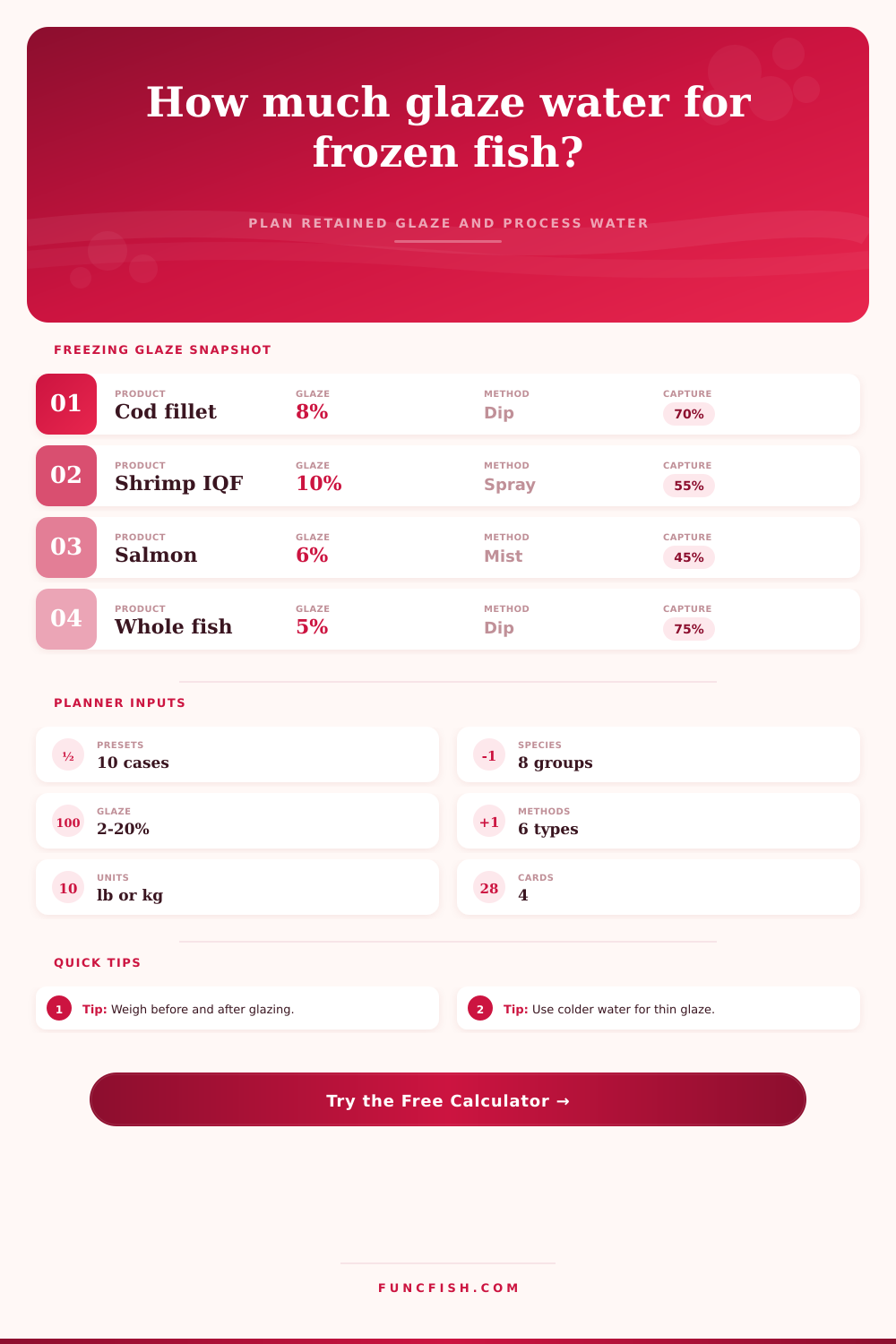
| Lean white fillets | 6% to 10% | General frozen storage | Edges dehydrate first |
| Shrimp and scallops | 8% to 14% | IQF shellfish | High surface area |
| Salmon portions | 4% to 8% | Retail packs | Oil lowers cling |
| Whole small fish | 4% to 7% | Round or dressed fish | Belly cavities drain |
| Tuna steaks | 3% to 6% | Firm low-surface cuts | Surface cracking |
| Method | Base capture | Best for | Process note |
|---|---|---|---|
| Dip tank | 72% | Baskets and whole fish | Drain consistency matters |
| Belt spray | 58% | Continuous fillets | Nozzle coverage sets loss |
| Fine mist tunnel | 45% | Thin appearance glaze | Often needs more passes |
| Hand rinse | 50% | Small lots | Operator variation is high |
| Tumbler glaze | 66% | Small separated pieces | Check breakage risk |
| Control item | Light glaze | Protective glaze | Heavy glaze |
|---|---|---|---|
| Water temperature | 34 F to 38 F | 33 F to 36 F | 32 F to 34 F |
| Product surface | 0 F or colder | -5 F or colder | -10 F or colder |
| Typical passes | 1 to 2 | 2 to 4 | 4 to 6 |
| Layer thickness | 0.2 to 0.5 mm | 0.5 to 1.2 mm | 1.2 mm plus |
| QA check | Formula | Example | Action |
|---|---|---|---|
| Glaze percent | Gain / raw weight | 8 lb / 100 lb | Adjust pass volume |
| Final weight | Raw plus glaze | 100 lb to 108 lb | Verify pack label |
| Pass split | Total water / passes | 4 gal / 3 | Evenly distribute |
| Coverage | Ice volume / area | 0.8 mm layer | Check bare spots |
5Practical tips
Weigh the same sample twice. Use the same drained sample before glazing and after the final freeze pass. The calculator estimates water demand, but scale checks confirm retained glaze.
Keep passes thin. Several cold, quick passes usually beat one heavy soak because thick water films can crack, shed, or create uneven glaze after hardening.
To store the frozen fillets, we add glaze… More like icing on a cake, to keep it fresh in storage.
But how much glaze do I need? How many cups of water is needed? What are the right amounts? Knowing what drives result lets you concentrate on doing the work and not on figuring out how much stuff is needed. It saves you time and money.
How to Glaze Fish Correctly
Water absorption on surface depends on type of fish. Cod, for example, has an open texture, so it will readily absorb moisture; whereas oily fish, such as salmon, have a slick surface and don’t hold water. The operator need to choose the right species group in the tool. If you use a thin glaze, lean fish might be too exposed; if you use a thicker glaze, it might slip off oily fish. So there’s a balance between matching the glaze strength with flesh structure. In many operations, they do one thing for all fish, and then they get variable results.
Efficiency varies with the application as well. Spraying a belt loses some water on the floor or into the air; dipping baskets in a tank is better at capturing it all. Dipping does not waste water like a spray system because dripping water relys on gravity to remove the excess. This results in lower rates of capture, which the reference table illustrates. So, the tank will have to hold more water to achieve your desired level of glaze. Failure to account for this lead to uneven coating and under-sized tanks. These initial mistakes could of resulted in having product that is too dry when you go to use it.
Water will freeze based off temperature. Water freezes quicker on contact with a colder surface of the product. A warmer product lets the water stay on top longer, diluting surface proteins and making them softer. The calculator takes into account the water and product temperatures because they dictate the speed of the freeze. It does matter that cold water freezes faster but you don’t want such a large temp differential as to shock the product. Ice needs to freeze fast yet not crack flesh.
A thin pass is superior than a single, thicker soaking. Thick layers of water will either slump or crack when frozen. If you apply half in one pass and then do it again the layer is more consistent and durable. By default, the tool split the volume over multiple applications (you determine how many). It’s a minor adjustment but greatly increases quality.
But confirm it on a scale. The calculator is only estimating under normal conditions. Nozzles don’t always perform the same and drain time isn’t constant in real world application. Actual percentage can be confirmed by weighing a sample both pre- and post-glazing. This will help avoid any rejected inventory.
Measure what you put out, and not just what goes in. A quality glaze protects your product.