Girth to Weight by Species Calculator
Estimate fish weight from measured length and girth with a species-adjusted divisor, condition setting, water type adjustment, and confidence range.
📌Named species presets
⚙Fish measurement inputs
Weight estimate
Calculation breakdown
🎣Gear and species comparison grid
Bass build
Trout build
Catfish build
Pike build
📋Species divisor reference
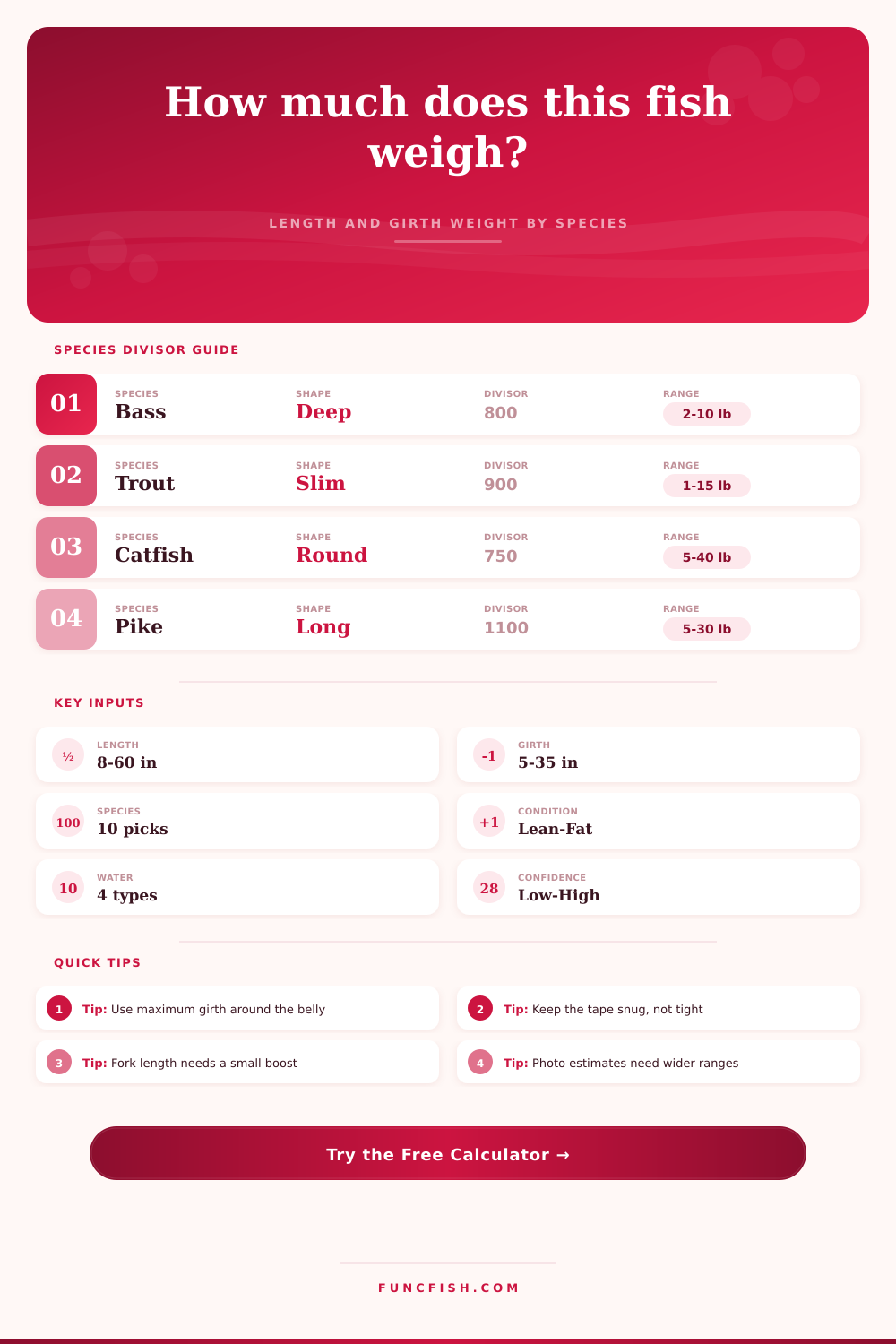
| Species preset | Base divisor | Body shape | Typical range |
|---|---|---|---|
| Largemouth bass | 800 | Deep, broad belly | 1-12 lb / 0.5-5.4 kg |
| Smallmouth bass | 850 | Compact and muscular | 1-8 lb / 0.5-3.6 kg |
| Rainbow trout | 900 | Slim to moderate | 1-15 lb / 0.5-6.8 kg |
| Lake trout | 950 | Long, heavy head | 5-35 lb / 2.3-15.9 kg |
| Walleye | 900 | Long and firm | 2-14 lb / 0.9-6.4 kg |
| Channel catfish | 750 | Round-bodied | 3-40 lb / 1.4-18.1 kg |
| Northern pike | 1100 | Long cylinder | 4-30 lb / 1.8-13.6 kg |
| Muskellunge | 1050 | Long, thick predator | 15-50 lb / 6.8-22.7 kg |
| Striped bass | 850 | Deep saltwater form | 5-50 lb / 2.3-22.7 kg |
| Common carp | 760 | Very deep belly | 5-45 lb / 2.3-20.4 kg |
⚖Condition and water adjustments
| Adjustment | Multiplier | Divisor effect | Use when |
|---|---|---|---|
| Thin or post-spawn | 0.88 | Raises divisor | Sunken belly or spent fish |
| Lean but healthy | 0.95 | Slightly raises divisor | Normal slim profile |
| Average condition | 1.00 | No change | Balanced shoulders and belly |
| Heavy shoulders or belly | 1.08 | Lowers divisor | Full belly or pre-spawn build |
| Trophy-thick build | 1.16 | Lowers divisor more | Exceptional depth and girth |
| Cold deep water | 0.98 | Tiny lift to divisor | Lean lake fish or cold season |
| Brackish estuary | 1.02 | Tiny divisor drop | Fed-up estuary fish |
| Saltwater coastal | 1.03 | Small divisor drop | Striped bass and coastal fish |
📏Measurement confidence reference
| Confidence level | Length error | Girth error | Weight range impact |
|---|---|---|---|
| High: tape on fish | +/- 1% | +/- 2% | Narrow result band |
| Medium: quick tape read | +/- 3% | +/- 5% | Good field estimate |
| Low: boat-side estimate | +/- 6% | +/- 10% | Broad estimate band |
| Photo-only estimate | +/- 10% | +/- 16% | Use as rough comparison only |
🧮Formula and gear range table
| Estimated fish weight | Suggested line class | Rod power match | Use note |
|---|---|---|---|
| Under 2 lb / 0.9 kg | 2-6 lb mono or braid equivalent | Ultralight to light | Panfish and stream trout |
| 2-8 lb / 0.9-3.6 kg | 6-14 lb line | Light to medium | Bass, walleye, stocked trout |
| 8-20 lb / 3.6-9.1 kg | 12-25 lb line | Medium-heavy | Big bass, carp, small catfish |
| 20-40 lb / 9.1-18.1 kg | 20-50 lb line | Heavy | Pike, stripers, heavy catfish |
| Over 40 lb / 18.1 kg | 40-80 lb line | Heavy to extra-heavy | Muskie, big catfish, saltwater fish |
💡Measurement tips
Tip: Use the largest girth around the belly and keep the tape level. Because girth is squared in the formula, a small girth error moves the estimate quickly.
Tip: If you measured fork length, use the calculator's small total-length adjustment. That keeps long-tailed species from being under-estimated.
The weight is never exact, but that’s not really what matters. The point of estimating weights is to survive. It help determine whether or not a fish will put meat on your stringer or snap it. A girth-to-weight calculator do the math for you. It makes an educated guess that will make you a better angler. Now you know how to adjust the number because you understand why the number move.
Here’s the basic geometry behind it all. Multiply your fish length times their girth squared and divide by species-specific constant. This is where biology comes into play. For example, divisor for a largemouth bass is low, at roughly 800 because of its deep bellies. Northern pikes are more cylindrical and longer, carrying less weight with each inch of girth. So their divisor are higher at 1100. Run a pike through the bass divisor and you’ll grossly overestimate it’s weight. Fortunately, the calculator do this for you, but you have to trust your species choice.
Why Estimating Fish Weight Matters
The variable that’s the most changeable, however, is girth. This is because formula squares the girth measurement. That means a very small error in girth will have an enormous effect on the outcome. On a twenty-inch fish, if you’re off by a half inch, you could of been off by ten pounds or twelve pounds. Guesstimating the girth is a very common mistake. Lots of folks will pay attention to the length and just wing it on the girth.
Wrap the tape all the way around the fullest portion of belly, directly behind the pectoral fins, and don’t rush it. Take your time. Don’t make the tape too tight. Just nice and snug. When you’re guessing from a picture, try to honestly assess how confident you feel in the measurement. The tool expands the range based off that level of confidence and that’s a good thing.
Species is one thing, but condition counts too. That’s why there are condition multipliers in the calculator. A skinny post-spawn bass isn’t as fat as it was before the spawn, and that goes into the equation. The divisor is increased, lowering the estimate of its weight. On the other hand, if a fish has thick shoulders and a trophy thickness, the divisor drop. Its weight increases.
Water type is less of a factor. However, saltwater fish are generally a bit heavier due to density and diet. Therefore, a small adjustment is made for fish caught on the coast.
Why does this matter? Because weight equals power. This means that if you think the fish is weighing more than twenty-pounds, you should use a stout rod with heavy line. If you underestimate and your fish hits the forty-pound mark, you’ll lose ‘em. Conversely, overestimating will cause you to swing a dainty trout around in some thirty pound braid. To quickly cross-reference an estimated weight against a rod and line size, check out the table at the bottom of the page (this is also a good sanity check before casting).
The number is nice, but it’s what you do between then and now that matters most. When you measure, you force yourself to look at the fish (to see how long its tail is), how full its belly is and how deep its body is. That information tells you more about the fish’s health and the ecosystem than any measurement on a scale will ever show. And even if you don’t plan to keep it, just the fact that you measured it grounds you in the present.
The next time you catch a good one, get out the tape and take some numbers. See the effect the divisor has on the number. See how much tighter your confidence range becomes as measurement improve. Adds a minute to your day, but it pays off when you are making smarter choices about what gear to use and understanding more about the fish that bit.
No guessing…just facts. And those feel better.