Fish Disease Risk by Temperature Calculator
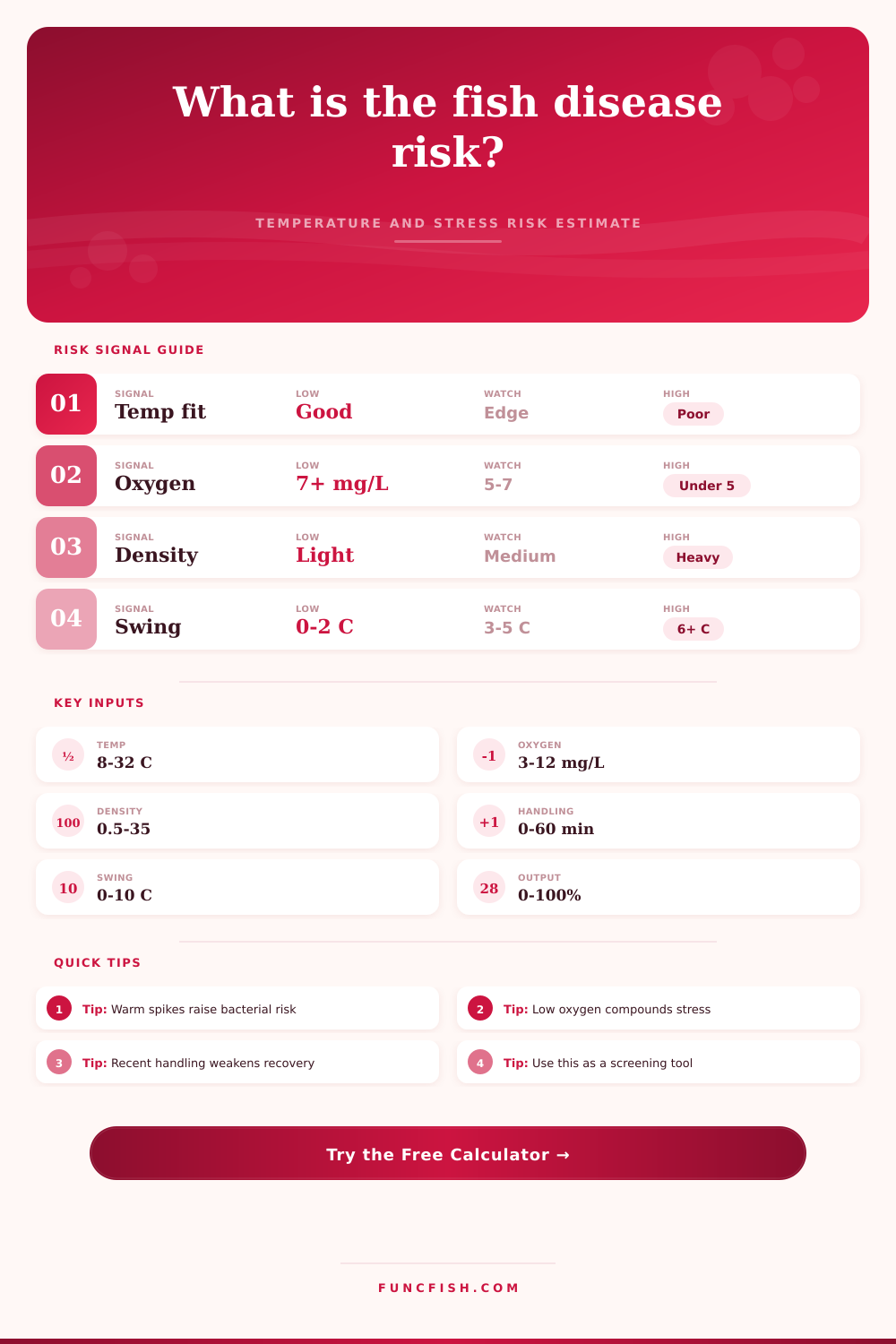
Estimate how water temperature, oxygen, density, handling, species tolerance, season, pathogen type, and recent temperature swing stack into a disease-risk score.
📌Species and condition presets
⚙Disease-risk inputs
Fish disease risk estimate
Full breakdown
🧪Species and disease grid
Rainbow trout
Salmon smolt
Walleye
Largemouth bass
Bluegill
Channel catfish
Striped bass
Common carp
Tilapia
Koi
📋Temperature, oxygen, and pathogen references
| Temperature position | Typical stress signal | Disease pressure | Calculator treatment |
|---|---|---|---|
| Inside comfort range | Normal feeding and respiration | Baseline exposure risk | Small temperature penalty |
| 1-3 C outside range | Behavioral stress begins | Opportunistic pathogens rise | Moderate temperature penalty |
| 4-6 C outside range | Recovery slows after handling | Outbreak probability rises | High temperature penalty |
| 7+ C outside range | Severe stress window | Multiple pathogen pathways | Maximum temperature penalty |
| Dissolved oxygen | Stress meaning | Risk shift | Best matching setting |
|---|---|---|---|
| 8+ mg/L | Strong oxygen reserve | Low DO penalty | Coldwater or flow-through water |
| 6-8 mg/L | Usable for most species | Light DO penalty | Stable pond or tank |
| 4-6 mg/L | Stress starts for sensitive fish | Moderate DO penalty | Summer pond, livewell, cage |
| Below 4 mg/L | Acute stress zone | High DO penalty | Algae crash or dense holding |
| Pathogen type | Temperature bias | Stress amplifier | Risk model note |
|---|---|---|---|
| General bacterial | Warm water | Low oxygen and wounds | Uses temperature plus handling |
| Flavobacterium | Warm-edge conditions | Crowding and organic load | Extra penalty near upper range |
| Fungal / Saprolegnia | Cool or swinging water | Skin damage after handling | Extra penalty for cold swing |
| Protozoan parasites | Moderate to warm water | Crowding and solids | Extra density penalty |
| Viral concern | Species and season dependent | Temperature swing | Extra swing and season weight |
| 48-hour temperature swing | Stress class | Likely effect | Calculator penalty |
|---|---|---|---|
| 0-2 C | Stable | Fish can acclimate normally | Low |
| 3-4 C | Watch | Feeding and immunity may wobble | Moderate |
| 5-6 C | Sharp shift | Stress rises after crowding | High |
| 7+ C | Severe shift | Outbreak-prone transition | Very high |
💡Practical checks
Tip: Treat a high score as an early screening flag. Confirm temperature and dissolved oxygen with fresh readings before comparing groups.
Tip: If handling, crowding, and a recent temperature swing all score high, retest the same group after the next stable water period.
The temperature of the water is an abstraction, until you see it flip them upside-down or press them up against a rock. They don’t die of heat as much as the heat makes their immune system work harder. That hard work make even the smallest scratch from net turn fatal in hours. There’s no chart of deadly limits to memorize. You just have to read your cumulative stress signals in water and compare that to the visible symptoms you’re seeing on your fish.
Above is a tool that puts all those signals together. It adds up crowding, handling time, oxygen level, and water temperature into one risk profile.
How to Keep Fish Healthy
The temperature are the controlling variable. It controls metabolism, which in turn affects everything in the water. As temperatures rise, metabolism increase. This leads to higher oxygen consumption and a faster food processing rate. Sounds great, right? Well yes, except your immune system has to works harder and germ reproduction rates increases as well. Bacteria like Flavobacterium thrive during these warm, active periods. And if your water is just a degree or two above the top end of the comfortable range for the species you have, then there isn’t much room for error. A rapid shift of just a few degrees in 48 hours or a few seconds of stress during transport can be all it takes to go from good to bad. Simply checking thermometer isn’t enough. You have to consider what your water temperature is different than the specific comfort level of fish you’re keeping.
The other side of that metabolic equation is oxygen availability. While fish require increased oxygen, warm water has less dissolved oxygen then cool water. You have a deadly squeeze on your hands. In a crowded pond or if you’re operating a recirculating system, oxygen may appear to be enough first thing in the morning. However, it may drop quickly by late afternoon because biofilters cannot keep up or algae is dying off. Oxygen suppression reduces the mucous layer on the fish skin, its main defense against parasites and fungi. Combine high density with low oxygen and you have a perfect storm for disease transmission. This pressure are factored into the calculator. In other words, the same tank that’s great with high oxygen levels becomes a danger zone once oxygen levels dips below five milligrams per liter.
These environmental factors are made worse by handling, which immediately imposes a level of acute stress. Physical abrasions occur during netting, sorting and transport and elicit a cortisol response that temporarily inhibits immune function. Add this to poor oxygen levels and/or warm water and you’ve taken away their final line of defense.
This is where the rapid temperature swing comes into play. When there’s a shift of just a few degrees within a two-day period, system goes into shock and there’s no way for the fish to acclimate. It will be volatile and often times more harmful than a consistently hot water temperature; there simply isn’t enough time for the body to adapt its enzymatic processes.
The built-in presets represent some of those everyday situations that experienced hatchery or pond fish keepers know all too well. An aquaponic greenhouse filled with Tilapia is not the same situation as one stocked with summer trout for recreational fishing. While Tilapia thrive in warmth, they struggles in cool temps. In contrast, trout are coldwater experts. As water temps climb past 18ºC, their risk spike. If you choose the right species for your situation, the numbers should of follow nature’s lead. That’s where the reference tables come into play. They unpack each species tendencies. You’ll see which pathogens responds to what conditions. For example, bacterial ulcers tend to flare up in warm, organic rich waters. Fungal issues (e.g., Saprolegnia) follow handling in cooler water.
To sum things up, it’s more of an early warning system than anything else. If your score comes back high, don’t panic. Just stop feeding, step up aeration and handle the fish less. Use it to remind yourself that there are a lot of factors at play when it comes to keeping healthy fish. In those situations where the variables line up against you, doing nothing might be the best thing you can do. Allow the water to stabilize and maintain low stress levels. This allow them to fight off infection on their own time. Keep in mind that you aren’t simply “filling a tank” but instead managing a living system. Treat the variables accordingly and they’ll repay you with resilience.