Fish Air Temperature Exposure Risk Calculator
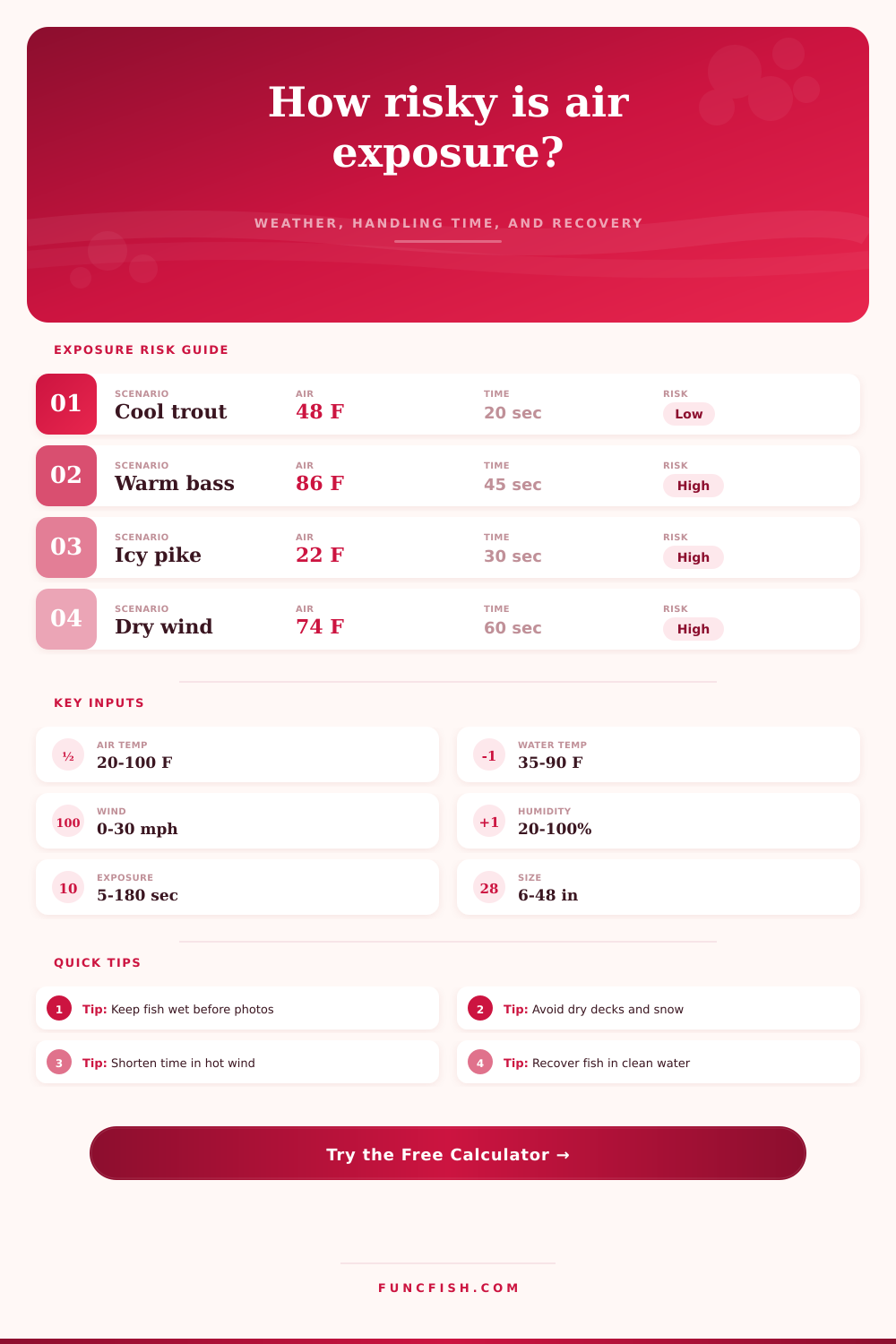
Estimate handling risk from air temperature, water temperature, wind, humidity, exposure seconds, fish size, species tolerance, contact surface, and recovery water.
📌Named exposure presets
⚙Exposure settings
This calculator is a field planning model, not a veterinary diagnosis. Lower the modeled risk by shortening air time, keeping surfaces wet, and returning fish to suitable water promptly.
Exposure risk forecast
Full breakdown
📋Species and weather grid
Coldwater Salmonids
Bass and Sunfish
Pike and Muskie
Warmwater Tough Fish
📘Reference tables
| Species group | Preferred water | Air exposure sensitivity | Best field cue |
|---|---|---|---|
| Coldwater trout | 44-60°F / 7-16°C | Very sensitive to heat and dry wind | Keep net in water until ready |
| Salmon / steelhead | 42-58°F / 6-14°C | High stress when handled warm | Short photo window |
| Walleye / perch | 50-70°F / 10-21°C | Moderate, rises in warm surface water | Wet hands and fast hook removal |
| Black bass | 60-78°F / 16-26°C | Moderate heat and contact risk | Avoid hot carpet or metal |
| Pike / muskie | 50-68°F / 10-20°C | High when large fish need long handling | Use a cradle or oversized net |
| Catfish and carp | 62-84°F / 17-29°C | Lower air sensitivity, mucus still matters | Keep body wet on a soft surface |
| Weather pattern | Drying driver | Temperature concern | Risk signal |
|---|---|---|---|
| Cool calm overcast | Low wind, higher humidity | Small air-water gap | Lowest drying pressure |
| Warm humid evening | Moist air slows drying | Warm water can limit recovery | Moderate handling window |
| Hot dry afternoon | Low humidity and heated surfaces | Air and surface both add load | High score if time exceeds 30 sec |
| Cold windy ice edge | Wind chill and freezing contact | Gill tissue can cool sharply | High for snow or ice contact |
| Gusty post-front day | Wind strips water from gills | Air gap may be modest | Drying score climbs fast |
| Contact surface | Modeled multiplier | Main hazard | Better substitute |
|---|---|---|---|
| Wet hands only | 0.82x | Grip pressure | Two-hand support |
| Rubber landing net | 0.76x | Mesh crowding | Keep net bag wet |
| Wet measuring mat | 0.90x | Delayed measuring | Pre-wet and pre-zero board |
| Boat deck or gunwale | 1.18x | Dry abrasion and heat | Wet mat or rubber net |
| Dry grass or bank | 1.26x | Debris and mucus loss | Wet sling or damp mat |
| Snow or ice contact | 1.34x | Freezing tissue contact | Wet glove or rubber net |
| Hot metal or plastic | 1.46x | Surface burn and drying | Shade and soaked mat |
| Risk score | Band | Handling interpretation | Suggested response |
|---|---|---|---|
| 0-24 | Low | Weather and timing are forgiving | Continue fast wet handling |
| 25-49 | Moderate | One driver is becoming important | Shorten photos and wet surfaces |
| 50-74 | High | Multiple stressors stack together | Unhook in net and skip delays |
| 75-100 | Severe | Air time or conditions are harsh | Keep fish in water when possible |
💡Practical tips
Tip: Set camera, pliers, and measuring board before lifting the fish. The easiest seconds to save are the seconds before handling starts.
Tip: A wet rubber net or soaked mat usually lowers modeled contact risk more than changing grip style after the fish is already out.
The wind kicks up, the lake surface turns to whitecaps, and now you have a fish on. It’s seventy five degrees out and sun is blazing down on the fiberglass deck of your boat, making it feel even warmer. Now you pick the fish up and clock begins. That’s when angler instinct can go awry.
Of course, we all think about fighting the fish, but we hardly ever consider atmospheric physics that will impact our fish the instant it leaves water. Once you plug in your local conditions, the calculator will do math for you, so you won’t have to guess at how these variables lines up with one another. Before you reach for the ruler, it’s important to know how and why it works.
How to Keep Your Fish Alive
Gills are the organs of breathing; they function only when immersed in water and depend on water to maintain separation between the breathing filaments. When air gets on them, gills close (essentially suffocating the fish), regardless of whether it has its mouth open. Low humidity or heavy winds will accelerate this closure as both rob water from the mucus layer protecting the fish’s skin from parasites and infection. Dry weather and hot metal decks makes it hard to keep that barrier from breaking down (a wet net is much easier to protect). It’s more than making the fish comfortable; it’s about keeping them alive.
In practice, the tool does break it down based off both environmental pressures as well as species tolerance. A coldwater fish such as a trout has a smaller thermal window different than a warmwater fish such as a catfish or bass. Metabolic stress is already high if you grab a trout out of water that are sixty-five degrees. Add a quick twenty seconds of hot dry air exposure, and now you’re pushing that stress into the red zone.
On the page, there’s a reference table that details how various species group together based on their preferred water temperature and how they is sensitive to air exposure. Again, not a big deal, but an important detail when what works for one species will kill another (i.e., carp vs steelhead).
It is not so much about size, but it is also not what you might think. While a larger fish has more overall mass (providing some buffering from quick temperature shifts), it also produce more body heat while fighting and requires additional time to release with care. Where a 3 pound bass could likely withstand a brief wait, a 10 pound musky would of wanted to be cradled gently rather than holding its mouth closed due to the sheer force of leverage causing bodily harm. To account for this, the calculator incorporate fish length into the risk score, acknowledging that larger is typically more difficult to handle.
And finally, there’s the last piece in the puzzle: Recovery. All that work in the fight and the lift mean nothing if you simply dump the fish back into warm, stagnant water with little oxygen. That’s why the tool checks recovery water conditions. Returning a fish to cool, flowing water provides its gills an opportunity to begin to recover and re-hydrate. This becomes even more true the higher the exposure score. Consider the recovery phase as the exhale following a prolonged period of stress. If you don’t have an exhale, the stress remain.
There’s nothing wrong with wanting the picture. Most of us do. But we shouldn’t let quality of the photograph come before well-being of the fish. It would be much better to have a fuzzy picture of a healthy, safe catch-and-release fish than a flawless portrait of a fish that died after being released.
The calculator provides a combination score so you can determine when it’s time to hang ’em up. If you’re looking at a severe or high-risk situation, put down the measuring board and send the fish straight back into the water. It’s not about eliminating all contact because we can’t. But it’s about making the most of the seconds you have together.
Wasting fewer seconds fumbling for a camera or pliers when the bite comes mean you are better prepared before it happens. Wetting your hands and nets minimizes any mucus damage. Knowing the weather conditions ahead of time allows you to see the issues instead of reacting to them. Low humidity combined with a howling wind shrinks the margin for error. And that margin is what defines a casual angler from a sustainable angler.
Ultimately, the fish you don’t catch was never going to stay with you anyway.