🎣 Fishing Reel Line Capacity Calculator
Calculate exact line yardage, spool fill, and backing needed for any reel and line combination
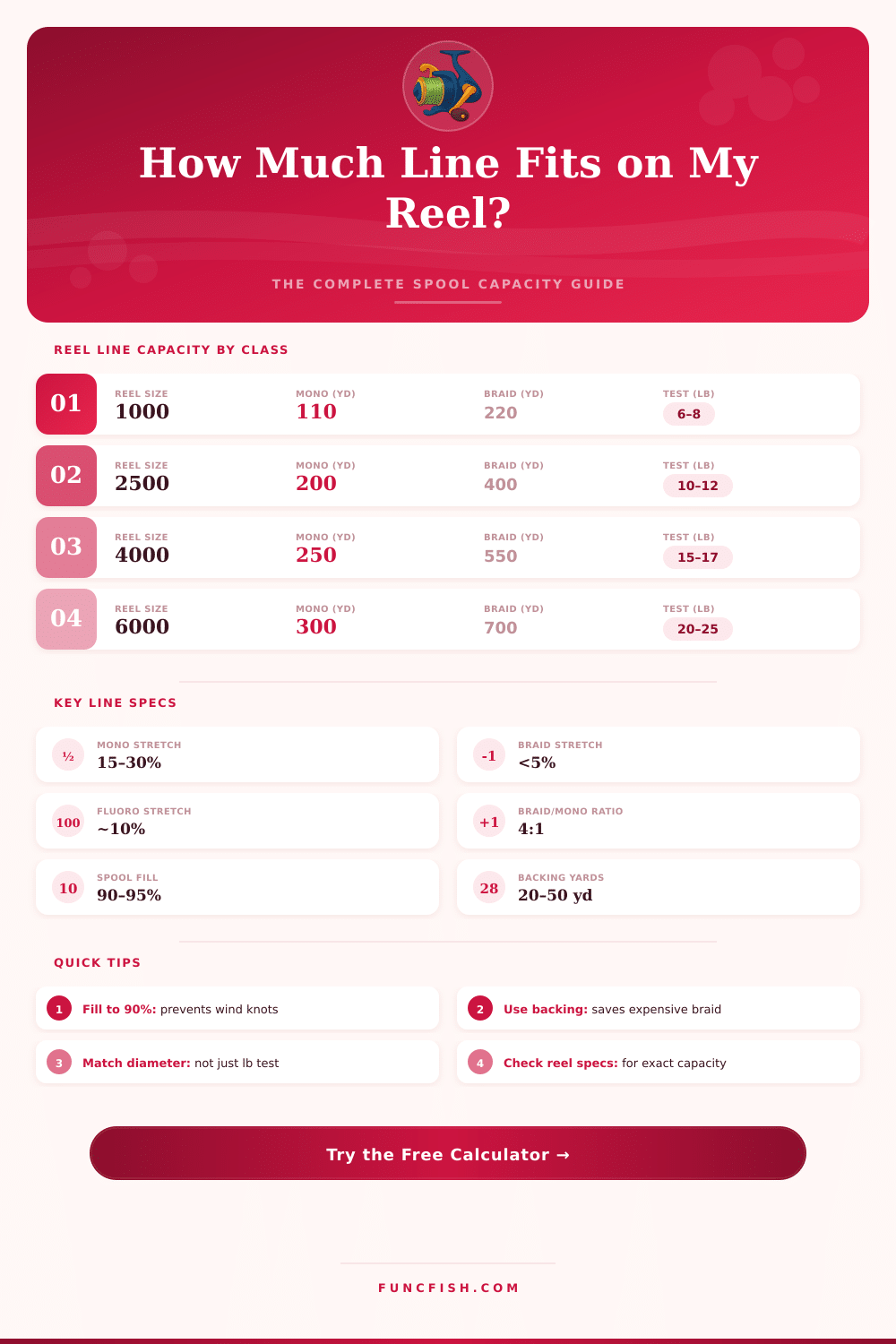
| Reel Size | Mono Capacity (yd / lb test) | Braid Capacity (yd / lb test) | Typical Use | Metric (m / kg) |
|---|---|---|---|---|
| 500 / 1000 | 110 yd / 6 lb | 220 yd / 6 lb | Panfish, Trout | 100m / 2.7kg |
| 2000 / 2500 | 200 yd / 8 lb | 400 yd / 8 lb | Bass, Walleye | 183m / 3.6kg |
| 3000 | 220 yd / 10 lb | 500 yd / 10 lb | Bass, Redfish | 201m / 4.5kg |
| 4000 | 250 yd / 12 lb | 550 yd / 15 lb | Inshore, Pike | 229m / 5.4kg |
| 5000 / 6000 | 300 yd / 17 lb | 700 yd / 20 lb | Surf, Salmon | 274m / 7.7kg |
| 8000 / 10000 | 350 yd / 20 lb | 800 yd / 30 lb | Offshore, Tuna | 320m / 9.1kg |
| Species | Typical Weight | Mono Rec. (lb) | Braid Rec. (lb) | Min. Yards Needed |
|---|---|---|---|---|
| Panfish / Bluegill | 0.25–1 lb (0.1–0.45 kg) | 2–4 lb | 4–6 lb | 75–100 yd |
| Trout (Stream) | 0.5–3 lb (0.2–1.4 kg) | 4–8 lb | 6–10 lb | 100–150 yd |
| Largemouth Bass | 1–10 lb (0.5–4.5 kg) | 10–17 lb | 20–50 lb | 150–200 yd |
| Walleye | 1–8 lb (0.5–3.6 kg) | 8–14 lb | 10–20 lb | 150–200 yd |
| Pike / Muskie | 5–30 lb (2.3–13.6 kg) | 17–25 lb | 40–80 lb | 200–250 yd |
| Catfish | 5–50 lb (2.3–22.7 kg) | 20–40 lb | 40–80 lb | 200–300 yd |
| Striped Bass (Surf) | 5–50 lb (2.3–22.7 kg) | 15–25 lb | 30–65 lb | 250–350 yd |
| Yellowfin Tuna | 50–200 lb (22.7–90.7 kg) | 50–80 lb | 80–150 lb | 400–600 yd |
| Mono Test (lb) | Mono Dia. (in / mm) | Equiv. Braid Test (lb) | Braid Dia. (in / mm) | Capacity Multiplier |
|---|---|---|---|---|
| 6 lb | 0.010 in / 0.25 mm | 10 lb braid | 0.006 in / 0.15 mm | ~2.5x more braid |
| 10 lb | 0.013 in / 0.33 mm | 20 lb braid | 0.009 in / 0.23 mm | ~2.5x more braid |
| 14 lb | 0.016 in / 0.41 mm | 30 lb braid | 0.011 in / 0.28 mm | ~2.7x more braid |
| 17 lb | 0.018 in / 0.46 mm | 40 lb braid | 0.013 in / 0.33 mm | ~2.8x more braid |
| 20 lb | 0.020 in / 0.51 mm | 50 lb braid | 0.014 in / 0.36 mm | ~3.0x more braid |
| 30 lb | 0.028 in / 0.71 mm | 65 lb braid | 0.017 in / 0.43 mm | ~3.2x more braid |
The Line Capacity of a Fishing Reel can seem like a riddle when you start but it really gets simpler when you break it into parts. At its base, Line Capacity simply means the biggest amount of line that the spool holds without packing the reel. You find that info printed somewhere on almost each reel.
Usually it is stamped to the right of the spool or on its body.
How Much Line a Fishing Reel Holds
Those numbers that you see, for instance “12/120”, show something very basic: the reel can store 120 yards of 12-pound test line. The most many makers count those values based on monofilament, which is important, because it affects how you read the specs. So, if you see a reel with mark 6/210 and 8/170, that means that it accepts either 210 yards of 6-pound line or 170 yards of 8-pound line.
Here is the spot, if your reel shows 12/120, stay in the limits of that advice to work most well. I noticed, that 10-, 12- or 14-pound test line deliver the best results, without overloading the system.
The diameter of the line quickly takes up the space on the spool. Consider a reel of size 6000, it at least stores 150 yards of 20-pound line. Even so, raising the pound test, the amount of line drops clearly.
By contrast, size 7000 fits around 200 yards of 30-pound line. It is a big difference, but heavy lines simply use the space more quikcly than lightweight.
The situation becomes interesting with braided line. The same spool, that fills with 95 yards of 10-pound braid, can sometimes double that with 4-pound braid instead. It is one of the reasons that some anglers insist to use braid for all there turning gear, the smaller diameter allows that empty spools cost only a little.
The actual capacity does not always match the claims of the maker. I saw numbers that promised 600 yards for a Fishing Reel, but the winding ended at around 545 yards. That matches 10 percent of the advertised capacity.
Such cases happen more commonly than you think, in my opinion.
Spincast reels are a whole other kind. Their spools store much less than baitcast or spinning reels of same size. Expanding them causes heavy problems, that makes them hard for many.
It is a real limit for fishing in deep waters, long casts or when fish makes a long run.
For usual work in fresh water, you rarely need more than 100 yards of line. Some anglers even get by with 50. Most fish will not pull 150 yards from your Fishing Reel, especially if it is braided.
In my experience, 200 to 300 feet is enough for most cases, unless you use light gear against big fish. That reserve is important, because you lose strong and costly line. If you pull 20 metres of line from a spool with only 100 metres, you have 80 metres left.
Notwell.