🐟 Fishing Knot Strength Calculator
Calculate knot breaking strength, efficiency rating & get the best knot for your setup
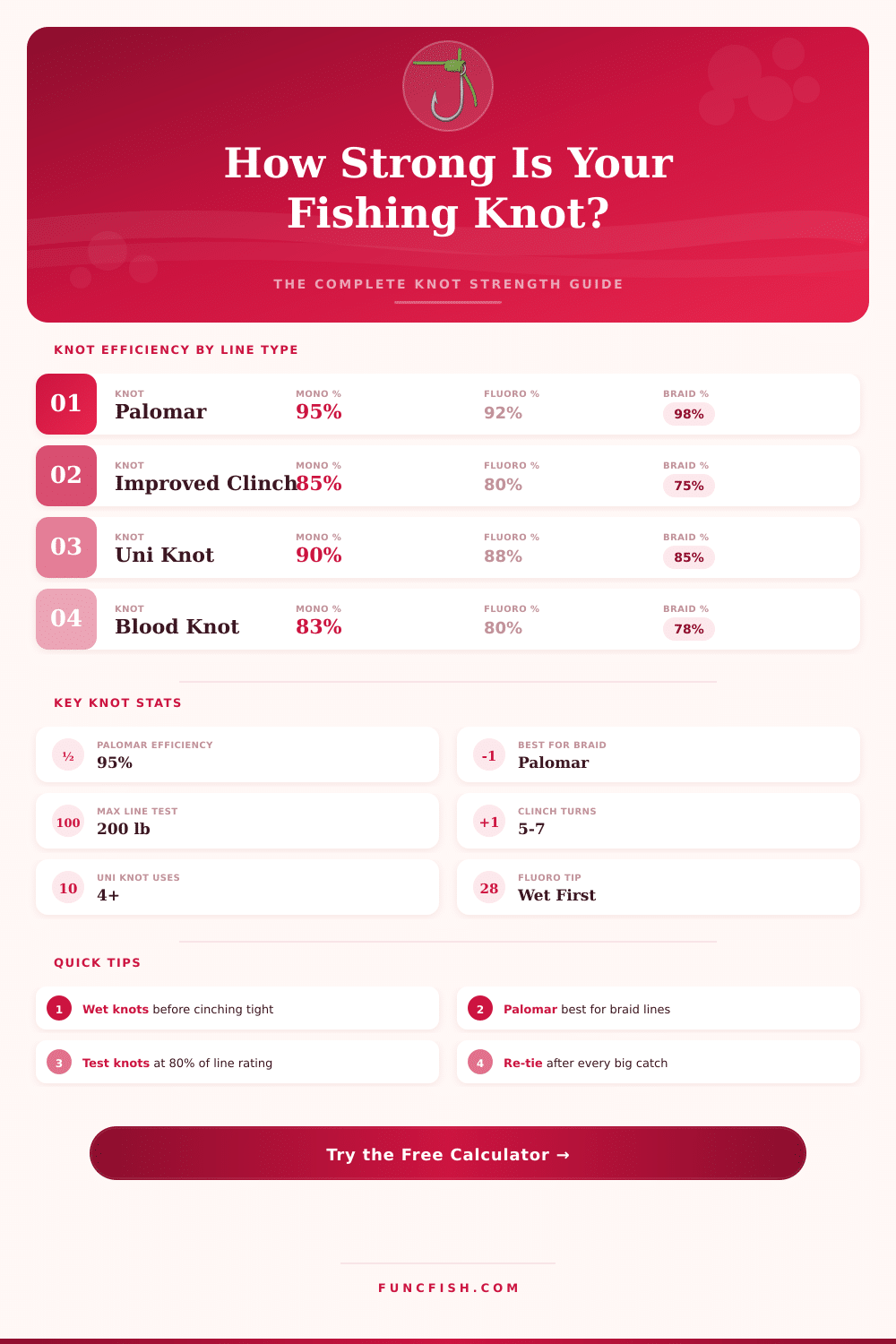
| Knot Name | Monofilament | Fluorocarbon | Braid | Best Use |
|---|---|---|---|---|
| Palomar | 95% | 92% | 98% | Terminal tackle, all lines |
| Improved Clinch | 85% | 80% | 75% | Mono & fluoro to lures |
| Uni Knot | 90% | 88% | 85% | Versatile, all lines |
| FG Knot | 90% | 88% | 95% | Braid-to-leader connection |
| Alberto Knot | 88% | 92% | 90% | Braid-to-fluoro leader |
| Bimini Twist | 99% | 98% | 99% | Double-line loops, offshore |
| Blood Knot | 83% | 80% | 78% | Line-to-line joining |
| Surgeon's Knot | 88% | 85% | 82% | Quick line-to-leader |
| Double Uni | 87% | 85% | 88% | Line-to-line, all types |
| Loop-to-Loop | 92% | 90% | 95% | Leader system connection |
| Species | Typical Weight | Rec. Line Test | Best Knot | Min Knot Strength |
|---|---|---|---|---|
| Panfish / Bluegill | 0.25–1 lb (0.1–0.45 kg) | 2–6 lb (0.9–2.7 kg) | Improved Clinch | 1.7–5.1 lb |
| Trout (stream) | 0.5–5 lb (0.2–2.3 kg) | 4–8 lb (1.8–3.6 kg) | Palomar / Uni | 3.4–6.8 lb |
| Bass (largemouth) | 2–12 lb (0.9–5.4 kg) | 10–20 lb (4.5–9 kg) | Palomar | 8.5–17 lb |
| Walleye | 1–10 lb (0.45–4.5 kg) | 6–14 lb (2.7–6.4 kg) | Uni / Double Uni | 5.1–11.9 lb |
| Northern Pike | 5–30 lb (2.3–13.6 kg) | 17–30 lb (7.7–13.6 kg) | Alberto / FG | 14.5–25.5 lb |
| Catfish (channel) | 2–40 lb (0.9–18 kg) | 20–60 lb (9–27.2 kg) | Palomar / Uni | 17–51 lb |
| Striped Bass | 5–50 lb (2.3–22.7 kg) | 15–40 lb (6.8–18 kg) | Bimini / FG | 12.75–34 lb |
| Offshore (tuna) | 50–300 lb (22.7–136 kg) | 50–150 lb (22.7–68 kg) | Bimini Twist | 42.5–127.5 lb |
| Line Type | Stretch | Abrasion Resist. | Visibility | Knot Ease |
|---|---|---|---|---|
| Monofilament | 25–30% | Good | Moderate | Easy |
| Fluorocarbon | 15–20% | Excellent | Near Invisible | Moderate |
| Braided Line | <5% | Very Good | High | Moderate |
| Copolymer | 20–25% | Very Good | Low | Easy |
| Wire Leader | <1% | Excellent | High | Difficult |
| Nanofil | <3% | Good | Low | Moderate |
| Superline | <5% | Very Good | Moderate | Moderate |
| Lead Core | 5–10% | Good | Colored | Difficult |
The strength of a fishing knot matters much more than many folks believe. If a fishing knot holds only eighty percent of the strength of the line, then a ten pound line will really break at only eight pounds. This gap can cause loss of fish.
Surprisingly many anglers never bother to test their own knots, even during contests with prizes on the line.
Make Your Fishing Knots Strong
Changing from a Double-Uni knot to an FG knot for the link between line and leader gave in one case thirty percent more strength. The FG knot is also a lot slimmer and without any bump, so it slips easily through the gudies of the rod during every cast. Many other knots are simply too thick for such flow.
Among the commonly used and tough knots is the Palomar knot. It works well for braided and mono lines and ties pretty easily. Bass anglers really like it during fishing in dense cover.
When you tie it to a hook, make sure to draw the loop against the line instead of directly too the eye of the hook itself, that can boost the fishing knot a bit.
Another reliable choice is the Uni knot. It works well with mono and braided lines, and has many uses, from hooks to swivels and leaders. Knots like Palomar, Uni, San Diego Jam, World Fair, Uni Cross and Centauri all can reach full strength of the line, if you tie them right.
Braided lines need more wraps or longer paths to stay flat under load. Tight curves focus the tension in the line. If you spread the curve over a longer step, like in the FG knot, that helps to keep the strength of the line, especially with a hard leader.
For mono lines a Bimini twist with only eight turns can reach more than ninety percent of fishing knot strength.
Different lines with different test ratings can cause different results for one same knot. Keep that in mind. A fishing knot that works great for thin line might fail with thick.
When lines pass eighty pounds in test, crimps become more useful than knots.
Wetting the fishing knot before pulling it tight is good practice. Spit works for this. No knot beats the strength of the line it ties to.
If the line holds fifteen pounds and the fishing knot eighty percent, it will break at thirteen point five pounds. To reach full fifteen, you must use a stronger main line. Even the best fishing knot in the world does not help if it is not tied right, so practice is justas important as the choice of knot.