🌡️ Fish Hawk Water Temperature Calculator
Convert readings, apply depth corrections & get fish activity forecasts for your Fish Hawk probe
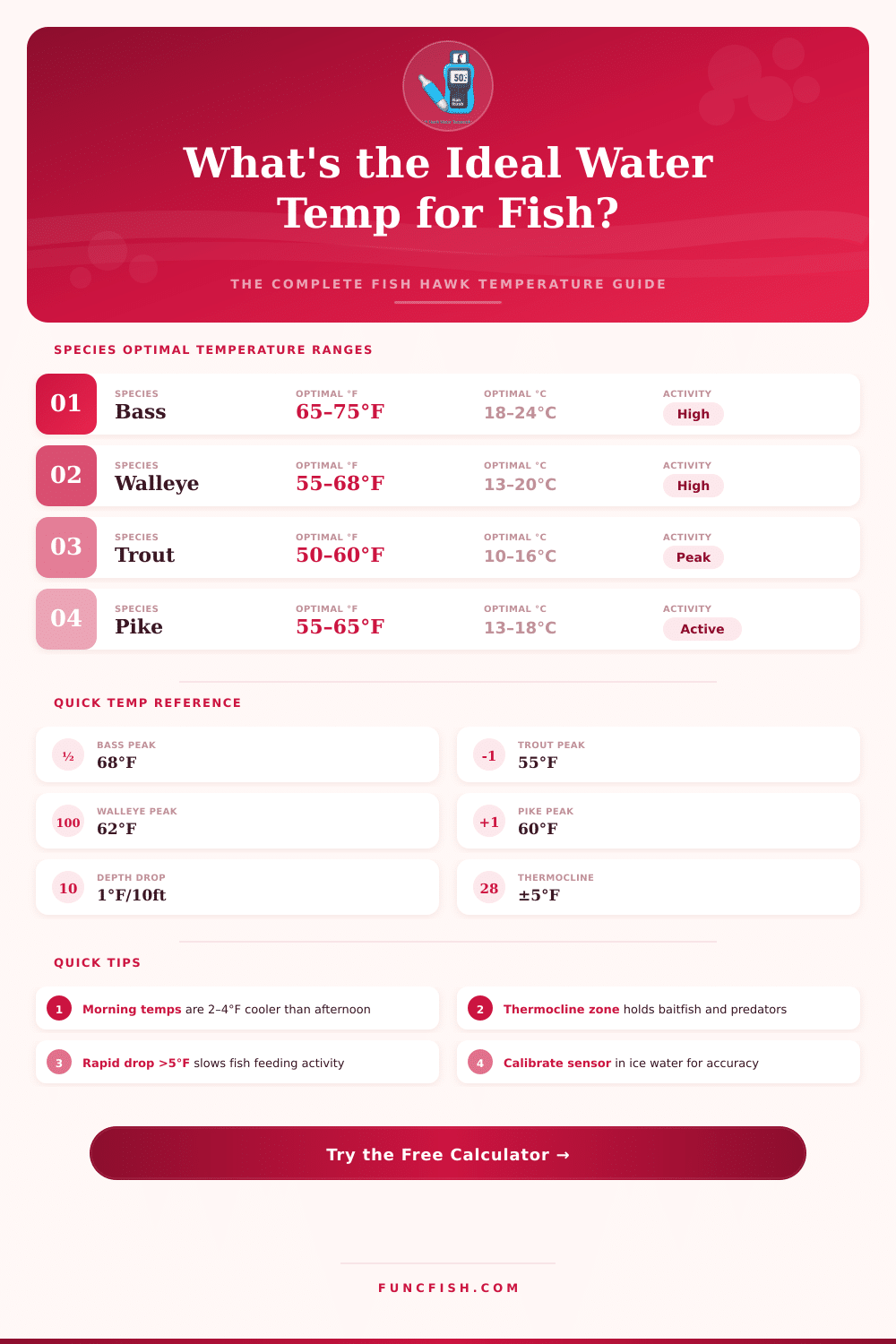
| Species | Optimal °F | Optimal °C | Stress Below | Stress Above | Activity Level |
|---|---|---|---|---|---|
| Largemouth Bass | 65–75°F | 18–24°C | 50°F / 10°C | 85°F / 29°C | High |
| Smallmouth Bass | 60–72°F | 16–22°C | 48°F / 9°C | 80°F / 27°C | High |
| Walleye | 55–68°F | 13–20°C | 40°F / 4°C | 75°F / 24°C | Peak |
| Brown Trout | 52–63°F | 11–17°C | 35°F / 2°C | 70°F / 21°C | Peak |
| Rainbow Trout | 50–60°F | 10–16°C | 34°F / 1°C | 68°F / 20°C | Peak |
| Chinook Salmon | 44–58°F | 7–14°C | 33°F / 1°C | 65°F / 18°C | High |
| Northern Pike | 55–65°F | 13–18°C | 38°F / 3°C | 75°F / 24°C | Active |
| Muskie | 60–70°F | 16–21°C | 40°F / 4°C | 80°F / 27°C | Active |
| Bluegill / Panfish | 68–78°F | 20–26°C | 50°F / 10°C | 88°F / 31°C | High |
| Yellow Perch | 58–68°F | 14–20°C | 35°F / 2°C | 75°F / 24°C | Active |
| Catfish | 70–84°F | 21–29°C | 50°F / 10°C | 90°F / 32°C | High |
| Steelhead | 48–58°F | 9–14°C | 33°F / 1°C | 65°F / 18°C | Peak |
| Depth (ft) | Depth (m) | Approx Temp Drop (°F) | Approx Temp Drop (°C) | Notes |
|---|---|---|---|---|
| 0–10 ft | 0–3 m | 0–1°F | 0–0.5°C | Surface mixed zone |
| 10–20 ft | 3–6 m | 1–3°F | 0.5–1.5°C | Epilimnion base |
| 20–35 ft | 6–11 m | 3–8°F | 1.5–4.5°C | Thermocline zone |
| 35–50 ft | 11–15 m | 8–15°F | 4.5–8.5°C | Thermocline base |
| 50–80 ft | 15–24 m | 15–22°F | 8.5–12°C | Hypolimnion |
| 80–120 ft | 24–37 m | 22–28°F | 12–16°C | Deep cold zone |
| 120+ ft | 37+ m | 28–35°F | 16–20°C | Near-constant cold |
| Model | Temp Accuracy | Max Depth | Speed Sensor | Display Range | Battery |
|---|---|---|---|---|---|
| Fish Hawk X4D | ±0.5°F | 300 ft / 91 m | Yes (0–9.9 mph) | –10 to 200°F | AA x2 |
| Fish Hawk X4 | ±0.5°F | 250 ft / 76 m | Yes (0–9.9 mph) | –10 to 200°F | AA x2 |
| Fish Hawk TD | ±1°F | 200 ft / 61 m | No | 0 to 200°F | AA x2 |
| Fish Hawk 400 | ±1°F | 150 ft / 46 m | No | 0 to 180°F | 9V x1 |
| Fish Hawk SP8 | ±0.5°F | 200 ft / 61 m | Yes (0–9.9 mph) | –10 to 200°F | AA x2 |
| Fish Hawk Ultra | ±0.5°F | 300 ft / 91 m | Yes (0–9.9 mph) | –10 to 200°F | AA x4 |
| Generic Digital | ±1–2°F | Varies | No | Varies | Varies |
| Analog Sensor | ±2–5°F | Limited | No | Dial gauge | None |
Water Temperature plays a big role in fishing. Every species of Fish favors a certain range of Water Temperature. Think of Water Temperature as a base for the pattern of the Fish.
By using the favorite Water Temperature one can quickly remove bad parts of the water and focus on the right places.
How Water Temperature Affects Fish
Fish are cold-blooded creatures, so they slow their body functions in cold water. Water is densest at 38 degrees, so the depth usually stays at that temperature, even if the surface is freezing. Fresh water never cools under 32 degrees Fahrenheit, so the air temperature does not affect past that limit.
During winter, Fish tend to move deep, where the water is fairly warmer. In summer, one finds them at the layers of temperature in the water.
The surface temperatures can really cheat in some seasons. After two straight warm nights and days, the surface water can warm up six to seven degeres without problem. Remember that before trusting fast readings.
About bass, old fishing books usually claimed that bass spawn at exactly 68 degrees. That created the idea that one must travel around the lake to find the ideal temperature, that then would attract all Fish over there. But reality does not work like this.
When the spawning happens, bass leave their nests, and later start periods of strong activity. This lasts the whole summer and belongs to the best moments for fishing in the year, when the Water Temperature moves between 70 and 75 degrees. When the water passes 50 degrees, the fishing becomes clearly good.
Under that level, active Fish are still present, but it becomes much more difficult.
During summer, the Water Temperature almost does not affect bass. It is warm, but bass do not change their behavior, whether the water stands at 80 or 90 degrees. The clarity of the water, the weather and the strength of the light become much more important.
Even so, warm water does not hold enough oxygen that Fish require. If it gets too warm and the oxygen drops, the Fish struggle and become still.
Trout form another case. The temperature is key, because it decides weather trout can stay in the water to be caught. If too warm, they move to search for cold water.
When the Water Temperature passes 65 degrees Fahrenheit, best to pack up the trout gear. Around 70 degrees widely marks the upper limit for rainbow trout. Above that, the danger of sudden death grows fast.
Brown trout have traveled 30 miles down the river to find cold water, when the temperatures reach the 70-degree range.
One can measure the Water Temperature with a simple thermometer. Infrared thermometers that read surface temperatures are very handy. Most thermometers for boats measure only some inches under the surface, which works well.
A cast thermometer from the bank of thewater still does not give readings that describe the whole water body.