🐟 Fish Farm Feed Calculator
Calculate daily & weekly feed requirements for your aquaculture operation by species, biomass, and feeding rate
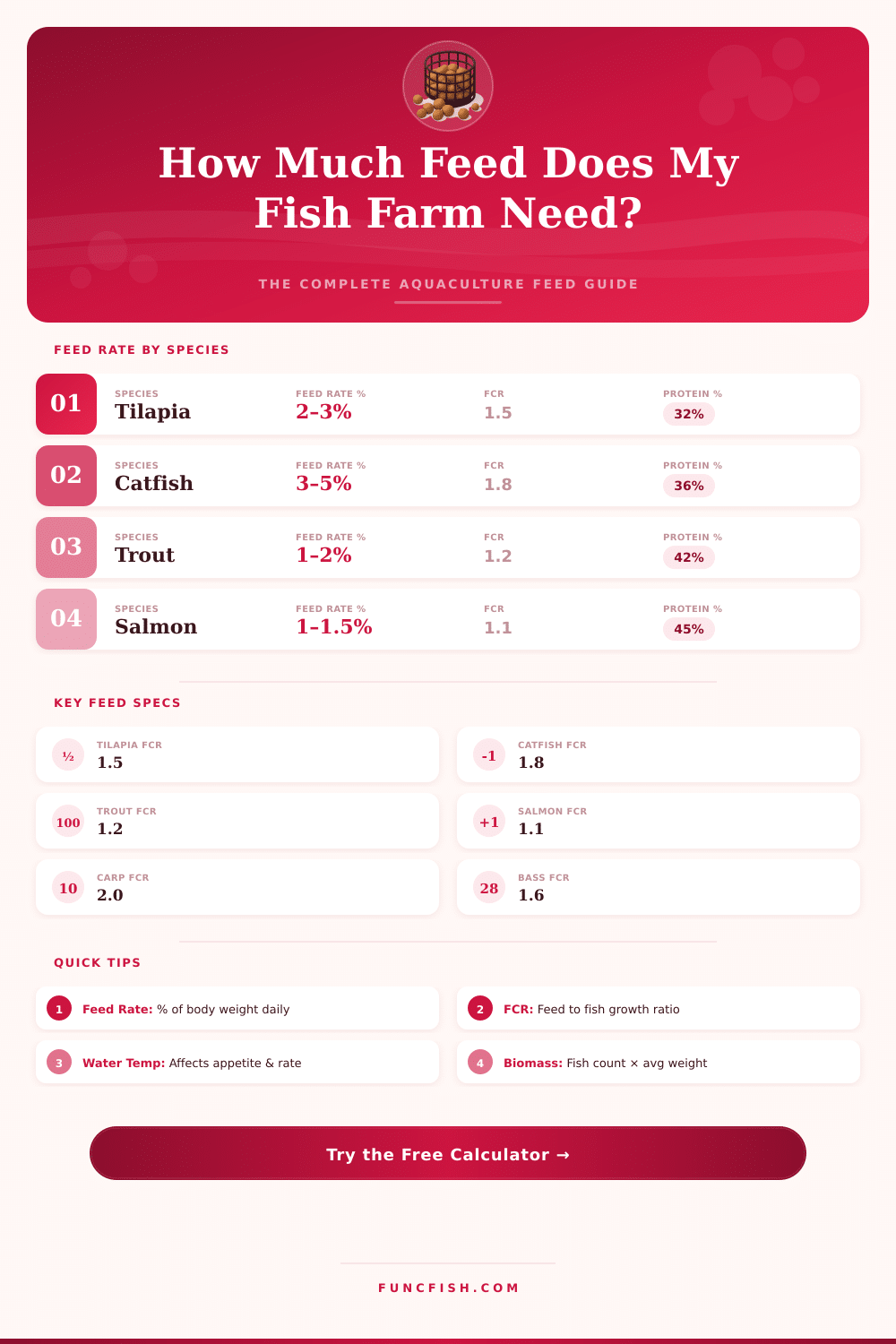
| Species | Daily Feed Rate (%BW) | FCR | Protein Req. (%) | Optimal Temp °F (°C) |
|---|---|---|---|---|
| Tilapia | 2–3% | 1.5 | 32–36% | 77–86°F (25–30°C) |
| Channel Catfish | 3–5% | 1.8 | 32–36% | 75–85°F (24–29°C) |
| Rainbow Trout | 1–2% | 1.2 | 40–45% | 55–65°F (13–18°C) |
| Atlantic Salmon | 1–1.5% | 1.1 | 44–50% | 50–60°F (10–16°C) |
| Common Carp | 2–4% | 2.0 | 28–35% | 68–82°F (20–28°C) |
| Largemouth Bass | 1.5–3% | 1.6 | 40–45% | 65–80°F (18–27°C) |
| Pacific White Shrimp | 4–6% | 1.8 | 35–40% | 75–90°F (24–32°C) |
| Stage | Avg. Body Weight (lb / g) | Feed Rate (%BW) | Feed Freq. / Day | Pellet Size |
|---|---|---|---|---|
| Starter (Fry/PL) | <0.02 lb / <10 g | 8–15% | 4–6x | 0.5–1 mm |
| Fingerling | 0.02–0.1 lb / 10–50 g | 4–8% | 3–4x | 1–2 mm |
| Grower | 0.1–0.5 lb / 50–230 g | 2–4% | 2–3x | 2–4 mm |
| Finisher | >0.5 lb / >230 g | 1–2% | 1–2x | 4–8 mm |
| Water Temp °F | Water Temp °C | Activity Level | Feed Adjustment |
|---|---|---|---|
| Below 50°F | Below 10°C | Very Low | Reduce 50–100% |
| 50–60°F | 10–16°C | Low | Reduce 30–50% |
| 60–70°F | 16–21°C | Moderate | Reduce 10–20% |
| 70–85°F | 21–29°C | Optimal | No adjustment (1.0x) |
| 85–95°F | 29–35°C | Reduced | Reduce 10–25% |
| Above 95°F | Above 35°C | Stressed | Reduce 50–75% |
Fish farming, or simply fish farming, ranks among the most quickly growing branches of food production. It grows more fast than the industries of meat and poultry. Intensive farmed fish receive made Feed rather than wild fish that search for their own food.
Such Feed forms a key part in modern commercial fish farming because they give the farmed fish the daily nutritious balance, that is needed for their health.
Why Fish Farm Feed Is Important
Feed for fish commonly appear as pellets or pills. They provide food in solid and dense state. That helps the fish eat well and reach their maximum size.
To grow well, fish need a balanced mix of key parts, like amino acids, fat acids and vitamins. When fish eat bad, they simply will not grow and stay weak.
Here is something that could surprise you. The main part in many Fish Farm Feed is actually other kinds of fish. Fish meal from anchovies or similar small fish deliver main protein and fat for commercial Feed.
Over years, those materials were used mostly in Feed for pigs and birds. Even so, the world growth of fish farming during teh last twenty years caused growing transfer of those resources straight to the making of Fish Farm Feed.
Atlantic salmon now is seen as the most efficient of the farmed food products, thanks too years of studies about its specific nutritious needs. It usually requires only 1.15 kg of Feed to gain 1 kg of weight. Pigs require more than double that, while sheep require almost six times that much.
Compared to other farmed animals, fish give high output in harvest.
Some farmed Fish Farm Feed aims to reach market weight as quickly as possible, similar to energy-rich fast food. They focus on short-term growth, but do not truly answer for long-term health in the most many species. Rather, present Feed also includes helpful extras like prebiotics, probiotics, natural fat acids and antioxidants, that helps to improve both health and growth.
Worldwide, fish farming uses half a metric ton of wild whole fish to produce one metric ton of farmed seafood. So, it actually acts as a net producer of fish protein. Although 94% of the world fish supplies already are fully used or overused, the sector works on new options like algae oil, insect Feed and protein from fermented sources.
For instance, algae oil can replace fish oil in Feed for farmed Atlantic salmon without reducing the growth. There are also species-specific Feed, like that for catfish, blue gill, largemouthbass and colored koi fish, that helps to keep their color. The mix of Feed is key, because more marine oil strengthens omega-3 levels, while plant-based Feed changes the balance of fat acids.