🎣 Fishing Rod Test Curve Calculator
Find the ideal test curve rating for your target species, technique, and fishing conditions
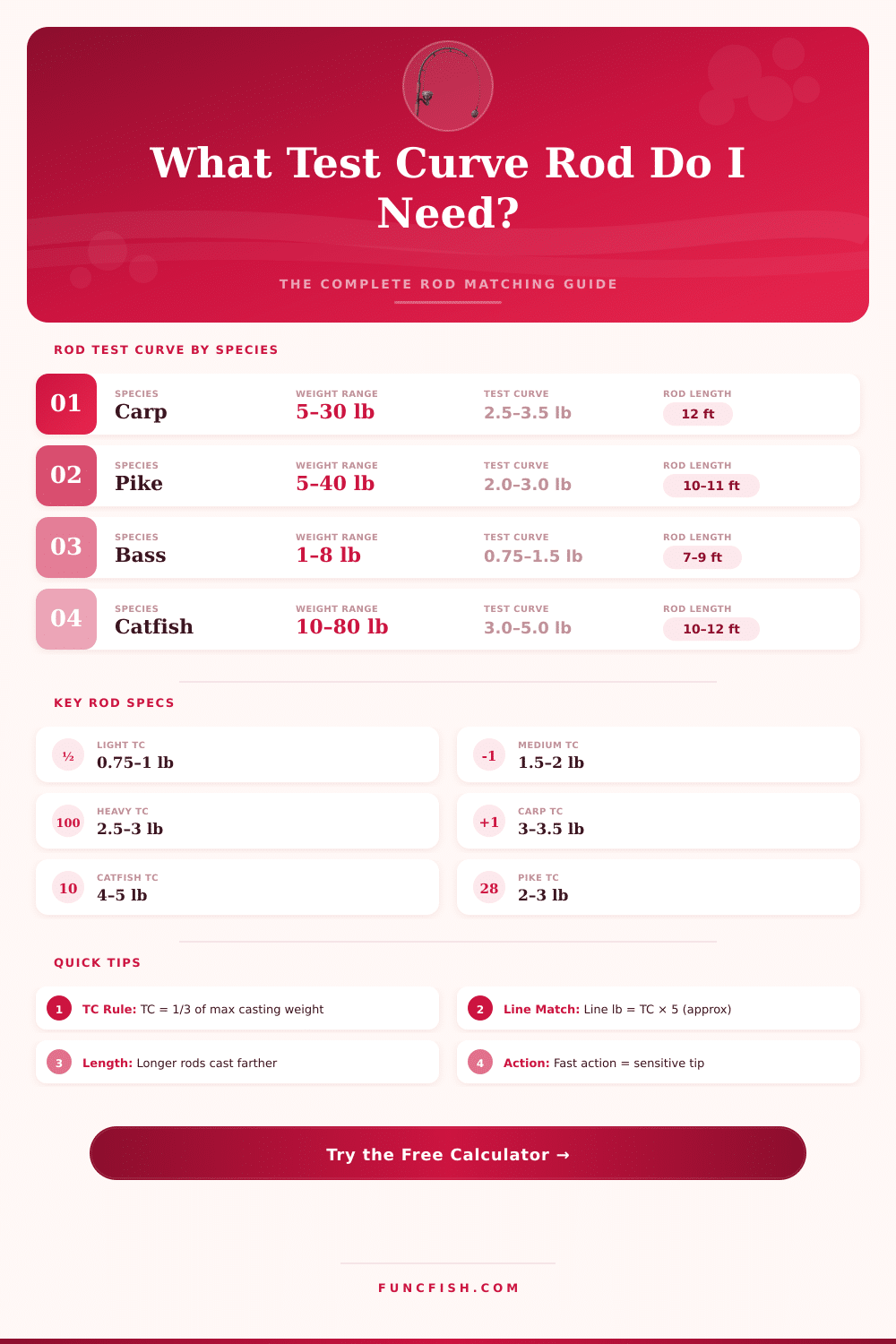
| Species | Typical Weight | Recommended TC (lb) | TC (kg) | Rod Length | Action |
|---|---|---|---|---|---|
| Common Carp | 5–30 lb | 2.5–3.5 lb | 1.13–1.59 kg | 12 ft | Medium |
| Pike | 5–40 lb | 2.0–3.0 lb | 0.91–1.36 kg | 10–11 ft | Medium-Fast |
| Largemouth Bass | 1–10 lb | 0.75–1.5 lb | 0.34–0.68 kg | 7–8 ft | Fast |
| Channel Catfish | 10–60 lb | 3.0–5.0 lb | 1.36–2.27 kg | 10–12 ft | Medium |
| Rainbow Trout | 0.5–8 lb | 0.5–1.0 lb | 0.23–0.45 kg | 8–10 ft | Fast |
| Walleye | 1–12 lb | 1.0–1.75 lb | 0.45–0.79 kg | 6.5–8 ft | Medium-Fast |
| Striped Bass (Surf) | 10–50 lb | 3.5–5.5 lb | 1.59–2.49 kg | 12–14 ft | Medium |
| Bluegill/Panfish | 0.1–1.5 lb | 0.25–0.5 lb | 0.11–0.23 kg | 4–6 ft | Slow |
| Offshore Billfish | 50–200 lb | 4.5–6.0 lb | 2.04–2.72 kg | 6–8 ft | Fast |
| Brown Trout (Fly) | 0.5–5 lb | 0.5–0.75 lb | 0.23–0.34 kg | 8–10 ft | Medium-Fast |
| TC Rating (lb) | TC Rating (kg) | Min Line (lb) | Max Line (lb) | Max Lead (oz) | Technique |
|---|---|---|---|---|---|
| 0.25–0.5 lb | 0.11–0.23 kg | 2 lb | 4 lb | 0.25–0.5 oz | Ultralight |
| 0.5–1.0 lb | 0.23–0.45 kg | 4 lb | 8 lb | 0.5–1.5 oz | Light spinning |
| 1.0–1.75 lb | 0.45–0.79 kg | 8 lb | 15 lb | 1–3 oz | Medium spinning |
| 1.75–2.5 lb | 0.79–1.13 kg | 12 lb | 20 lb | 2–4 oz | Medium-heavy |
| 2.5–3.5 lb | 1.13–1.59 kg | 15 lb | 30 lb | 3–6 oz | Carp / feeder |
| 3.5–5.0 lb | 1.59–2.27 kg | 25 lb | 50 lb | 5–10 oz | Heavy / surf |
| 5.0–6.0 lb | 2.27–2.72 kg | 40 lb | 80 lb | 8–16 oz | Offshore / big game |
| Material | Modulus | Sensitivity | Weight | TC Factor | Best Use |
|---|---|---|---|---|---|
| Nano-Carbon (IM12) | Very High | Excellent | Very Light | 0.92 | Precision casting |
| High-Mod Carbon (IM8+) | High | Very Good | Light | 0.95 | Lure, spinning |
| Mid-Mod Carbon (IM6) | Medium | Good | Medium | 1.0 | All-round |
| Low-Mod Carbon | Low-Med | Moderate | Medium | 1.05 | Budget carp, beach |
| Carbon-Glass Composite | Medium | Moderate | Medium-Heavy | 1.08 | Feeder, float |
| Fibreglass | Low | Low | Heavy | 1.15 | Boat, trolling |
| Boron-Carbon | Very High | Excellent | Light | 0.90 | Big game, jigging |
| Bamboo / Cane | Very Low | Unique | Variable | 1.25 | Fly fishing, heritage |
The test curve of a fishing rod helps to guess its strength. In its base it points how much weight must be used to bend the rod tip down to a 90-degree corner from the handle, while the handle stays held level. Like this, a fishing rod with a 3-pound test curve needs 3 pounds of force to reach that bend.
It seems simple, but it really deals with more than just that number.
How the Test Curve Affects a Fishing Rod
test curve shows the full potential of a fishing rod. It affects how the fishing rod acts in different fishing situations. Here is the spot: two rods with the same test curve can feel entirely differently.
One maybe has soft, giving action, that cushions sudden pulls of fish beside the net. The otehr can seem more rigid and good for casting long distances. Also the action and the length of a fishing rod matters a lot.
For carp fishing, most rods sit between 2.5 and 3.5-pound test curve. Rods in that range work well for almost every carp fisherman. A fishing rod with 2 to 2.5-pound test curve works for smaller carp.
For bigger carp, something in the 3 to 3.5-pound range is better. Even so, test curve does not exactly point the maximum size of fish, that won can land. Carps above 30 pounds already were caught with 2.5-pound test curve rods without any trouble.
The choice of test curve depends mostly on the place and style of your fishing. Do you fish in a small pool? A 2.5-pound fishing rod works well.
Do you fish in big water, where you need to cast heavy leads or method feeders long away? A 3-pound or higher test curve fishing rod works more. For stalking and surface fishing, a fishing rod with 1.5 or 1.75-pound test curve in Avon or barbel style forms a good option.
Rods of around 10 to 12 feet with 2.5 to 3-pound test curve work for margin fishing or use of bait boats. Long rods between 12 and 13 feet with 3.5-pound test curve well handle big waters and heavy casts. Rods with higher test curve are built for distance, but they take from the fun, when one plays the fish with the fishing rod.
Rods with higher test curve usually are made for bigger or harder fish, and they have bigger rings forheavy lines and longer handles.
There is an old rule, that suggests multiplying the test curve by five to find the right line strength. A 2-pound test curve fishing rod then would mean a 10-pound line. But in real use it does not work like this.
The right line strength depends more on the action and length of the fishing rod than just on that test curve number. A fishing rod with 2.75-pound test curve feels less stiff and gives more fun during play with fish, compared to a heavier 3.5-pound fishing rod, that mostly helps to cast big feeders.