🎣 Fishing Reel Backing Calculator
Calculate exactly how much backing line you need for any reel, species, and fishing scenario
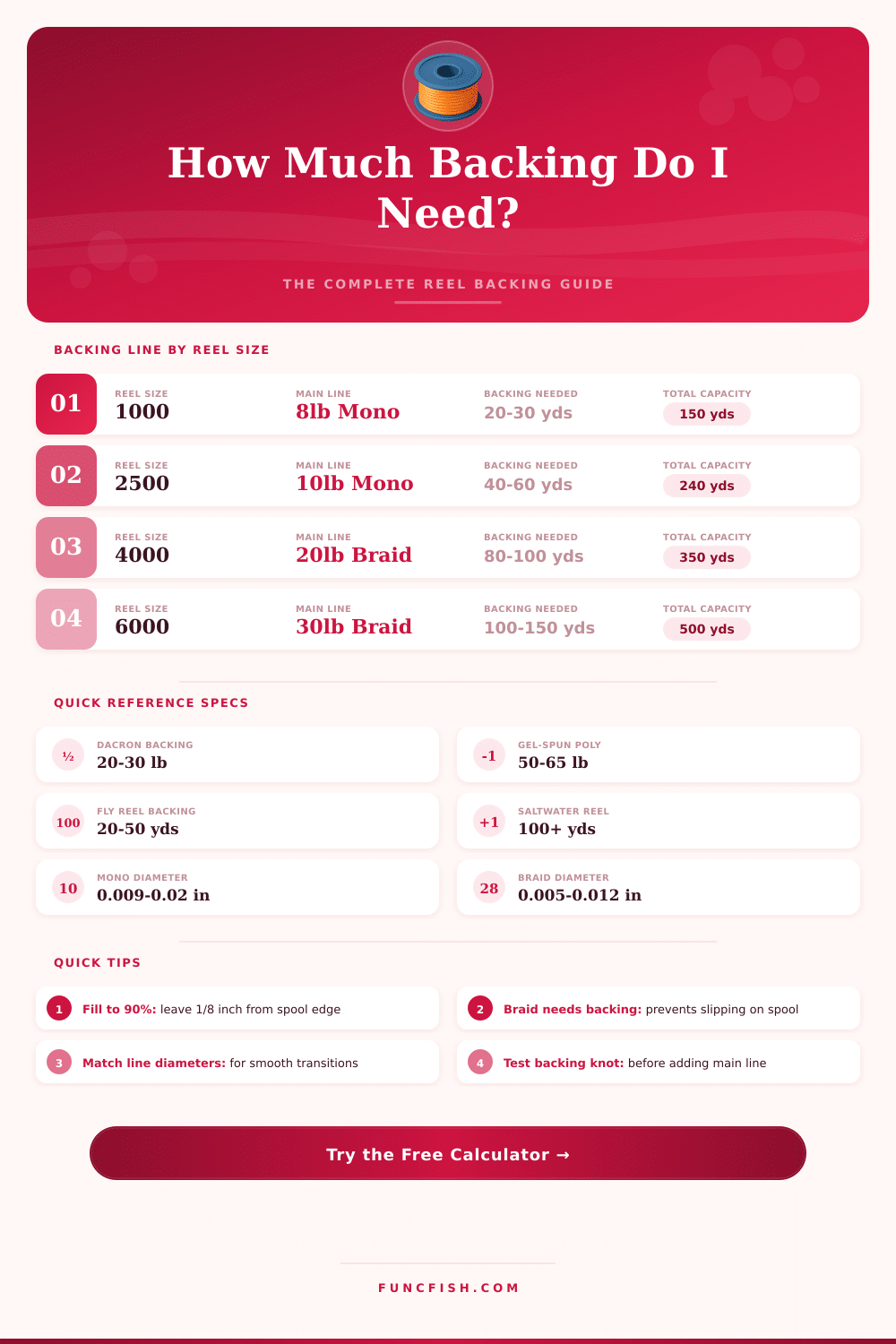
| Reel Size | Capacity (10lb Mono) | Capacity (20lb Braid) | Typical Backing (yds) | Recommended Backing Type |
|---|---|---|---|---|
| 1000 / Ultralight | 100 yds (91 m) | 130 yds (119 m) | 15–25 yds | Mono or Braid |
| 2000–2500 / Light | 170 yds (155 m) | 220 yds (201 m) | 25–50 yds | Mono or Braid |
| 3000–3500 / Med-Light | 240 yds (219 m) | 300 yds (274 m) | 40–70 yds | Dacron or Braid |
| 4000–4500 / Medium | 300 yds (274 m) | 400 yds (366 m) | 60–100 yds | Dacron or Braid |
| 5000–6000 / Med-Heavy | 380 yds (347 m) | 500 yds (457 m) | 80–130 yds | Dacron or Gel-Spun |
| 8000–10000 / Heavy | 500 yds (457 m) | 700 yds (640 m) | 100–180 yds | Gel-Spun or Hollow Core |
| Target Species | Typical Weight | Main Line | Backing Strength | Backing Length |
|---|---|---|---|---|
| Panfish / Crappie | 0.5–2 lb (0.2–0.9 kg) | 4–6 lb mono | 6–10 lb | 10–20 yds (9–18 m) |
| Trout (Stream) | 0.5–4 lb (0.2–1.8 kg) | 4–8 lb mono | 10–20 lb Dacron | 20–50 yds (18–46 m) |
| Bass (Largemouth) | 2–10 lb (0.9–4.5 kg) | 10–20 lb mono/braid | 15–20 lb | 30–60 yds (27–55 m) |
| Walleye | 2–8 lb (0.9–3.6 kg) | 8–14 lb mono/braid | 15–20 lb | 30–60 yds (27–55 m) |
| Pike / Musky | 5–40 lb (2.3–18 kg) | 20–65 lb braid | 20–30 lb | 50–100 yds (46–91 m) |
| Salmon / Steelhead | 8–30 lb (3.6–14 kg) | 12–20 lb mono | 20–30 lb Dacron | 50–100 yds (46–91 m) |
| Striped Bass | 10–60 lb (4.5–27 kg) | 20–50 lb braid | 30–50 lb | 75–150 yds (69–137 m) |
| Offshore (Tuna/Mahi) | 20–200+ lb (9–90+ kg) | 50–130 lb braid | 50–100 lb | 100–300 yds (91–274 m) |
| Fly Line Weight | Target Species | Fly Line Length | Backing Strength | Typical Backing |
|---|---|---|---|---|
| 1–3 wt | Small Trout / Panfish | 75–80 ft (22–24 m) | 12–20 lb Dacron | 15–30 yds (14–27 m) |
| 4–5 wt | Trout / Small Bass | 80–90 ft (24–27 m) | 20 lb Dacron | 25–50 yds (23–46 m) |
| 6–7 wt | Bass / Salmon | 90–100 ft (27–30 m) | 20–30 lb Dacron | 50–100 yds (46–91 m) |
| 8–9 wt | Steelhead / Saltwater | 90–100 ft (27–30 m) | 30 lb Dacron / Gel-Spun | 100–200 yds (91–183 m) |
| 10–12 wt | Tarpon / Big Offshore | 90–100 ft (27–30 m) | 30–65 lb Gel-Spun | 150–300 yds (137–274 m) |
The Backing in fishing is a layer of material that protects the spool before the main Fishing Reel line comes in play. It sits between the spool itself and the main line that one uses for actual fishing. There are several useful reasons for its use, and it works somewhat differently depending on the kind of fishing; whether fly fishing or spin fishing with baitcasting.
In fly fishing, the Backing extends the whole amount of line on the spool. The fly line itself is quite thick so that it barely reaches 25 yards on a spool. When a big fish pulls hard, that simply does not suffice.
What Backing Is and Why You Need It
Thin Backing adds easily 100 yards or even more. Usually one makes it from Dacron, with strength of 12 to 30 pounds. In short, it works like insurance: it maybe never gets used, but if a fish goes crazy and pulls the whole main line, that reserve part keeps everything together.
Most anglers even never notice their Backing during trout fishing. One angler used the same on his fly reel for more than 10 years without any trouble. On the other hand, for salmon and steelhead, around 200 yards on the spool are more typical.
The specs of spools usually show how much Backing one can lay, and if one chooses 30-pound line instead of 20-pound, the space drops by around 20 percent.
For spin fishing and baitcasting spools, the Backing does another task. Braided line slips easily and does not grip the spool well. Mono line as Backing stops that sliding of braid.
Without it, the spool could spin freely under the line, and a big fish wood pull everything even if the drag is fully turned down. Choose 8 to 10-pound mono for Backing in spinning reels is a solid idea. If it is too heavy, the braid will not lay flat or can catch on the knot.
The Backing helps to also save money. Braid costs a lot, and thin types like 8-pound need a huge amount to fill a spool. If one lays first cheap mono for half or two-thirds of the spool, one needs less braid.
One 300-yard roll of braid then works for four to six spools with this method.
Even a small strip of electrical tape above the tie knot can be useful. The knot can snag and always catch the line. The tape stops that from happening.
Some anglers fully skip the mono as Backing and simply lay tape under the braid to stop sliding.
The arbor knot works well for attaching the Backing to the spool. The uni-to-uni knot ties it to the main line. A full spool in spin fishing matters, because it improves the cast distance.
The ideal is that the line sits right below the edge of the spool, and Backing helps toreach that by leveling easily, without waste of expensive line.