🎣 Fly Rod Guide Spacing Calculator
Calculate precise guide placement for any fly rod build — imperial & metric supported
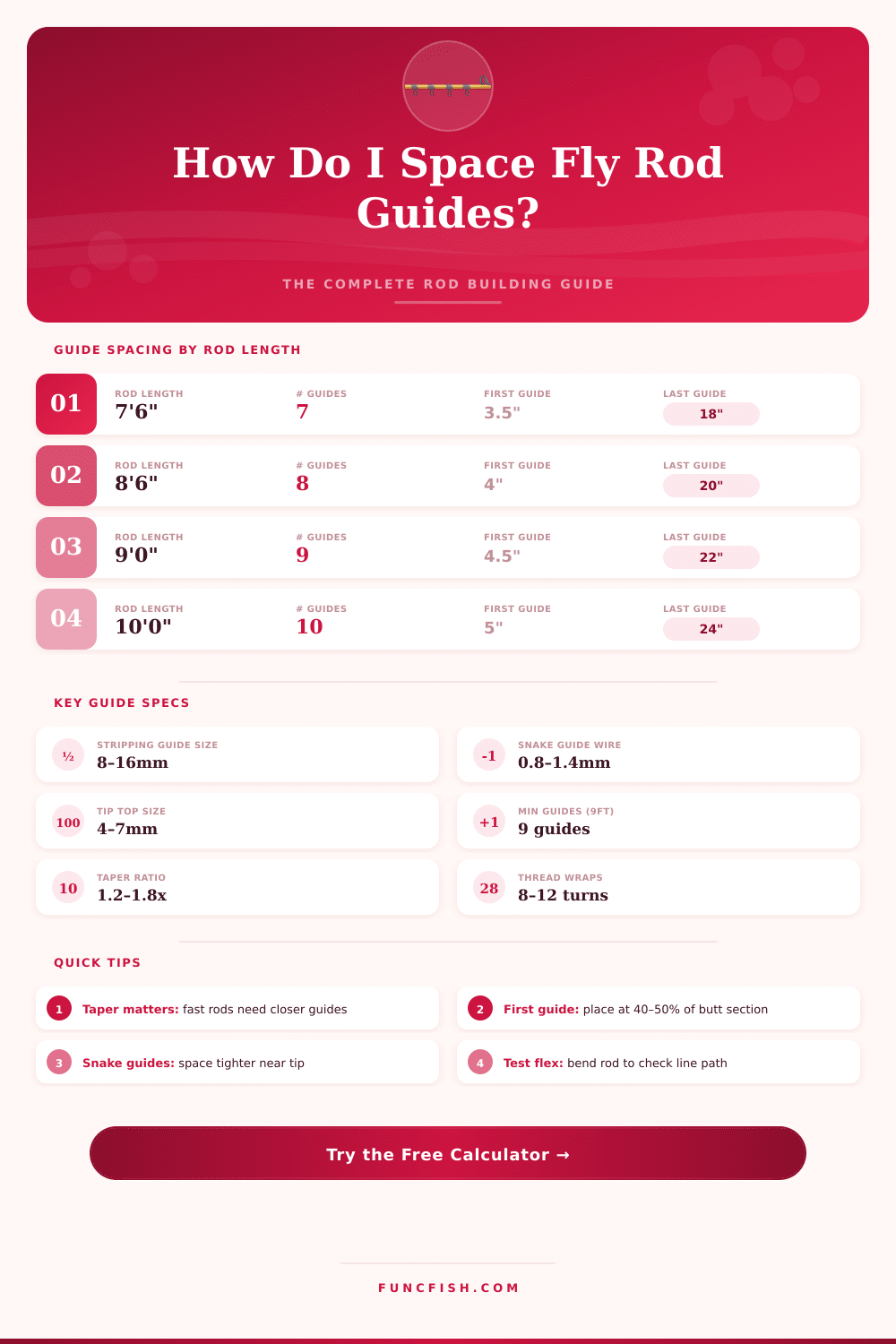
| Rod Length | Line Weight | Min Guides | Recommended | First Guide From Tip (in) | Stripping Guide Size |
|---|---|---|---|---|---|
| 7’0" | 2–3wt | 6 | 7 | 3.0" | 8mm |
| 7’6" | 3–4wt | 6 | 7 | 3.25" | 8mm |
| 8’0" | 4–5wt | 7 | 8 | 3.5" | 10mm |
| 8’6" | 4–5wt | 7 | 8 | 3.75" | 10mm |
| 9’0" | 5–6wt | 8 | 9 | 4.0" | 10mm |
| 9’0" | 7–8wt | 8 | 9 | 4.25" | 12mm |
| 9’6" | 5–7wt | 8 | 10 | 4.25" | 12mm |
| 10’0" | 4–6wt | 9 | 10 | 4.5" | 10mm |
| 11’0" | 6–7wt | 10 | 11 | 5.0" | 12mm |
| 13’0" | 7–9wt | 11 | 13 | 5.5" | 14mm |
| Rod Action | Flex Zone | Tip Guide Cluster | Butt Guide Spacing | Spacing Multiplier | Best Method |
|---|---|---|---|---|---|
| Extra Fast | Top 20% | Very Tight | Wide | 1.5–1.8x | Geometric Taper |
| Fast | Top 30% | Tight | Moderate-Wide | 1.4–1.6x | Geometric Taper |
| Moderate-Fast | Top 40% | Moderate | Moderate | 1.3–1.5x | Geometric / Progressive |
| Moderate | Top 50% | Even | Moderate | 1.2–1.4x | Progressive |
| Slow | Full Rod | Evenly Distributed | Narrow | 1.1–1.3x | Equal / Progressive |
| Target Species | Rod Length | Line Weight | Action | Guides | Stripping ID |
|---|---|---|---|---|---|
| Brook Trout | 7’–7’6" | 2–3wt | Slow–Moderate | 6–7 | 8mm |
| Brown/Rainbow Trout | 8’6"–9’ | 4–5wt | Moderate-Fast | 8–9 | 10mm |
| Smallmouth Bass | 9’ | 6–7wt | Fast | 9 | 12mm |
| Largemouth Bass | 9’ | 7–8wt | Fast | 9 | 12mm |
| Bonefish | 9’ | 7–8wt | Fast | 9 | 12mm |
| Redfish | 9’ | 8–9wt | Fast | 9 | 14mm |
| Pike / Musky | 9’–9’6" | 9–10wt | Fast | 9–10 | 16mm |
| Atlantic Salmon | 13’–14’ | 8–10wt | Moderate-Fast | 12–14 | 14mm |
| Steelhead (Spey) | 12’–14’ | 7–9wt | Moderate-Fast | 11–13 | 14mm |
| Tarpon | 9’ | 11–12wt | Extra Fast | 9 | 16mm |
The Guide Spacing of guides on a Fly Rod seems pretty simple, but it requires careful attention. For example, where to lay guides, positions and spools on a built cane are useful charts about Guide Spacing. Many makers of blanks prepare such charts according to brand and kind of cane, including Fly Rods, spin rods and casting rods.
However such charts serve only as a rough guide for starting.
How to Space Guides on a Fly Rod
Real work starts when guides are placed on the blank. During building of the stick, you set the guides in the wanted position and bend the blank. The task is to ensure that the line follows the blank according to smooth bending, without clear corners.
So alter, add or remove guides according to need. For control, wrap the cane, set it to something stable, bind the line and bend it. When the beidng looks good, everything is in order.
Even so about charts are this: they no always work perfectly, because each blank has a bit of difference, even between identical copies. Sometimes two sections of cane slip one in the other a bit different, which can disturb the Guide Spacing of guides beside the ferrule. In such a case, move the ferrule guide a bit will not harm the general action of the Fly Rod.
Progressive Guide Spacing is natural. The first guide of the stick must sit around three to three and a half inches apart. On blanks for fast action, the flexibility focuses in the upper part, so you need more guides here to well follow the curve.
Commonly one counts guides from the length of the cane in feet, one guide each foot. Some companies lay even thirteen guides on a nine-foot cane. The principle is cover the curve buy means of the fewest guides, to cut the weight.
The stripper-guide is another case. It does not belong at the most bottom spot according to a distance chart. Rather, one places it more beside the handle, because it serves to ease fishing and casting, not for the flexibility of the cane.
Good spacing is from 28 to 32 inches from the bottom of the cane.
Not always bigger guides are better. Big guides allow the line to slap more freely around the cane, which hurts long casts. For light sticks, guides on the tip must be small, so that the cane feels well.
One way to choose place for guides on canes of lightweight line is lay them on the belly for lines of 2 to 6 weights, while for heavier canes of 7 to 13 weight one places guides on the spine for better casting or return of line. Custom builders can freely follow their own tastes regarding size andGuide Spacing of guides, because each cane and each angler are a bit different.