⚓ Outboard Motor Propeller Calculator
Find the ideal prop pitch, diameter & RPM range for your boat and motor
Baseline Eff.
Efficiency Gain
Efficiency Loss
Efficiency Gain
Efficiency Gain
Change
Change
Range
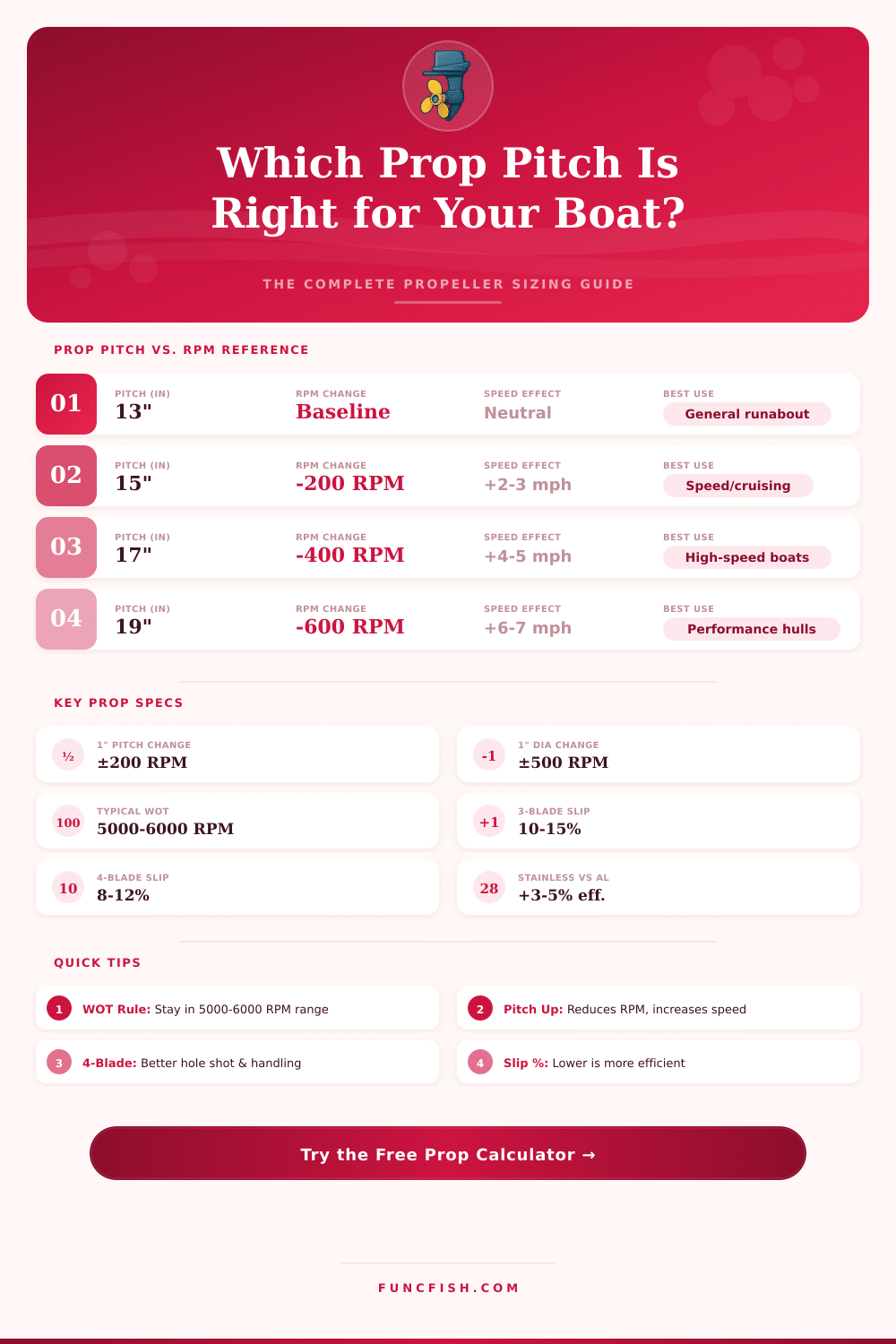
| Prop Pitch | RPM Change vs. 15" | Approx. Speed Effect | Best Application | Typical Slip % |
|---|---|---|---|---|
| 9" (23 cm) | +1200 RPM | -6 to -8 mph | Kayak / small tender motors | 20-30% |
| 11" (28 cm) | +800 RPM | -4 to -6 mph | Jon boats, inflatables | 18-25% |
| 13" (33 cm) | +400 RPM | -2 to -3 mph | Pontoons, heavy loads | 15-20% |
| 15" (38 cm) | Baseline | — Baseline — | General runabouts, fishing boats | 12-15% |
| 17" (43 cm) | -400 RPM | +2 to +3 mph | Center consoles, cruising | 10-13% |
| 19" (48 cm) | -800 RPM | +4 to +5 mph | Ski/wakeboard, sport boats | 9-12% |
| 21" (53 cm) | -1200 RPM | +6 to +7 mph | High-speed hulls | 8-11% |
| 23" (58 cm) | -1600 RPM | +8 to +10 mph | Performance / offshore | 7-10% |
| 25" (64 cm) | -2000 RPM | +10 to +12 mph | Racing / extreme speed hulls | 6-9% |
| Boat Type | HP Range | Ideal WOT RPM | Pitch Range | Recommended Blades |
|---|---|---|---|---|
| Jon Boat / Flat Bottom | 15–40 hp | 4800–5200 | 9–13" | 3-blade aluminum |
| Aluminum Fishing Boat | 60–150 hp | 5000–5500 | 13–17" | 3-blade alum. or SS |
| Pontoon Boat | 40–150 hp | 4800–5200 | 11–15" | 3 or 4-blade alum. |
| Center Console / Fiberglass | 100–300 hp | 5200–6000 | 15–21" | 3-blade SS |
| Flats / Skiff Boat | 60–150 hp | 5400–6000 | 15–19" | 3-blade SS |
| Offshore Sport Fishing | 200–400 hp | 5000–5800 | 19–25" | 3 or 4-blade SS |
| Ski / Wakeboard Boat | 150–300 hp | 5200–5800 | 19–23" | 4-blade SS |
| Deck Boat | 150–250 hp | 5000–5600 | 17–21" | 3 or 4-blade SS |
| Inflatable / RIB | 10–60 hp | 4800–5400 | 8–13" | 3-blade alum. or comp. |
| Kayak / Small Tender | 2–10 hp | 4500–5200 | 6–10" | 2 or 3-blade alum. |
| Material | Relative Efficiency | Typical HP Range | Repairability | Best For |
|---|---|---|---|---|
| Aluminum | Baseline (0%) | Up to 150 hp | Easy / low cost | Everyday fishing, budget setups |
| Stainless Steel | +3 to +5% | All ranges | Professional shop only | Performance, all-around upgrade |
| Composite / Plastic | -2 to -4% | Up to 40 hp | Replace only | Inflatables, emergency spare |
| Bronze / Nibral | +3 to +4% | Inboard / large OB | Welding possible | Commercial, heavy-duty use |
| Cupped Stainless | +5 to +7% | All ranges | Professional shop only | Top performance, clean water exit |
| High-Five Aluminum | +1 to +2% | Up to 200 hp | Easy / moderate cost | 5-blade smooth ride, wake boats |
Choosing the right propeller for fishing with an outboard motor, one can reach big change in the speed of the boat. Basically the propeller is that part that drives the boat through the water, and if one chooses wrong, the engine must work too hard or spin too quickly. Such wrong choice cuts the lifetime of the engine and reduces the overall efficiency.
Choosing a propeller, the main things to consider is its size, pitch, material and fit with the engine. The best choice depends on the size of the boat, the power of the engine and the main use of the boat, whether for fishing, cruising or water sports.
How to Choose the Right Propeller for Your Outboard Motor
The pitch of the propeller matters a lot. One can imagine it like the gear ratio of a car. A lower pitch helps to better boost from a stop, so the boat quickly moves and reaches higher speed soon.
Even so, it limtis the top speed. On the contrary, higher pitch does the opposite. For instance, one fishing boat came with a 20-pitch propeller.
The turns per minute were a bit too high, so the owner switched to 22-pitch to find the ideal balance between big waves and final top speed.
New boats usually come with a propeller already installed on the outboard motor. The makers care that everything will be best for overall performance and fuel saving. That average solution works for many users, but others want more from there boat, for instance for simple fishing or pontoon boating.
Propellers with three blades are lighter, solid and long lasting. They work well at top speeds without raising the turns. Propellers with four blades are different.
They give smoother ride and better pull, especially at low speeds. Four blade propellers work for outboard fishing boats, heavy boats like cabin cruisers and boats in rough waters, because they provide stronger push at low speeds.
Also the materials matter. Aluminum propellers cost less and work for many cases. One boat owner chose aluminum because they did not need the extra price of stainless steel.
Rather, stainless steel is stronger and can perform better depending on the kind of boat and engine, but for big fishing or cruising boats, many think that the extra cost is not worth it.
The goal is to choose a propeller that allows the engine to reach the middle or higher in its full range of turns per minute in normal load. That range delivers the most power from the outboard motor. One must consider also the noise.
A propeller and its wear truly can hurt fishing in the area by scaring the fish. Greasing the axis of the propeller once yearly is good practice for upkeep, even if it does not seem necessary. A specialiststore about propellers can help choose and fit the right one for your outboard motor.