🐟 Fish Yield Calculator
Estimate edible fillet weight from your whole catch — by species, preparation method & size
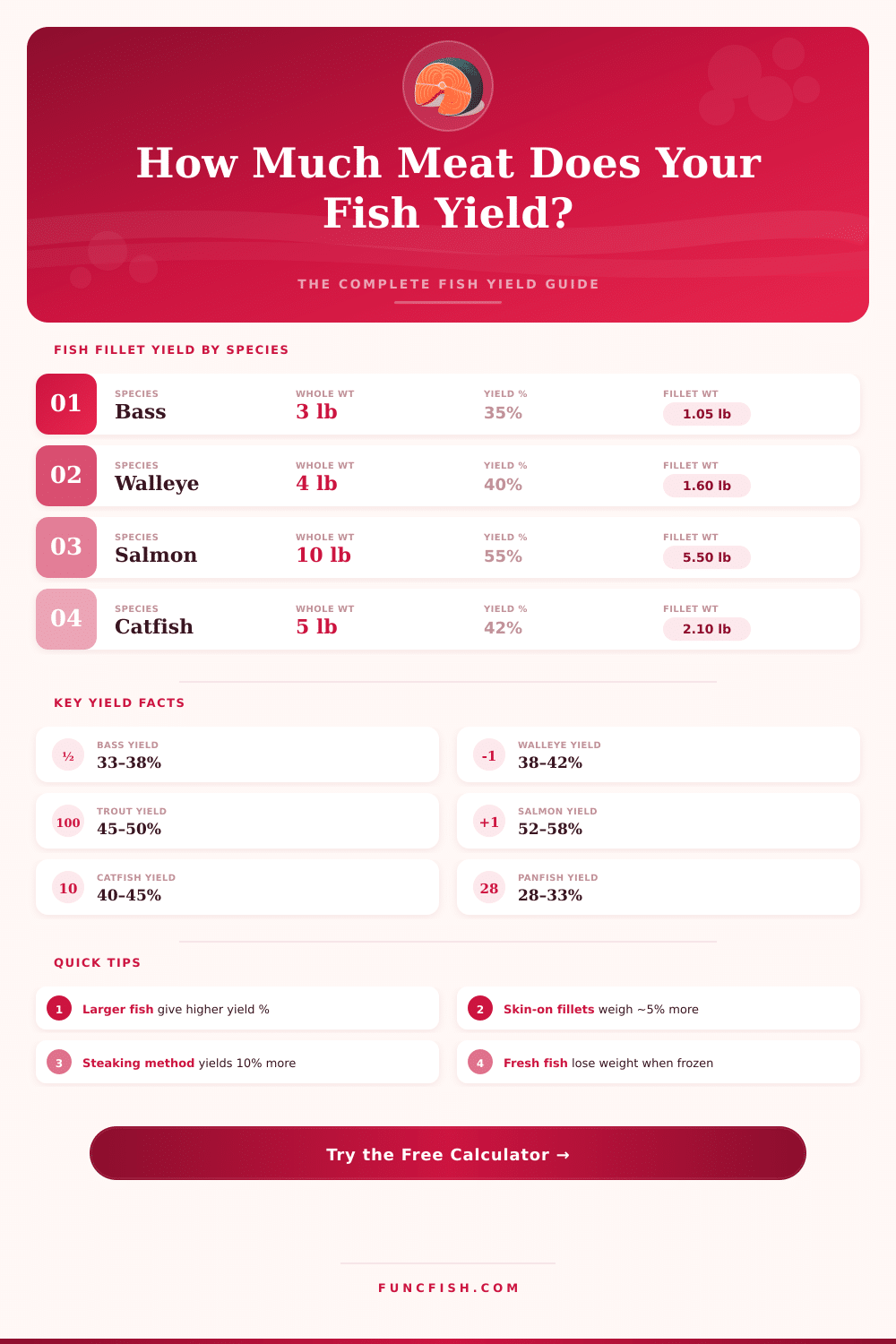
| Species | Fillet Yield % | Dressed Yield % | Avg Fish Wt | Fillets / Fish |
|---|---|---|---|---|
| Largemouth Bass | 33–38% | 55–60% | 1–5 lb | 2 |
| Smallmouth Bass | 32–37% | 54–58% | 0.5–3 lb | 2 |
| Walleye | 38–42% | 58–63% | 1–6 lb | 2 |
| Atlantic Salmon | 52–58% | 68–72% | 5–20 lb | 2 |
| Rainbow Trout | 45–50% | 63–67% | 0.5–5 lb | 2 |
| Brown Trout | 44–49% | 62–66% | 0.5–4 lb | 2 |
| Channel Catfish | 40–45% | 60–65% | 2–10 lb | 2 |
| Bluegill / Panfish | 28–33% | 50–55% | 0.25–1 lb | 2 |
| Crappie | 30–35% | 52–57% | 0.25–1.5 lb | 2 |
| Northern Pike | 36–40% | 56–60% | 3–15 lb | 5 (Y-bone) |
| Striped Bass | 38–43% | 58–63% | 2–20 lb | 2 |
| Halibut | 50–56% | 65–70% | 10–100 lb | 4 |
| Cod | 48–53% | 64–68% | 3–25 lb | 2 |
| Tilapia | 32–37% | 55–60% | 0.5–3 lb | 2 |
| Servings Needed | Raw Fillet Needed | Whole Bass Needed | Whole Walleye Needed |
|---|---|---|---|
| 1 person | 0.33 lb (150g) | ~1 lb whole | ~0.85 lb whole |
| 2 people | 0.67 lb (300g) | ~2 lb whole | ~1.7 lb whole |
| 4 people | 1.33 lb (600g) | ~4 lb whole | ~3.4 lb whole |
| 6 people | 2 lb (900g) | ~6 lb whole | ~5 lb whole |
| 10 people | 3.3 lb (1.5 kg) | ~10 lb whole | ~8.5 lb whole |
| 20 people | 6.7 lb (3 kg) | ~20 lb whole | ~17 lb whole |
| Factor | Type | Yield Adjustment | Notes |
|---|---|---|---|
| Expert Filleting | Skill | +3 to +5% | Clean cuts near backbone |
| Beginner Filleting | Skill | -5 to -8% | More meat left on bones |
| Previously Frozen | Condition | -3 to -5% | Water loss during thaw |
| Trophy / Large Fish | Size | +2 to +4% | Better muscle-to-bone ratio |
| Small / Juvenile | Size | -3 to -6% | Higher bone-to-meat ratio |
| Skin-On Fillet | Method | +4 to +6% | Skin adds weight |
| Butterfly Method | Method | +2 to +3% | Single connected piece |
Not all fish give the same amount of usable meat when you try to estimate how much you indeed receive. Two pounds of salmon do not produce as much meat as two pounds of trout. Different species have bigger bones and require more work to process them.
Knowing how much food you can expect from common fish helps to estimate more easily how much meat whole fish give
How Much Meat You Get from Whole Fish
Most meat from whole fish reach around 50 percent. For skinless meat you receive even less. For instance grouper give a much lower amount because of its big head.
Hence it is better to hunt fish with small heads. Flat fish reach around 40 percent. The white meat is at 40 percent, if you have basic skills for filleting.
Prime Atlantic cod, without guts, give usually 42 to 44 percent for skinless, boneless meat in non-spawning season. While spawning the amount drops close to 38 percent, even to 30 percent. Here is a big differnce.
After removing the head, you receive around 73 to 76 percent for skin-on meat, depending on the method.
Gutted Atlantic salmon, without head, give around 65 percent after filleting and skinning. If you remove also the brown fat below, the amount falls to around 60 percent. Some other species do better: Mormyrus rume, Labeo senegalensis and Clarias gariepinus reach 55 percent or more.
Cooking the whole fish, those numbers change entirely. Because you eat the flesh beside bones and around the head, the usable amount jumps to 70 to 90 percent for the most species. Even with good filleting and machines to withdraw the flesh, less stay on the bones.
In developed lands you eat fish filleted, so without bones or only with pin bones and commonly without skin. Separate numbers for skinless meat against whole edible meat helps to estimate exactly how much fish folks eat in various regions.
Knowing yields are useful for planning meals or deciding how much fish to buy. When you know what percentages of meat stay after filleting of whole fish, you can reduce the amount you buy. Here is the problem: fish die more commonly because of record temperatures in ocean waters.
Research shows that this biology could reduce global fish yields to 30 percent in worst warming scenarios. Overharvesting is blamed most, but environmental damages; pollution, wetland destruction, reef wounds and estuary loss… Add strongly.
Anadromous species like salmon suffer in addition because of river dams and siltation of bank erosion.