
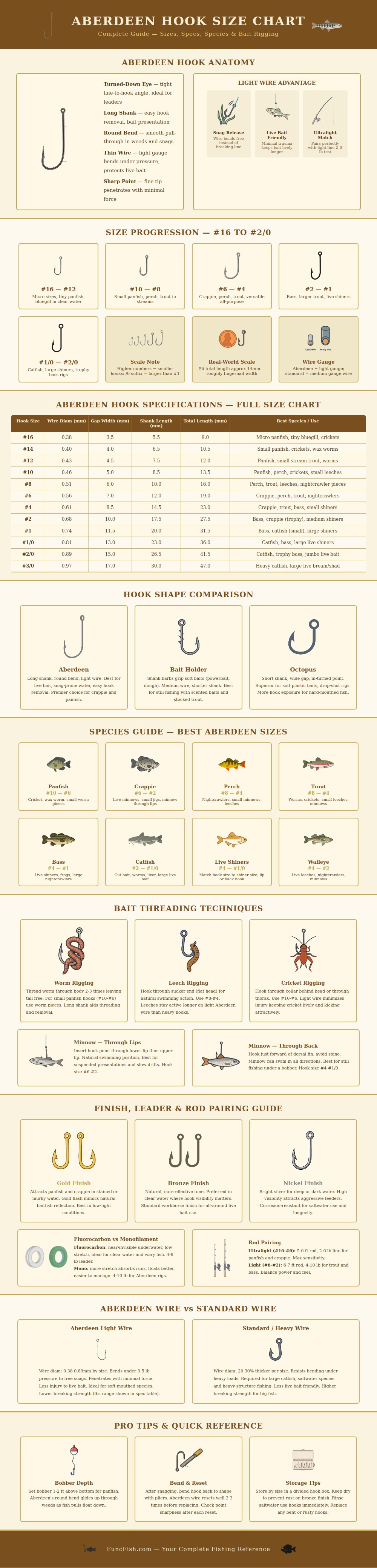
Aberdeen hook are a specific type of fishing hook that is designed for use with live bait. The Aberdeen hook has a thin wire construction and a long shank, both of which makes it suitable for use in catching species like panfish, perch, or bass. The size of the Aberdeen hook should of be chose according to the size of the mouth of the fish you are targeting, as well as the conditions of the water.
The design of an Aberdeen hook include several specific components. An Aberdeen hook has a turned down eye, which allows the person to tie a knot in the leader that attach to the Aberdeen hook. Additionally, an Aberdeen hook has an extra long shank that allows the person to remove the hook from the fish’s jaw.
All About Aberdeen Hooks
An Aberdeen hook also has a smooth, round bend, which allows the hook to slip through weeds in the pond or river without hooking on the vegetation. Additionally, Aberdeen hooks is made of light wire, which allows the Aberdeen hook to bend and prevent the line from breaking when the hook encounters a root. Finally, the light wire construction of the Aberdeen hook prevent damage to the live bait.
Aberdeen hooks come in a variety of size. Aberdeen hooks with smaller numbers is smaller in size, while larger numbers (or the use of the “/0” size) indicate a larger Aberdeen hook. Small Aberdeen hooks are used to catch small fish species like bluegill.
Medium size Aberdeen hooks are used to catch species like crappie or trout. For instance, a medium sized Aberdeen hook is roughly the width of a fingernail, and medium sized Aberdeen hooks is used to thread nightcrawlers or hold perch. The size of the Aberdeen hook should be chose according to the type of live bait that will be used with the hook; if the Aberdeen hook is too large for the bait, the bait will slide off the hook, but if the Aberdeen hook is too small for the fish, the fish may not be caught using the Aberdeen hook.
According to the type of fish that one intend to catch, different sizes of Aberdeen hooks should be used. Panfish can be caught using small Aberdeen hooks that use live bait like wax worms. Crappie and perch can be caught using medium sized Aberdeen hooks that use bait like minnows.
Trout can also be caught using medium sized Aberdeen hooks that use live bait like leeches. Bass can be caught using larger Aberdeen hooks that use bait like shiners. Finally, catfish require the heaviest “/0” size Aberdeen hooks to catch them, and they is best caught using large Aberdeen hooks with cut bait or jumbo minnows.
In order to rig live bait to an Aberdeen hook, the bait can be thread multiple times along the long shank of the Aberdeen hook. Additionally, crickets can be passed through the collar of the Aberdeen hook; the light wire of the Aberdeen hook allow the cricket to continue to hop while attached to the Aberdeen hook. The flexibility of Aberdeen hooks allow the live bait to move natural while attached to the hook; rigid hooks will kill the natural movement of the live bait.
Aberdeen hooks are different than other types of fishing hooks. For instance, bait holder hooks include barbs along the shank of the hook to hold doughbait. Octopus hooks have a short and wide gap on the hook, and are used for plastic bait.
Aberdeen hooks are best used in live bait in weedy areas due to the round bend in the Aberdeen hook, which allow the hook to release from cover. The finish of an Aberdeen hook can also have an impact on the ability of the Aberdeen hook to catch fish. For instance, Aberdeen hooks with a gold finish will flash in murky water, and the flash will mimic the scales of baitfish.
Aberdeen hooks finished in bronze finish will blend into the water in clear streams. Finally, Aberdeen hooks finished in a nickel finish are resistant to corrosion in brackish water. Additionally, the power of the fishing rod should match the size of the Aberdeen hook; for instance, an ultralight fishing rod can be used with micro Aberdeen hooks, and light action rods can be used with medium sized Aberdeen hooks.
Finally, Aberdeen hooks should be maintained. For instance, if the Aberdeen hook becomes bent after contacting some object, you can straighten it with pliers. The point of the Aberdeen hook can also be sharpened with a file.
Finally, Aberdeen hooks should be stored in a dry place, and stored in a sorted manner to avoid rust on the Aberdeen hooks.