
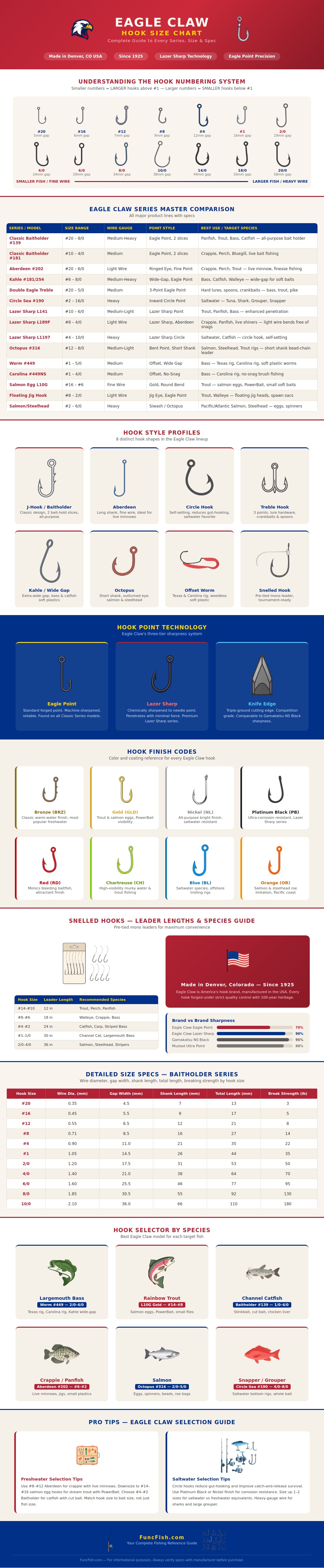
Selecting an correct hook size is a necessary part of the fishing process because the size of the hook will determine whether the fish will remain attach to the hook. Many anglers loses there caught fish due to incorrect hook size. If the hook is too small for the fish, the hook may not be able to hold the fish.
If the hook is too large for the fish to eat, the fish will not be able to swallow the bait on the hook. Hook sizes can become confusing because of the number associated with the sizes of the hooks. Numbers above 1 represent smaller sizes of hooks.
How to Choose the Right Fishing Hook
Numbers with a zero represent larger sizes of hooks. It is important for anglers to become familiar with these size in order to properly select the correct hook size for their fishing need. Another factor to consider when selecting the correct hook is the thickness of the wire of the hook.
Hooks with thin wire will go into the fish easily but may bend if the fish shakes its head. Hooks with thick wire will not bend but may be difficult to get into the jaw of the fish. Depending on the type of fish that you plan to catch, you can select the proper thickness of the wire of the hook.
For instance, if you are fishing for panfish, using lighter wire will make it easy to catch the fish because panfish are easily spooked. However, if you are fishing for bottom feeders, using heavy wire will allow the hook to more better withstand the force with which the fish will pull on the bait. The different shapes of the hooks serve specific purpose in fishing.
Baitholder hooks have two small slices on the baitholder that help to hold the bait on the hook. These hooks are useful when fishing for many different types of fish, such as panfish and catfish. Aberdeen hooks have a long thin wire that allow live minnows to be placed on the hook so that they can swim natural in the water.
Additionally, wide gap kahle hooks have a large opening that allows bulky soft plastic baits to rotate on the hook so that the mouth of the bass can catch it. Another factor to consider with fishing hooks is the sharpness of the point of the hook. Most hooks have a standard point, but there are premium fishing hooks with a chemical etch point that create a fine point on the hook.
These types of hooks is beneficial for catching fish in clear water or for fish that have strong mouth, like walleye. Other factors to consider with fishing hooks is the finish of the hook. Depending on the type of water in which you are fishing, the finish of the hook can affect the visibility of the hook to the fish.
For instance, bronze finishes are used in freshwater area, nickel finishes are used in saltwater area, and black platinum finishes are used in murky water because the black finish will hide the hook from the fish and the hook will not rust. When selecting the correct hook size for fishing, there are specific rules that anglers should follow. The angler should first size the hook according to the bait that will be use on the hook.
Then, the angler should size the hook according to the type of fish that will be targeted. For instance, if minnows are to be used as the bait, a #12 Aberdeen hook should be selected. However, if plastic worms six inches in length are to be used, a 3/0 hook should be selected regardless of the type of fish that are to be targeted.
One mistake that anglers should avoid when selecting hooks is using a hook that is too large for the bait or the fish. Using too large of a hook will scare the fish away from the bait. Additionally, anglers should also avoid using a hook that is too small for the fish.
Using too small of a hook will result in the hook failing when the fish fight. Certain fish species has specific requirements for the type of hook and size of hook that is to be used to catch these types of fish. For instance, bass will use offset worms on 2/0 to 4/0 hook.
Trout will use small #14 gold baitholder hooks with fish egg or dough. Catfish will use #1 baitholder hooks with stinkbait. Offshore fish like snapper will use 6/0 circle hooks on the bottom fishing rig.
Crappie will use Aberdeen hooks for finesse fishing. Additionally, salmon will use octopus hooks because the short shank of the hook allows the hook to flip natural in the water currents in which salmon swim. By knowing and understanding the different factor of the hook, anglers can greatly increase there chances of successfully catching fish.