🦪 Stingray Out-of-Water Survival Time Calculator
Estimate safe air exposure time for stingrays based on species, size, temperature & conditions
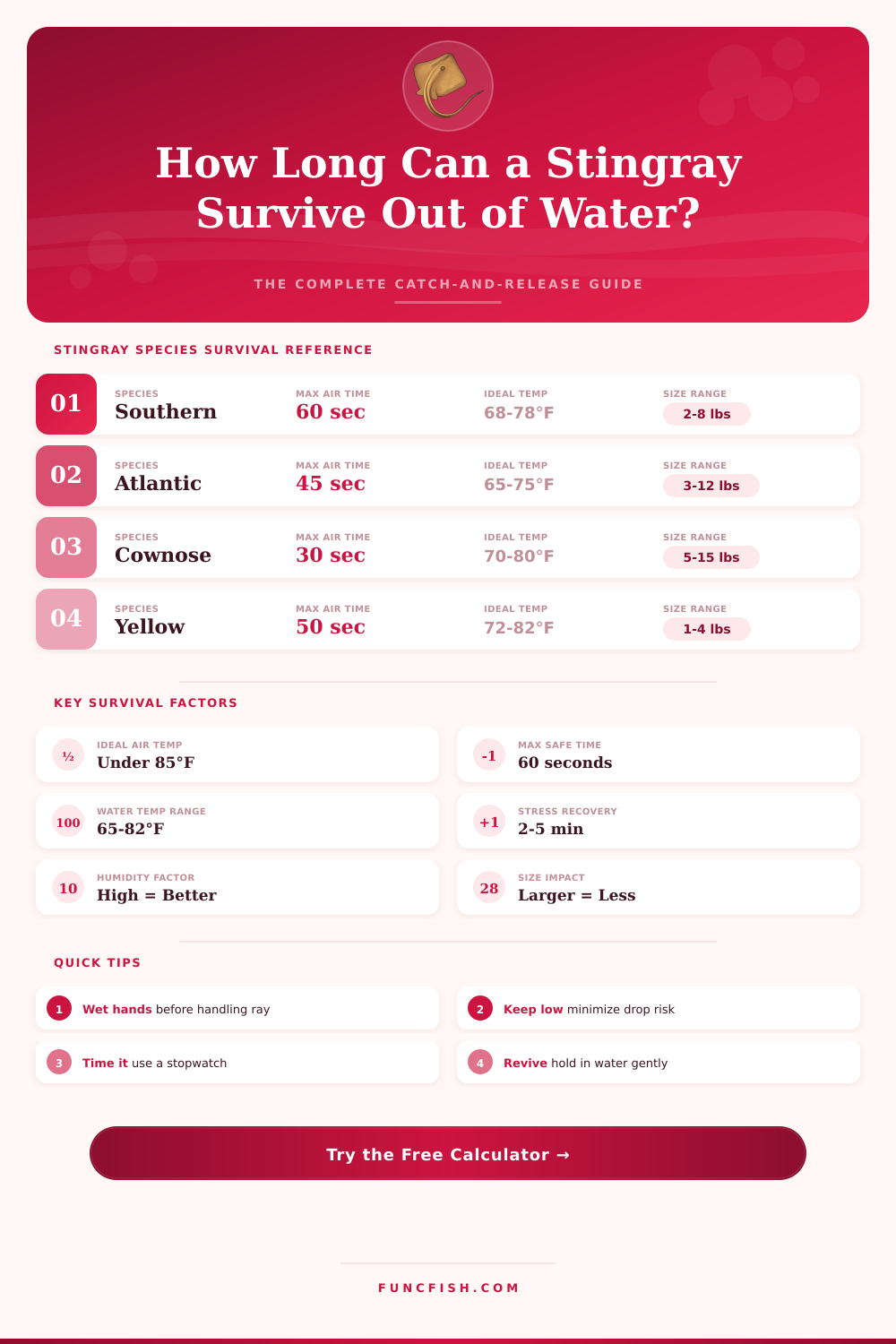
| Species | Base Max Air Time | Optimal Water Temp | Typical Weight | Stress Sensitivity |
|---|---|---|---|---|
| Southern Stingray | 60 seconds | 68–78°F / 20–26°C | 2–8 lb / 0.9–3.6 kg | Moderate |
| Atlantic Stingray | 45 seconds | 65–75°F / 18–24°C | 3–12 lb / 1.4–5.4 kg | Moderate-High |
| Cownose Ray | 30 seconds | 70–80°F / 21–27°C | 5–15 lb / 2.3–6.8 kg | High |
| Yellow Stingray | 55 seconds | 72–82°F / 22–28°C | 0.5–4 lb / 0.2–1.8 kg | Low-Moderate |
| Spotted Eagle Ray | 35 seconds | 68–79°F / 20–26°C | 10–500 lb / 4.5–227 kg | Very High |
| Roughback Stingray | 50 seconds | 66–78°F / 19–26°C | 2–10 lb / 0.9–4.5 kg | Moderate |
| Air Temp Range | °F Range | °C Range | Survival Multiplier | Risk Level |
|---|---|---|---|---|
| Cool Conditions | Under 65°F | Under 18°C | +20% time | Low |
| Ideal Conditions | 65–75°F | 18–24°C | Baseline | Low-Moderate |
| Warm Conditions | 75–85°F | 24–29°C | –15% time | Moderate |
| Hot Conditions | 85–95°F | 29–35°C | –30% time | High |
| Extreme Heat | Above 95°F | Above 35°C | –50% time | Very High |
| Ray Size | Weight (lb) | Weight (kg) | Air Time Modifier | Handling Notes |
|---|---|---|---|---|
| Very Small | Under 1 lb | Under 0.45 kg | +10% | Dry out faster – return quickly |
| Small | 1–3 lb | 0.45–1.4 kg | Baseline | Standard handling protocol |
| Medium | 3–8 lb | 1.4–3.6 kg | –5% | Support body weight fully |
| Large | 8–20 lb | 3.6–9 kg | –15% | Two-person lift recommended |
| Very Large | 20+ lb | 9+ kg | –25% | Minimize air time, revive in water |
Stingrays have a limited amount of times in which the animals can remain out of the water before the stingray begins to die. Many people believe the stingray can remain out of the water for three to five minute. However, this time is inaccurate as there are a variety of factor that affect the survival time of a stingray.
In order to ensure the survival of the stingray when it is extracted from the water, it is necessary to understand these factors. The way in which stingrays breathes is one of the factors that determines how long a stingray can survive out of the water. Stingrays do not use gill to breathe in the same way as other fish species.
How to Keep a Stingray Alive Out of Water
Instead, stingrays use spiracles to draw water to it mouth in order to breathe. These spiracles are located behind the stingrays eyes. If the stingray is out of the water, these spiracles cannot perform their function of allowing the stingray to breathe.
Additionally, if debris or dryness blocks the spiracles, the stingray will struggle to breathe. Furthermore, if the air is exposed to the stingray, its skin will dry out; drying out of the skin causes stress to the stingray. Another of the factors that determines the survival time of the stingray is the environmental condition around the stingray.
If the air temperature is more higher than the water temperature, the air will contribute to the dehydration of the stingray. If the humidity in the environment is low, the stingray will lose moisture to the low humidity in the air. Warm air and low humidity is dangerous to stingrays.
Additionally, the surface upon which the stingray is placed has an impact upon its survival. If the stingray is placed upon a dry deck, the stingray will lose moisture to the dry deck. However, if the stingray is placed upon a wet towel or wet sling, the stingray will not lose moisture to the surface.
It is important to avoid placing the stingray upon its belly upon a hard surface as this may squeeze fluid out of the stingrays body. The size of the stingray and its species are another of the factors that play a role in the survival time of the species. Small stingray species have shorter survival windows than larger stingray species.
For instance, yellow stingrays, which are small stingrays measuring 10 inches in diameter, have shorter survival windows than larger stingray species. Additionally, the freshwater stingray species have longer survival windows than the saltwater stingray species. This is due to the robust builds of freshwater stingrays as they are adapted to the conditions of river environments.
However, you must take care when removing the stingray from the water as large stingrays can get injured if they are lifted by their tails. Another of the factors that contributes to the survival of stingrays is the length of the fight that the stingray has with the individual before the stingray is removed from the water. If the fight between the stingray and the individual lasts for an extended period of time, the stingray will produce more lactic acid during the fight.
The buildup of lactic acid will make the stingray acidotic; an acidotic stingray has less time to survive after being removed from the water. To minimize the time that the stingray is out of the water and to increase its survival, it is important to aim to minimize the length of the fight between the two party. In order to ensure the survival of the stingray after it is removed from the water, specific procedure should be followed.
The disc of the stingray should be kept flat and wet. A wet sling or towel should be used to support the stingray and to cradle the stingrays disc. Additionally, the stingray should be returned to the water head first in a slow, evenly motion.
Returning the stingray head-first will allow water to naturaly clear from the stingrays spiracles so that it can breathe again. Additionally, if the fishing hook is buried within the stingray, the individual should cut the line while the stingray is still within the water to avoid furthering the time that the stingray is out of the water. Finally, the individual should use there judgment to ensure the survival of the stingray.
If the stingray is appearing to be lethargic, or if the spiracles of the stingray are flared open, the best action to take is to release the stingray immediately. The survival of the stingray is more important than taking a photograph of the species. Photographs should be taken while the stingray is within the net or while the stingray is still within the water.
By following these step, the probability of the stingrays survival after being removed from the water will be increased. It could of been avoided if you’re careful.