🐟 Walking Catfish Land Survival Time Calculator
Estimate how long a walking catfish (Clarias batrachus) can survive out of water based on temperature, humidity, surface type, and fish condition
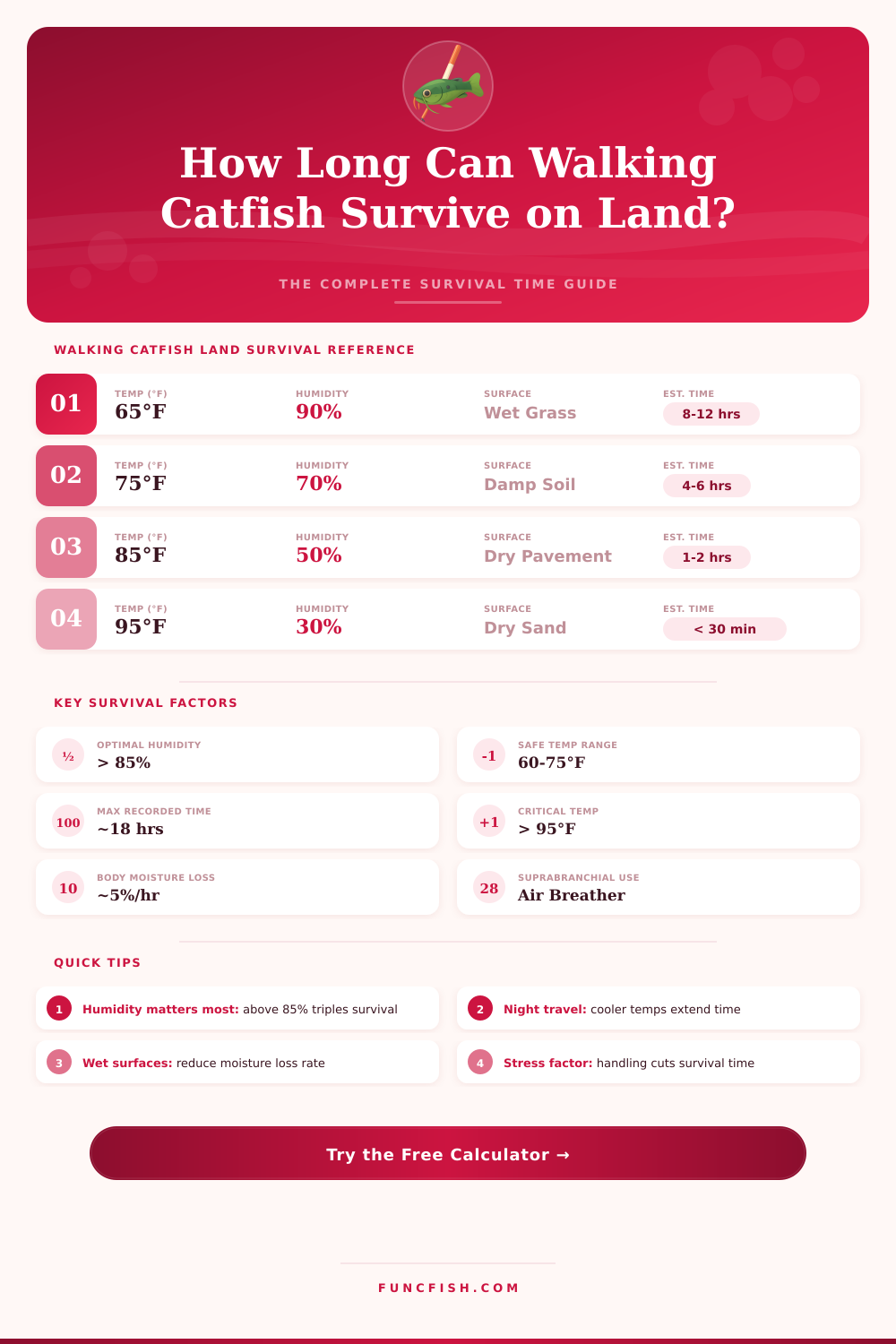
| Temp (°F) | Temp (°C) | Humidity 90%+ | Humidity 60–89% | Humidity <60% | Risk Level |
|---|---|---|---|---|---|
| 50–60°F | 10–16°C | 16–20 hrs | 10–14 hrs | 5–8 hrs | Low |
| 61–70°F | 16–21°C | 12–16 hrs | 7–11 hrs | 3–6 hrs | Low–Mod |
| 71–80°F | 22–27°C | 7–10 hrs | 4–7 hrs | 1.5–3 hrs | Moderate |
| 81–90°F | 27–32°C | 3–6 hrs | 1.5–3 hrs | 30–90 min | High |
| 91–100°F | 33–38°C | 1–2.5 hrs | 30–60 min | 10–30 min | Critical |
| >100°F | >38°C | <60 min | <30 min | <10 min | Lethal |
| Condition / Stage | Survival Modifier | Moisture Loss Rate | O₂ Extraction Efficiency | Notes |
|---|---|---|---|---|
| Adult – Healthy | 1.00x (baseline) | ~3–5% / hr | ~68% of aquatic | Suprabranchial organ fully active |
| Adult – Handled | 0.75x | ~5–7% / hr | ~55% of aquatic | Stress hormones elevate O₂ demand |
| Adult – Stressed | 0.55x | ~7–10% / hr | ~40% of aquatic | Cortisol impairs gill/skin function |
| Adult – Post-Spawn | 0.65x | ~6–8% / hr | ~48% of aquatic | Depleted energy reserves |
| Sub-adult | 0.80x | ~4–6% / hr | ~62% of aquatic | Suprabranchial organ still developing |
| Juvenile | 0.45x | ~8–12% / hr | ~35% of aquatic | Underdeveloped air-breathing organ |
| Species | Max Land Survival | Air-Breathing Organ | Typical Weight | Native Range |
|---|---|---|---|---|
| Walking Catfish (Clarias batrachus) | Up to 18 hrs (ideal) | Suprabranchial chamber | 0.5–3 lb (0.2–1.4 kg) | SE Asia / Invasive FL |
| Clarias gariepinus | Up to 20 hrs | Suprabranchial chamber | 1–10 lb (0.5–4.5 kg) | Africa |
| Snakehead (Channa argus) | Up to 4 days (moist) | Suprabranchial labyrinth | 1–15 lb (0.5–6.8 kg) | Asia / Invasive US |
| Mudskipper (Periophthalmus spp.) | Days (wet skin) | Skin / buccal cavity | 0.02–0.1 lb (9–45 g) | Africa, Asia, Australia |
| Spotted Gar (Lepisosteus oculatus) | 2–4 hrs max | Primitive swim bladder | 2–8 lb (0.9–3.6 kg) | North America |
| Bowfin (Amia calva) | 1–3 hrs (moist) | Modified swim bladder | 1–12 lb (0.5–5.4 kg) | Eastern North America |
| Wind / Sun Combo | Evaporation Rate | Time Reduction | Notes |
|---|---|---|---|
| Calm + Full Shade | Very Low | Baseline (0%) | Optimal terrestrial conditions |
| Calm + Partial Shade | Low | –8% | Minor temp elevation |
| Calm + Full Sun | Moderate | –20% | Skin dries faster |
| Light Breeze + Shade | Low–Moderate | –12% | Convective cooling helps slightly |
| Light Breeze + Full Sun | Moderate–High | –30% | Combined evaporative stress |
| Moderate Wind + Full Sun | High | –45% | Rapid mucus desiccation |
| Strong Wind + Full Sun | Very High | –60% | Survival halved in extreme cases |
Relative humidity above 85% can more than double land survival time compared to 40% humidity at the same temperature. Walking catfish use their suprabranchial organ for aerial respiration, but skin moisture is equally critical for oxygen diffusion through the skin surface.
Walking catfish naturally migrate at night when temperatures drop and humidity rises. If calculating survival for observed migration events, nighttime conditions (lower temps, higher humidity, reduced solar radiation) dramatically improve survival estimates — often by 3–5x versus midday conditions.
The walking catfish are an invasive species that is native to Southeast Asia. The walking catfish is able to move across land during periods of flood. The walking catfish uses a suprabranchial organ for gulp at the air.
This organ allow the walking catfish to breathe while it isnt in water. The walking catfish also relies upon a mucus coat and skin capillary to retain moisture. However, if the environment is more hot or dry for the walking catfish, it will lose moisture at a rapid rate.
How Long Can a Walking Catfish Survive on Land
The length of time that a walking catfish can survive on land is dependent upon several factors. For instance, one factor is the temperature of the land where the walking catfish move. If the temperature is high, the metabolism of the walking catfish will increase.
A high metabolism increase the rate at which the walking catfish consume its energy reserves. Another factor is the humidity of the area in which the walking catfish move. If the humidity is low, the mucus coat of the walking catfish will evaporate at a rapid rate, leading to dehydration of the catfish.
Another factor is the size of the walking catfish. A juvenile walking catfish will have more baseline time to survive on land than an adult walking catfish of the same size. The juvenile walking catfish has less body mass than the adult, allow its body to dehydrate at a slower rate.
The surface upon which the walking catfish moves is another factor that can impact how long the walking catfish can survive. If the walking catfish move upon wet mud, it can retain moisture better than upon hot pavement. Hot pavement causes the walking catfish to lose moisture and heat at a rapid rate.
The wind speed in which the walking catfish moves is another factor in how long it can survive on land. The faster the wind speed, the more faster the mucus film that covers the walking catfish will evaporate. Finally, another factor is the distance between the walking catfish and the nearest body of water.
The survival time for a walking catfish on land is only useful if the species can reach a body of water before it perishes. The physical condition of the walking catfish is another factor that determine how long it can remain on land. For instance, if the walking catfish is of an ideal weight for its length, it will have more survival reserves.
A walking catfish that is underweight will have less survival time than one of an ideal weight. If the walking catfish is moving in a frantic state upon the land, it will use up its energy at a faster rate than if it were rest. Additionally, if a person handles the walking catfish in a rough way, it may shred the fish skin barrier.
The catfish will lose moisture at a faster rate if its skin barrier are damaged. Many people make mistakes when they attempt to calculate the length of time that a walking catfish can survive on land. For instance, they may not understand that juveniles and adults has different survival times on land.
Additionally, they may not understand that the effects of each of the mentioned variables multiply each other. For instance, high heat and high wind speeds are more dangerous for the walking catfish than high heat alone. Another mistake people make is to assume that the walking catfish can reach its maximum theoretical survival time.
It’s biological variable (such as injuries or gill issues) will prevent it from reaching such survival times. Finally, people should of use some safety margin in calculating the survival time of the walking catfish to account for these biological variables. Its a lot of things to consider when your looking at survival time.