🐟 Bluegill Lifespan Calculator
Estimate your bluegill's age, growth stage, and lifespan from length, weight, or known parameters
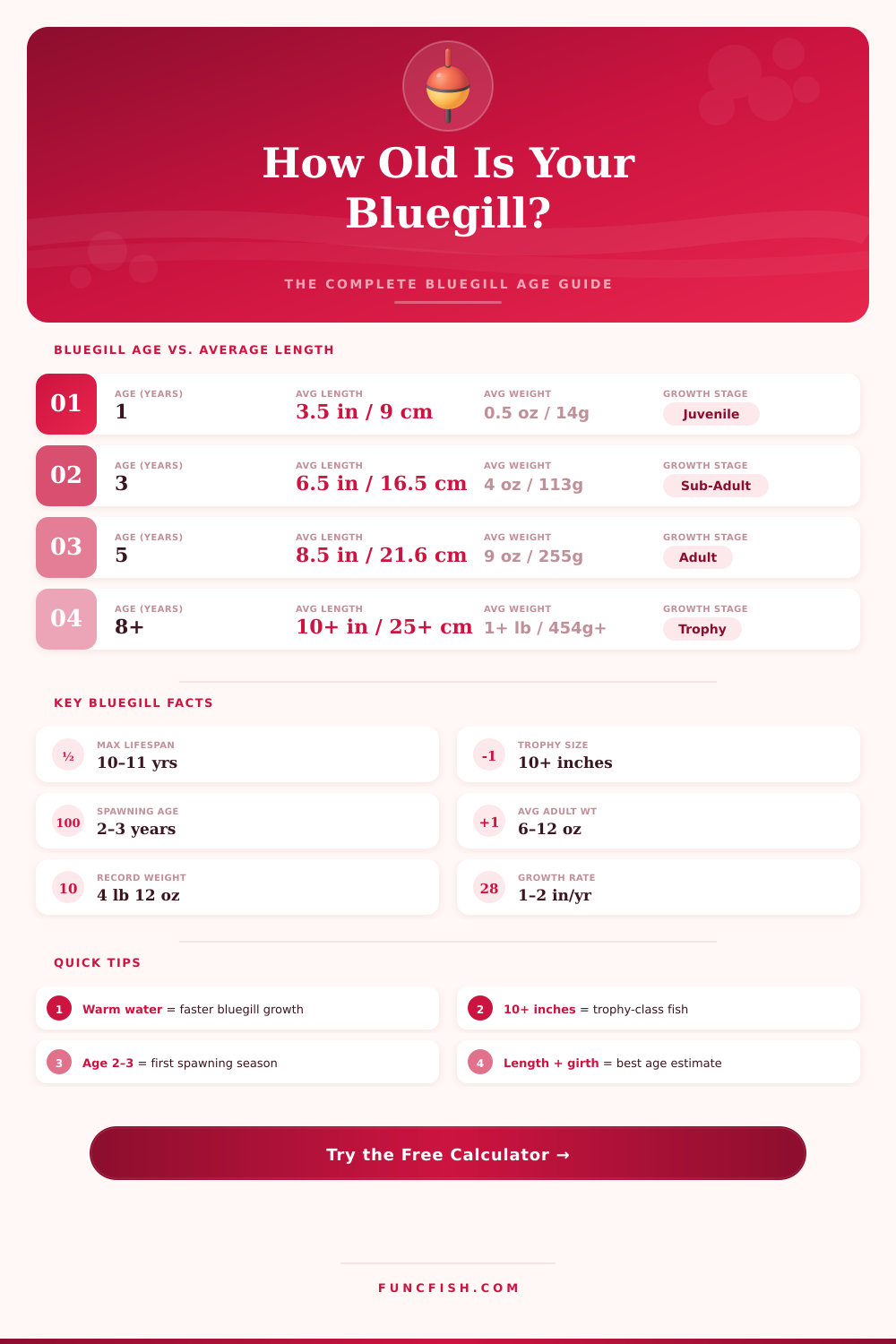
| Age (Years) | Avg Length (in) | Avg Length (cm) | Avg Weight (oz) | Avg Weight (g) | Growth Stage |
|---|---|---|---|---|---|
| 1 | 3.0 – 4.0 | 7.6 – 10.2 | 0.3 – 0.7 | 8 – 20 | Juvenile |
| 2 | 4.5 – 5.5 | 11.4 – 14.0 | 1.0 – 2.5 | 28 – 71 | Sub-Juvenile |
| 3 | 5.5 – 7.0 | 14.0 – 17.8 | 2.5 – 5.0 | 71 – 142 | Sub-Adult |
| 4 | 6.5 – 8.0 | 16.5 – 20.3 | 4.5 – 8.0 | 128 – 227 | Young Adult |
| 5 | 7.5 – 9.0 | 19.0 – 22.9 | 7.0 – 11.0 | 198 – 312 | Adult |
| 6 | 8.0 – 9.5 | 20.3 – 24.1 | 9.0 – 13.0 | 255 – 369 | Adult |
| 7 | 8.5 – 10.0 | 21.6 – 25.4 | 11.0 – 16.0 | 312 – 454 | Mature Adult |
| 8 | 9.0 – 10.5 | 22.9 – 26.7 | 13.0 – 20.0 | 369 – 567 | Senior |
| 9 | 9.5 – 11.0 | 24.1 – 27.9 | 15.0 – 24.0 | 425 – 680 | Senior |
| 10+ | 10.0+ | 25.4+ | 18.0+ | 510+ | Trophy |
| Water Type | Temp Regime | Avg Annual Growth | Age to 7 in (17.8 cm) | Max Expected Size |
|---|---|---|---|---|
| Farm Pond | Warm (South) | 1.8 – 2.2 in/yr | 3 – 4 years | 10–11 in / 25–28 cm |
| Natural Lake | Moderate (Midwest) | 1.2 – 1.8 in/yr | 4 – 5 years | 9–10 in / 23–25 cm |
| Reservoir | Warm | 1.5 – 2.0 in/yr | 4 years | 10 in / 25 cm |
| River | Moderate | 1.0 – 1.5 in/yr | 5 – 6 years | 8–9 in / 20–23 cm |
| Small Stream | Cool (North) | 0.7 – 1.2 in/yr | 6 – 8 years | 7–8 in / 18–20 cm |
| Northern Lake | Cool | 0.8 – 1.3 in/yr | 6 – 7 years | 8 in / 20 cm |
| Life Stage | Age Range | Typical Length | Typical Weight | Key Characteristic |
|---|---|---|---|---|
| Fry | 0 – 6 months | < 1 in / < 2.5 cm | < 0.1 oz / < 3 g | Schooling near nest |
| Juvenile | 6 mo – 1 yr | 1 – 3.5 in / 2.5–9 cm | 0.1–0.5 oz / 3–14 g | Rapid early growth |
| Sub-Adult | 2 – 3 yrs | 4.5–7 in / 11–18 cm | 1–5 oz / 28–142 g | Approaching maturity |
| Adult | 3 – 7 yrs | 7–9.5 in / 18–24 cm | 5–16 oz / 142–454 g | Actively spawning |
| Trophy | 7–11 yrs | 10–12 in / 25–30 cm | 14 oz–4 lb / 397 g–1.8 kg | Dominant breeder |
Bluegill form developing ring on there ear bones, and these ring allow a person to determine the age of a bluegill. More specifically, a person can use these ring to estimate how many year a bluegill has lived and how many years a bluegill has left to live. Many factors influence how many years a bluegill lives, such as habitat quality, food availability, water temperature, and water oxygen level.
Habitat quality is one of the main factor that determines the lifespan of a bluegill. The quality of the habitat is often defined by how much space and cover a bluegill have in the water. For instance, in a crowded backyard pond, the density of bluegill is likely to be very high.
How to Tell a Bluegill’s Age and What Affects Its Life
This high density in these small bodies of water means the bluegill must compete for food, so they are likely to stay small in size and have shorter lifespans. If there are bluegill population in protected lake cove, though, they are likely to be in a habitat with lots of space to roam, and there will be plenty food for all of them. These type of habitats may allow for the bluegill to grow to much larger size, and they will likely have longer lifespans then bluegills found in crowded backyard ponds.
A bluegill that lives in one of these crowded backyard ponds might only be able to live for four or five year, but a bluegill that has found its way to one of these protected lake cove might be able to live between eight and eleven years. Availability of food is another factor that can determine how long a bluegill lives. If the bluegill do not have access to consistent source of food, then the bluegill will experience stunted growth; this stunted growth will reduce the number of years that a bluegill lives.
If, on the other hand, the bluegill is able to access consistent source of food, it will be able to grow larger in size and will have longer life spans. For instance, if a three year old bluegill is seven inches long, it shows that the bluegill has had plenty of food to eat during those three years. If a three year old bluegill is five inches long, though, it is an indicator that that species has lacked sufficient food for much of its life.
The quality of the