🐟 Perch Lifespan Calculator
Estimate perch age & remaining lifespan based on species, size, and habitat conditions
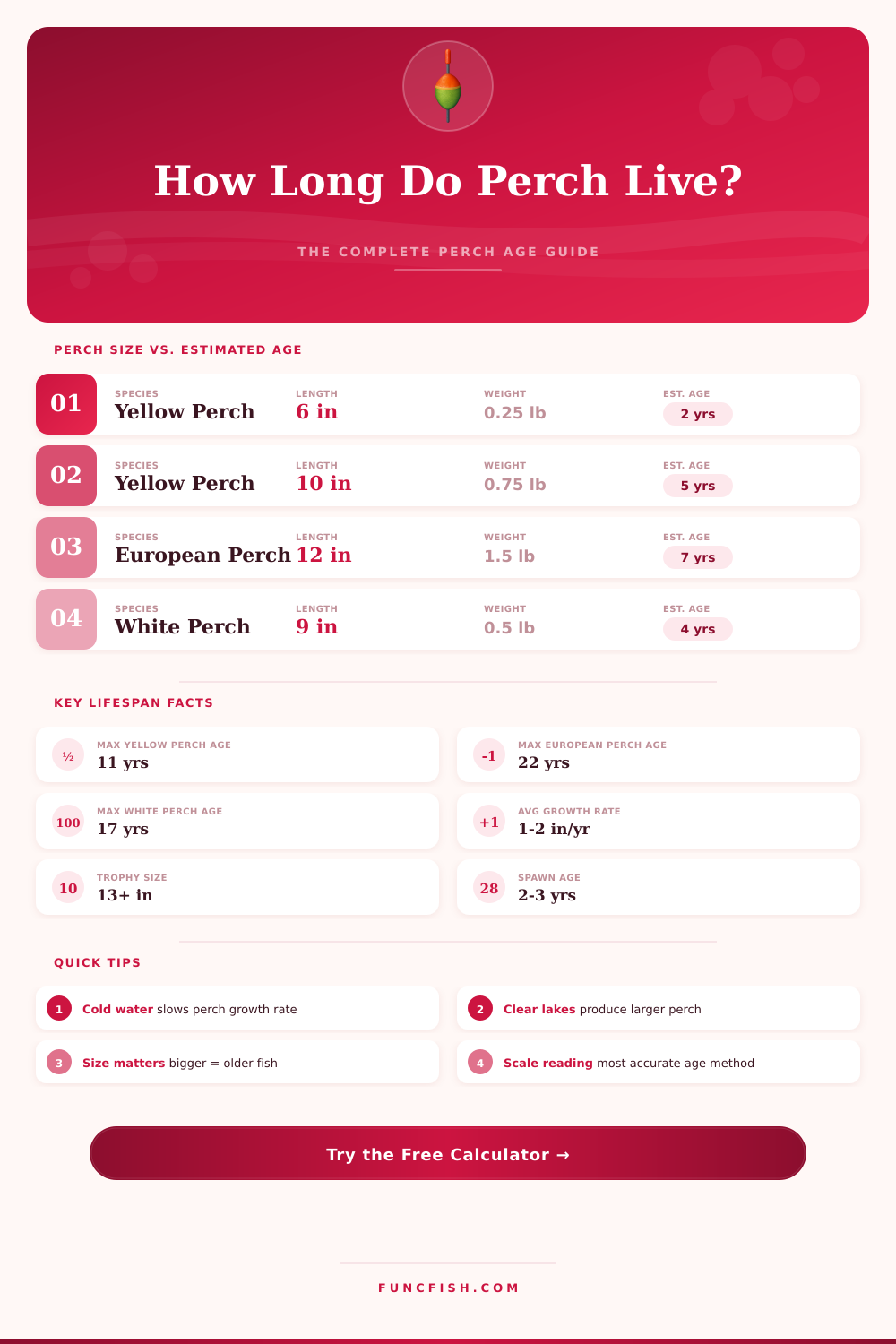
| Species | Age (yrs) | Avg Length (in / cm) | Avg Weight (lb / kg) | Growth Rate (in/yr) |
|---|---|---|---|---|
| Yellow Perch | 1 | 3–4 in / 7.6–10 cm | 0.05 lb / 0.02 kg | ~3.5 in |
| Yellow Perch | 3 | 6–8 in / 15–20 cm | 0.25 lb / 0.11 kg | ~1.5 in |
| Yellow Perch | 5 | 9–11 in / 23–28 cm | 0.5–0.8 lb / 0.23–0.36 kg | ~1.2 in |
| Yellow Perch | 8 | 11–13 in / 28–33 cm | 1.0–1.5 lb / 0.45–0.68 kg | ~0.8 in |
| European Perch | 2 | 5–7 in / 13–18 cm | 0.15 lb / 0.07 kg | ~2.5 in |
| European Perch | 5 | 10–13 in / 25–33 cm | 0.8–1.5 lb / 0.36–0.68 kg | ~1.5 in |
| European Perch | 10 | 14–18 in / 36–46 cm | 2.0–4.0 lb / 0.9–1.8 kg | ~1.0 in |
| European Perch | 15 | 18–22 in / 46–56 cm | 4.0–7.0 lb / 1.8–3.2 kg | ~0.6 in |
| White Perch | 2 | 4–6 in / 10–15 cm | 0.1 lb / 0.05 kg | ~2.0 in |
| White Perch | 5 | 8–10 in / 20–25 cm | 0.5–0.7 lb / 0.23–0.32 kg | ~1.2 in |
| White Perch | 10 | 11–13 in / 28–33 cm | 1.0–1.5 lb / 0.45–0.68 kg | ~0.6 in |
| Factor | Condition | Growth Effect | Lifespan Effect |
|---|---|---|---|
| Water Temperature | Cold (<10°C) | Slower growth | +20–30% longer |
| Water Temperature | Moderate (10–18°C) | Average growth | Baseline |
| Water Temperature | Warm (>18°C) | Faster growth | –10–20% shorter |
| Food Availability | Excellent | 30–50% faster | +15–25% longer |
| Food Availability | Poor | 20–40% slower | –15–30% shorter |
| Habitat Type | Large Lake | Largest fish | Near max lifespan |
| Habitat Type | Small Pond | Stunted growth | –20–40% shorter |
| Current Speed | Fast River | Leaner, slower growth | Moderate reduction |
| Classification | Yellow Perch | European Perch | White Perch |
|---|---|---|---|
| Juvenile | <5 in / <13 cm | <6 in / <15 cm | <4 in / <10 cm |
| Sub-adult | 5–8 in / 13–20 cm | 6–10 in / 15–25 cm | 4–7 in / 10–18 cm |
| Adult | 8–11 in / 20–28 cm | 10–15 in / 25–38 cm | 7–10 in / 18–25 cm |
| Trophy | >12 in / >30 cm | >16 in / >40 cm | >12 in / >30 cm |
| Record Class | >14 in / >36 cm | >20 in / >51 cm | >14 in / >36 cm |
The lifespan of a perch is the result of several different factors. These factors includes the type of perch, the temperature of the water, the oxygen in the water, and the quality of the habitat in which the perch live. In order to determine the lifespan of a perch, it is first nessecary to become familiar with the specific species of perch that is being evaluate.
For instance, yellow perch can live for approximately eight years, and they typically reach maturity at two or three year of age. European perch live more longer than yellow perch, though, living for up to thirteen years. Estuary perch can live for up to eighteen years, though they require specific conditions in there water to reach this lifespan.
What Affects How Long Perch Live
The type of perch species is, therefore, the first factor that must be considered when attempting to calculate the lifespan of a perch. Water temperature has a significant impact upon the lifespan of a perch. Perch live in water that is cool to the touch, and the ideal temperature for water where perch lives is around sixty-five degrees Fahrenheit during the summer months.
If the water temperatures rise to levels of seventy-five degrees Fahrenheit or higher, the perch begin to experience stress in relation to its metabolism. Such stress upon the perch species results in a shortening of the lifespan of those fishes. In addition to temperature, the amount of dissolved oxygen in the water also has an impact upon the lifespan of the perch.
Insufficient amounts of oxygen can lead to health problem for the gills of the perch. If the amount of oxygen in the water drops to levels of seven milligram per liter or less, the gills of the perch will suffer, and their lifespan will be shortened as a result. In addition to oxygen content in the water, the amount of space in which the perch can live has an impact upon the lifespan of that fish.
If there is not enough space for the perch to swim freely in its habitat, the fish will experience stress as a result of these conditions. The quality of the habitat in which the perch lives has an impact upon the lifespan of those fish. Habitat quality includes factors like the amount of shelter in which the perch can hide from predators, and the amount of forage upon which the fish can feed to gain the energy necessary to survive for a long period of time.
If there is not enough shelter within the habitat, the perch will experience stress from having to endure encounters with predators, which will shorten its lifespan. Additionally, if the habitat does not provide enough forage for the perch species, their lifespan will be reduced. Other factors that impact the lifespan of a perch include the level of predation in the habitat, the stability of the area during the winter months, and the way in which human handles the perch.
Each of these factors have the potential to reduce the lifespan of the species. These factors can each be used to project the lifespan of a perch. For instance, one could determine that a three-year-old yellow perch living in a bay containing abundant weeds will live for nine more years.
However, if the number of perch in that bay were to be increased, or if the winter stability in that bay were to decline, the lifespan of the yellow perch would decrease. Furthermore, a habitat grid can be used to evaluate the lifespan of a perch, which will allow the understanding of the stability of the water where the fish lives. If the score that is provided as a result of the habitat grid is high, this indicates that the conditions of the water for the perch are stable.
However, if the score is low, this indicates that changes must be made to the water conditions in order to increase the lifespan of the perch. In attempting to increase the lifespan of the perch, many individuals may attempt to address only one of the factors that impact the lifespan of the species. For instance, an aerator can be added to the habitat to increase the amount of oxygen in the water.
However, if the water is too warm for the perch, the addition of an aerator will not have a significant impact upon the lifespan of the fish. Additionally, plant rafts can be added to the water to provide cover for the perch from predators, as well as to provide an increased amount of forage for the perch. Rock piles can be built within the habitat to provide hiding spots for juvenile perch, as well as circulation pumps can be introduced to remove waste from the water.
Each of these small changes can have a significant impact upon the total lifespan of the species. In addition to these beneficial changes, some mistakes should of been avoided in attempts to ensure that the lifespan of the perch is maximized. One of the most common mistakes is overcrowding the water where the perch live.
Overcrowding of the water occurs if there are too many fish to the number of gallons of water in the habitat by the rule of thousand gallons of water per thousand fish. Additionally, the age of the perch should be monitored, as the older the fish, the more quickly they reach their thresholds for reaching the senior years of their lives. Additionally, the genetics of the perch can impact the lifespan of the species.
If perch are bred in a hatchery, they may not be as strong as those caught from natural waters. By managing the water temperature, the amount of dissolved oxygen in the water, the amount of space provided for the fish, and the quality of the habitat where the perch live, an individual can increase the number of seasons during which the perch will survive.