🐟 Fresh-Caught Fish Freshness Time Calculator
Calculate exactly how long your catch stays safe to eat based on species, storage method, and temperature
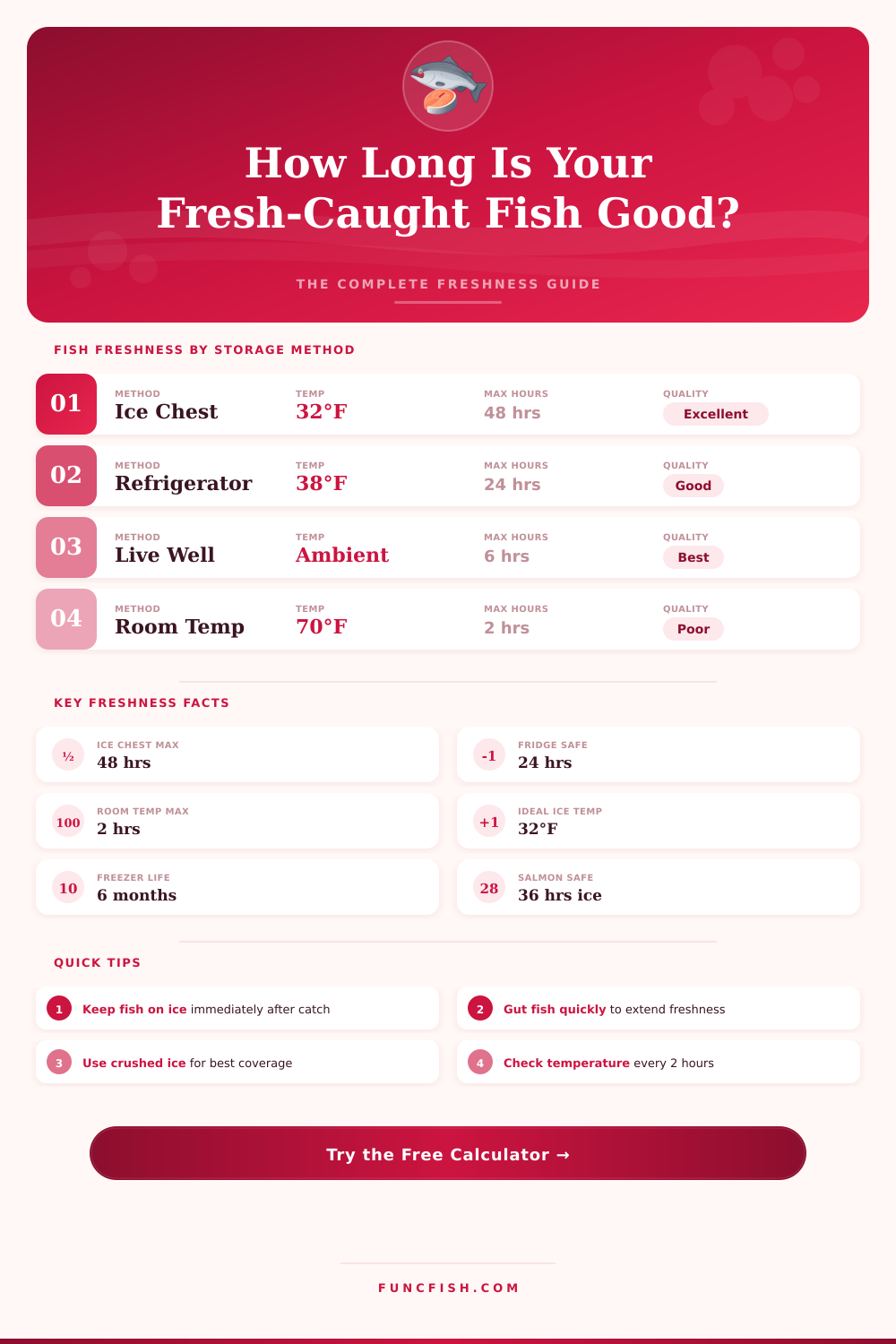
| Species | Typical Weight | Max on Ice (hrs) | Ideal Temp (°F) | Spoilage Rate | Notes |
|---|---|---|---|---|---|
| Largemouth Bass | 1–8 lb (0.5–3.6 kg) | 36–42 | 32–34 | Moderate | Gut quickly in warm weather |
| Rainbow Trout | 0.5–5 lb (0.2–2.3 kg) | 30–38 | 32–34 | Moderate | High fat content speeds spoilage |
| Salmon | 5–40 lb (2.3–18 kg) | 36–48 | 30–32 | High | Ice slurry strongly recommended |
| Catfish | 2–30 lb (0.9–13.6 kg) | 30–40 | 32–34 | Low | Hardy; skin delays spoilage |
| Walleye | 1–10 lb (0.5–4.5 kg) | 32–40 | 32–34 | Moderate | Excellent table fish; handle carefully |
| Redfish / Red Drum | 3–50 lb (1.4–22.7 kg) | 28–36 | 32–34 | High | Saltwater species spoil faster |
| Bluefin Tuna | 50–600 lb (22.7–272 kg) | 24–36 | 29–31 | Very High | Requires ice slurry immediately |
| Crappie / Panfish | 0.25–2 lb (0.1–0.9 kg) | 24–36 | 32–34 | Moderate | Small size — gut as a group |
| Flounder | 0.5–10 lb (0.2–4.5 kg) | 30–40 | 32–34 | Moderate | Flat body cools evenly on ice |
| Northern Pike | 3–30 lb (1.4–13.6 kg) | 30–38 | 32–34 | Moderate | Gut quickly; bony — fillet fast |
| Temperature (°F) | Temperature (°C) | Bacterial Growth Rate | Safe Window | Storage Zone |
|---|---|---|---|---|
| 28–32°F | -2–0°C | Negligible | Up to 48 hrs | ✅ Optimal Zone |
| 33–38°F | 0.5–3.3°C | Very Slow | 24–40 hrs | ✅ Safe Zone |
| 39–50°F | 3.9–10°C | Slow | 12–24 hrs | ⚠️ Caution Zone |
| 51–60°F | 10.5–15.5°C | Moderate | 6–12 hrs | ⚠️ Danger Approaching |
| 61–70°F | 16–21°C | Rapid | 2–6 hrs | 🔴 Danger Zone |
| 71–85°F | 21.5–29.5°C | Very Rapid | 1–2 hrs | 🔴 High Danger |
| Above 85°F | Above 29.5°C | Extremely Rapid | Under 1 hr | ⛔ Critical Danger |
| Prep State | Freshness Multiplier | Reason | Best For |
|---|---|---|---|
| Whole (Ungutted) | 0.8x base | Gut bacteria accelerate decay | Short transport only |
| Gutted Only | 1.0x base | Removes main spoilage source | Day trips, overnight |
| Scaled & Gutted | 1.1x base | Better ice contact | Longer trips |
| Filleted | 1.2x base | Max surface to ice contact | Best for extended storage |
Fish will begins to degrade immediately after a person catch a fishes due to the enzymes that begins to break down the proteins in the fish’s body and the bacteria that begins to grow on the fish. The rate at which the fish degrade is not the same for each species of fish, and the environment in which the fish is caught also affects the rate at which the fish degrade. For example, lean fish like tuna will degrade at a fasterer rate than fatty fish like salmon due to the myoglobin in the lean fish meat oxidizing rapid when the fish is exposed to warm water temperatures.
Additionally, the size of the fish can affect how quickly the fish will degrade; the larger the fish, the longer that the thick muscle of the fish will retain the body heat of the fish. A person can slow the degradation of the fish by taking certain steps after a person catch the fish. For instance, a person can bleed the fish by cutting the gill in the fish to allow the blood to drain from the fishs body.
How to Keep Fish Fresh After You Catch Them
Bleeding the fish reduce the amount of waste that builds up in the fishs body. Additionally, you can gut the fish to allow the fishs body to cool more quick. It is also important to avoid leaving the caught fish in the sun; the sun will dry the fish and increase the amount of bacteria on the fish’s body.
Instead, the person should place the fish in a cooler that is placed in the shade to extend the amount of time that the fish can remain fresh. The method in which the fish is chilled will also impact the quality of the fish. For instance, one can use crushed ice to chill the fish because the crushed ice will make direct contact with the fish.
Crushed ice will remove heat from the fish. Even better is using a slurry, which is a 1:3 mixture of ice and water; the slurry will “hug” the curve of the fish allowing for an even chill down of the fishs body. Additionally, one should avoid air pockets in the cooler because the warm air pockets will warm the fish and reduce the rate at which the fish can be cooled.
Each species of fish will have different temperature requirement in order to maintain the quality of the fishs meat. For instance, trout from cold streams will stay fresh at temperatures near 40 degrees Farenheight, while fish like bass have lean fish meat and require temperatures between 50-60 degrees Farenheight. Additionally, tuna has lean fish muscle tissue and must be maintained at near freezing temperature.
If it is not chilled immediately after being caught, the histamines that builds up in the tuna can pose a health risk to those who consume the fish. Thus, a fish dealer must understand the requirements of the species of fish that he or she will be processing. In order to calculate the freshness of the fish, there are several factor that must be considered.
For instance, the temperature of the water and the air, the size of the fish, the species of the fish, the length of the transport of the fish from the catch location, and the rate at which the fish is added to the cooler will impact the freshness of the fish. If any of these variables are under-estimated, the quality of the fish will decline. For instance, if a person under-estimates the length of time it will take to transport the fish to the cooler, the fish may no longer be in it’s peak state of freshness.
If there is heavy traffic in the area, the travel time for the fish is likely to increase; consequently, the fish will no longer be in its peak state of freshness. In order to ensure that the fish is maintained at an appropriate temperature, one should prepare the necessary equipment prior to beginning to fish for the day. For instance, placing ice within the cooler overnight can pre-chill the cooler to ensure that the cooler will not transfer heat to the fish while the fish is within the cooler.
Additionally, you should clean the cooler in which the fish will be placed prior to packing the fish; proper drainage within the cooler will allow for the melted ice to be removed so that the water does not warm the fish. If the fish will be transported over long distance, the fish should be vacuum sealed within an airtight bag after being chilled. Vacuum sealing remove the oxygen from the fish, which slows the oxidation of the fishs meat.
However, vacuum sealing should not be utilized on fish that are still warm; vacuum sealing warm fish will trap the steam and bacteria that is present in the fishs body.