🐟 Fish Catch & Release Survival Calculator
Estimate post-release survival probability based on species, water temperature, fight time, handling, and conditions
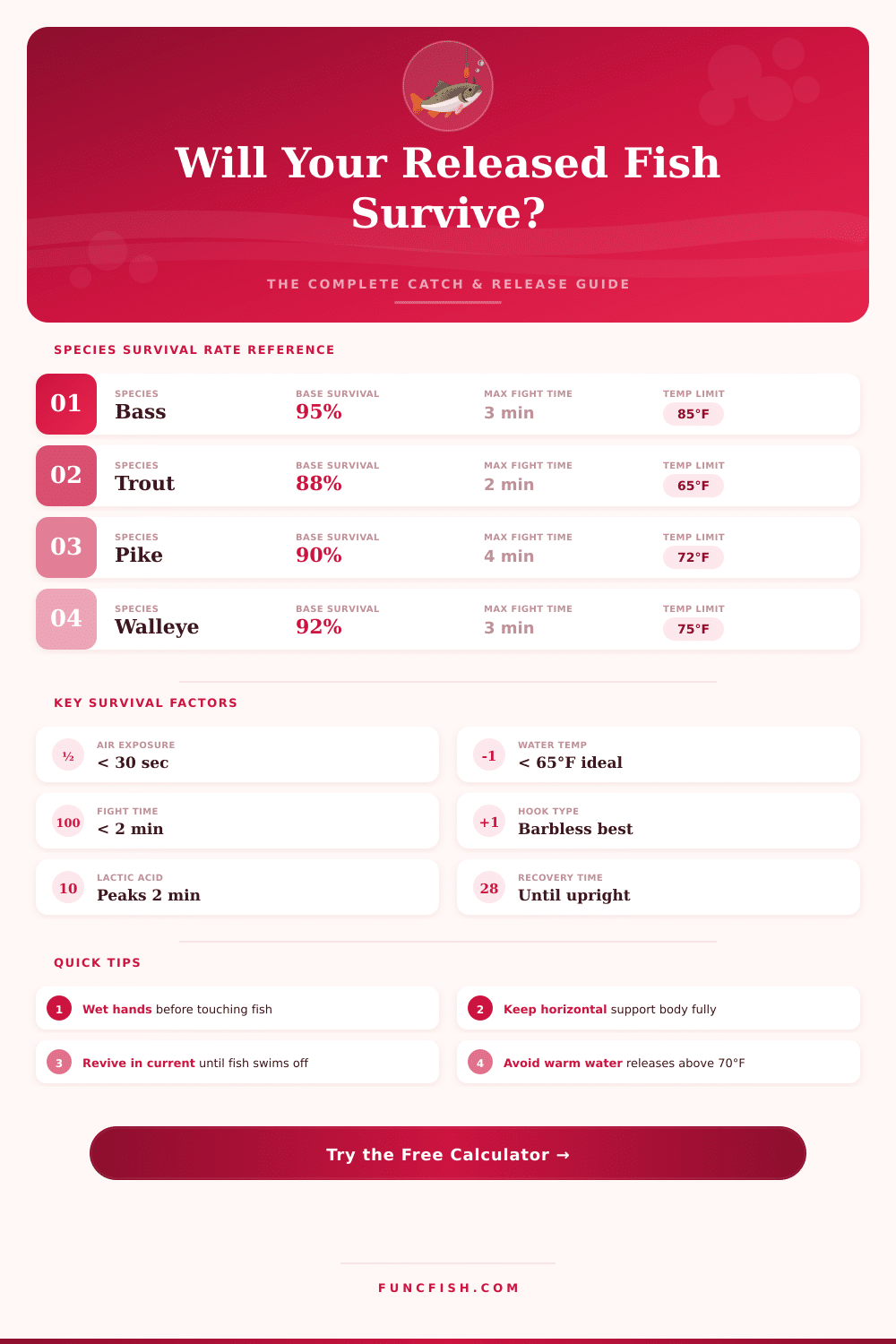
| Species | Base Survival Rate | Temp Stress Threshold | Max Fight Time | Max Air Exposure | Barotrauma Risk Depth |
|---|---|---|---|---|---|
| Largemouth Bass | 95% | 85°F / 29°C | 4 min | 45 sec | Low |
| Smallmouth Bass | 94% | 80°F / 27°C | 3 min | 40 sec | Low |
| Rainbow Trout | 88% | 65°F / 18°C | 2 min | 20 sec | Low |
| Brook Trout | 87% | 60°F / 16°C | 2 min | 15 sec | Low |
| Brown Trout | 89% | 68°F / 20°C | 2.5 min | 20 sec | Low |
| Walleye | 92% | 75°F / 24°C | 3 min | 30 sec | High (>20ft) |
| Northern Pike | 90% | 72°F / 22°C | 4 min | 45 sec | Low |
| Muskie | 91% | 75°F / 24°C | 5 min | 60 sec | Low |
| Atlantic Salmon | 85% | 65°F / 18°C | 3 min | 25 sec | Low |
| Striped Bass | 93% | 78°F / 26°C | 4 min | 40 sec | Medium |
| Redfish | 94% | 82°F / 28°C | 3.5 min | 35 sec | Low |
| Panfish | 96% | 85°F / 29°C | 3 min | 45 sec | Very Low |
| Hook Type | Survival Modifier | Avg Hook Removal Time | Injury Rate | Best Use Case |
|---|---|---|---|---|
| Barbless Single | 0% penalty | 3–5 sec | Very Low | Trout, Salmon, Fly fishing |
| Barbed Single | -3% penalty | 10–20 sec | Low | General freshwater |
| Circle Hook | +1% bonus | 5–10 sec | Very Low | Saltwater, live bait |
| Treble Hook | -8% penalty | 30–60 sec | Medium–High | Lure fishing (minimize use) |
| Deep-Set / Swallowed | -25% penalty | 60+ sec / cut line | High | Cut line recommended |
| Temperature Range (°F) | Temperature Range (°C) | Stress Level | Dissolved Oxygen | Release Recommendation |
|---|---|---|---|---|
| Below 45°F | Below 7°C | Low | High (12+ ppm) | Good conditions, quick revival |
| 45°F – 60°F | 7°C – 15°C | Minimal | High (10–12 ppm) | Optimal for most releases |
| 60°F – 70°F | 15°C – 21°C | Moderate | Good (8–10 ppm) | Acceptable, minimize handling |
| 70°F – 80°F | 21°C – 27°C | High | Reduced (6–8 ppm) | Reduce fight time, keep in water |
| Above 80°F | Above 27°C | Critical | Low (<6 ppm) | Avoid C&R for sensitive species |
| Fight Time | Lactic Acid Level | Survival Modifier | Recovery Time Needed | Status |
|---|---|---|---|---|
| 0 – 1 min | Low | 0% penalty | 0–30 sec | Ideal |
| 1 – 2 min | Moderate | -2% penalty | 30–60 sec | Good |
| 2 – 4 min | High | -6% penalty | 1–3 min | Caution |
| 4 – 7 min | Very High | -12% penalty | 3–8 min | Elevated Risk |
| 7+ min | Critical | -20% penalty | 8+ min or mortality | High Risk |
Fishing is one of the best ways for people without much experience to feed themselves, especially during a big disaster or financial emergency. It gives protein and fat that are hard to get from plants. In the north it matters because you can hardly get enough fat to survive without fish.
In a survival situation, it matters to use all resources to increase the chances of catching fish. That means going beyond usual methods, turning to passive techniques and traps, that give remarkable results. A rod and reel is not the only option.
Easy Ways to Catch Fish in a Survival Situation
For survival there are nets, traps and various tools. If fish is your main food, combine passive traps like weirs with active methods, for instance hand-fishing or spearing, to reach maximum amount with little energy.
Passive fishing is made up of setting the device and coming back later. For long survival ideal is something that does not require a lot of time. Also it matters to find a reliable place for fishing.
The gorge hook belongs to the simplest traps to make in an emergency. Fish gives almost perfect nutrition, and in a long disaster that simple trick can really feed a person well.
Clear water works well for spear fishing. Cloudy water requires a funnel trap. Simple one-way stick traps are among the most basic.
Using a worm with a bobber in a lake full of bluegills you get great results, and the method can scale up. In a survival case some variant of this probably will be what will provide food.
When dealing with catch and release, fish caught on artificial lures widely survive more often. A study on walleyes showed that almost all caught with artificials stayed alive, while live bait caused much more deaths. Snook in big net-pens had 98 percent survival, and most dead snook were caught with live bait.
Survival rates for released fish range from 20 to 90 percent depending on species. Fish can only survive out of water for a few minutes, but simply being alive is not enough. They must bee healthy, otherwise they easily become prey.
Proper ways to handle fish are simple, work for many species, and the more techniques you use, the more likely thereleased fish will survive.
Food indeed is not among the main priorities for survival. It matters more to stay physically safe and dry. Even so, being good at fishing gives a big advantage when it counts.