🐟 Ungutted Fish On-Ice Storage Calculator
Estimate safe storage time for ungutted fish on ice — by species, temperature & conditions
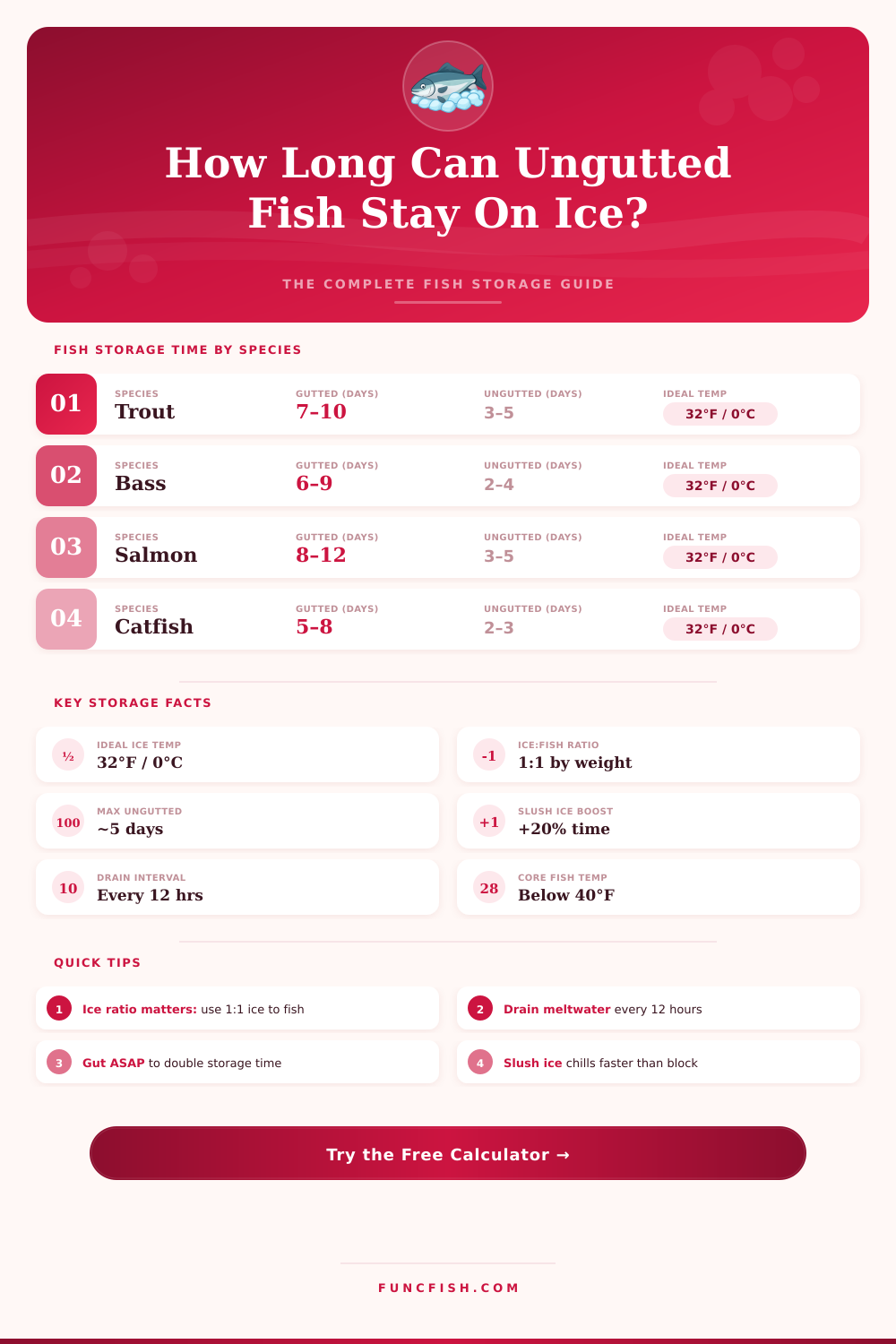
| Species | Ungutted Max (days) | Gutted Max (days) | Ideal Temp °F / °C | Oil Content |
|---|---|---|---|---|
| Rainbow Trout | 3–5 | 7–10 | 32°F / 0°C | Medium |
| Bass (LM/SM) | 2–4 | 6–9 | 32°F / 0°C | Low |
| Atlantic Salmon | 3–5 | 8–12 | 32°F / 0°C | High |
| Catfish | 2–3 | 5–8 | 32°F / 0°C | Low-Med |
| Walleye | 2–4 | 7–10 | 32°F / 0°C | Low |
| Yellowfin Tuna | 2–4 | 5–8 | 32°F / 0°C | High |
| Panfish (Bluegill) | 1–3 | 4–7 | 32°F / 0°C | Low |
| Northern Pike | 2–4 | 6–9 | 32°F / 0°C | Low-Med |
| Red Snapper | 3–5 | 7–11 | 32°F / 0°C | Low |
| Cod / Haddock | 3–5 | 8–12 | 32°F / 0°C | Very Low |
| Ice Type | Contact Coverage | Storage Modifier | Best Use Case | Melt Rate |
|---|---|---|---|---|
| Slush Ice (brine) | Excellent — full surface | +15–20% | Saltwater fish, charters | Slow (insulated) |
| Crushed Ice | Very Good | +10% | All species, day trips | Medium |
| Block Ice | Good — gaps possible | Baseline | Long trips, coolers | Very Slow |
| Dry Ice (indirect) | Limited — no direct contact | +5% | Very long storage | Sublimation |
| Gel Ice Packs | Fair | -15% | Short trips only | Slow melt |
| Handling Quality | Description | Storage Modifier | Equivalent Temp Penalty |
|---|---|---|---|
| Excellent | Bled + iced within 15 min | +30% | None (optimal) |
| Good | Iced within 30 min | Baseline | +2°F equivalent |
| Fair | Iced within 2 hours | -25% | +5°F equivalent |
| Poor | Iced after 2+ hours | -50% | +10°F equivalent |
| Storage Temp °F | Storage Temp °C | Ungutted Duration | Gutted Duration | Safety Rating |
|---|---|---|---|---|
| 28–32°F | -2 to 0°C | 3–5 days | 7–12 days | Optimal |
| 33–36°F | 1–2°C | 2–4 days | 5–9 days | Good |
| 37–40°F | 3–4°C | 1–2 days | 3–5 days | Caution |
| 41–45°F | 5–7°C | 12–24 hrs | 1–2 days | Poor |
| Above 45°F | Above 7°C | <12 hrs | <1 day | Unsafe |
Ungutted fish stored on ice have roughly half the shelf life of gutted fish. The digestive enzymes and gut bacteria in an ungutted fish actively accelerate spoilage. If you plan to store fish for more than 2 days, gutting is strongly recommended. For same-day or next-day consumption, ungutted storage on well-iced ice is acceptable.
Slush ice (made from crushed ice and a small amount of saltwater or freshwater) achieves full contact with the fish surface, pulling heat away up to 20% faster than block ice with air gaps. For ungutted fish where surface bacteria spread is a concern, better thermal contact meaningfully extends your safe storage window. Drain meltwater every 6–12 hours to prevent the fish from sitting in warm water — this alone can add 12–24 hours of safe storage time.
When you catches whole fish you must understand how to manage the temperature of the fish in order to preserve the quality of the fishes. Whole fish have internal organ that will retain the heat from the fish. Because the internal organs will retain the heat from the fish, the temperature of the fish will drop more slow than fish fillets.
Some fish will hold the heat better then other fish; trout are leaner fish than mackerel for example, and will shed the heat from there bodies more quickly. Additionally, the larger the fish is the more body mass the fish has; an large salmon will contain more body mass than a small bass, for instance, so the salmon will take longer to cool down then the bass. The temperature of the water in which the fish was caught is one of the primary factor in how long the fish will remain fresh.
How to Keep Whole Fish Cold
Fish caught in water that is 40-degrees is closer to the temperature of ice than fish that is caught in 60-degree water. The air temperature also impacts the fish as well. Warm air will transfer heat to the fish and the ice.
Both the temperature of the water in which the fish was caught and the air temperature must be accounted for; the air temperature will impact how quick the ice melts. High air temperatures will melt the ice rapidly; if the ice melts the fish will warm up. Another factor to consider is the ratio of ice to the fish.
Using a 1-to-1 ratio of ice to fish is using a small amount of ice. A 1-to-1 ratio of ice to fish may not be enough to maintaining the temperature of the fish if the air temperature is high. Using a 2-to-1 ratio of ice to fish will provide more cooling power to the fish if the air temperature is high.
If there isnt enough ice the ice will melt and the fish will lose quality. The type of cooler in which the fish are transported will also impact the temperature of the fish. A rotomolded cooler has more insulation than a soft bag cooler, for instance, and the thicker insulation will maintain the temperature of the ice for a more longer period of time.
The last factor to consider is how the fish are pack into the cooler. The fish should be layered on top of the ice and layered on the bottom of the ice in the cooler. Placing the fish in contact with the ice both above and below the fish will create a cradle of ice around the fish; this cradle will reach the belly of the fish to cool the internal organ.
These organs will retain the heat from the fish; if they are not cooled the fish will spoil. Therefore, packing the whole fish with ice in this manner will remove the heat from the fish effective.