🌊 Diver Depth Calculator
Calculate exact trolling depth for Dipsy Divers, Jet Divers & other diving devices — imperial & metric
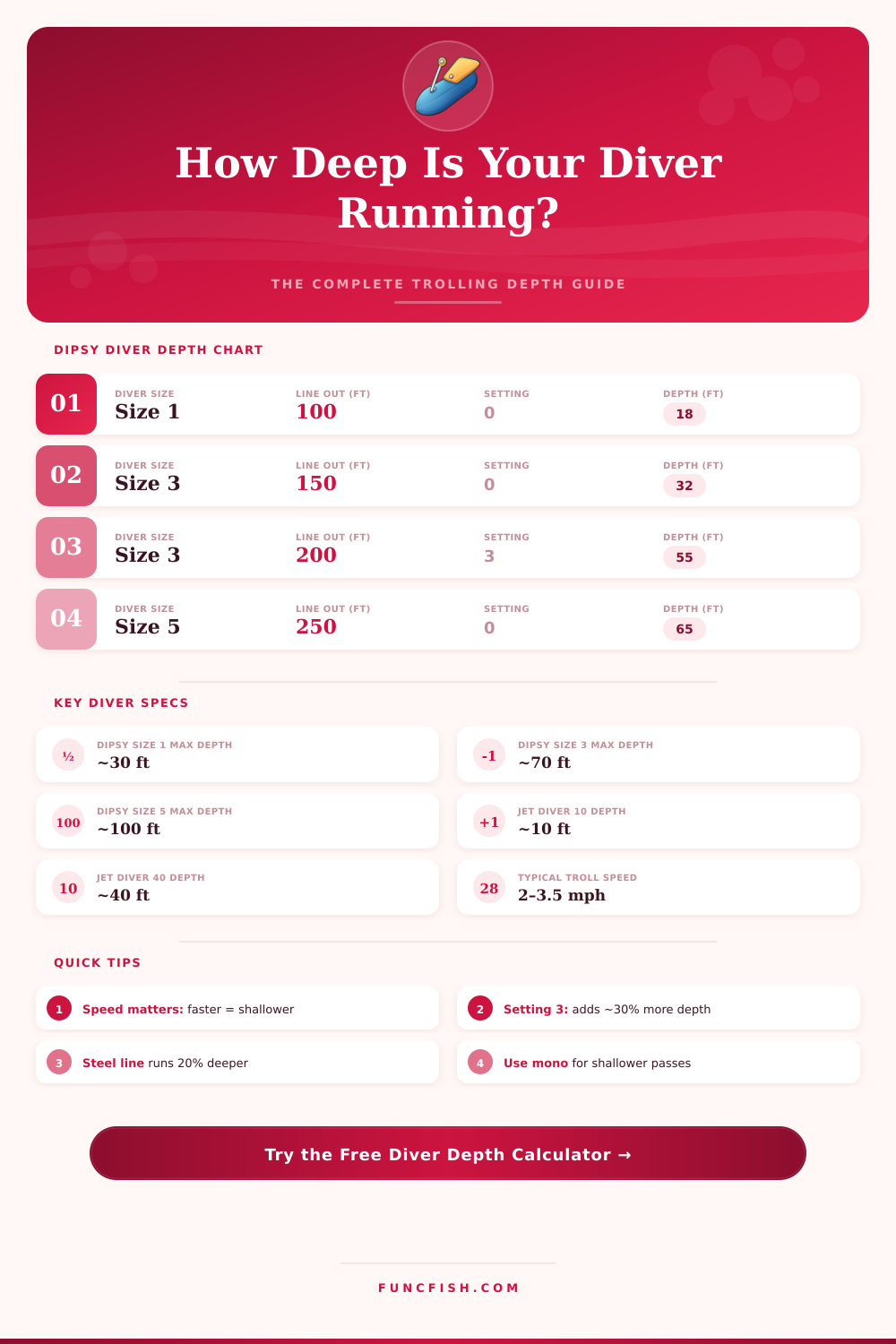
| Line Out (ft) | Size 0 Depth (ft/m) | Size 1 Depth (ft/m) | Size 3 Depth (ft/m) | Size 5 Depth (ft/m) |
|---|---|---|---|---|
| 50 ft (15 m) | 6 ft / 1.8 m | 8 ft / 2.4 m | 12 ft / 3.7 m | 18 ft / 5.5 m |
| 100 ft (30 m) | 10 ft / 3.0 m | 18 ft / 5.5 m | 24 ft / 7.3 m | 35 ft / 10.7 m |
| 150 ft (46 m) | 13 ft / 4.0 m | 24 ft / 7.3 m | 32 ft / 9.8 m | 50 ft / 15.2 m |
| 200 ft (61 m) | 16 ft / 4.9 m | 30 ft / 9.1 m | 45 ft / 13.7 m | 65 ft / 19.8 m |
| 250 ft (76 m) | 18 ft / 5.5 m | 36 ft / 11.0 m | 55 ft / 16.8 m | 80 ft / 24.4 m |
| 300 ft (91 m) | 20 ft / 6.1 m | 42 ft / 12.8 m | 65 ft / 19.8 m | 100 ft / 30.5 m |
| Species | Typical Depth (ft) | Typical Depth (m) | Recommended Diver | Notes |
|---|---|---|---|---|
| Walleye | 15–40 ft | 4.6–12.2 m | Dipsy Size 1 or 3 | Thermocline edge, dawn/dusk |
| Chinook Salmon | 40–100 ft | 12.2–30.5 m | Dipsy Size 5, Setting 3 | Follow baitfish depth |
| Coho Salmon | 20–60 ft | 6.1–18.3 m | Dipsy Size 3, Jet 40 | More surface oriented |
| Lake Trout | 60–120 ft | 18.3–36.6 m | Dipsy Size 5, Steel Line | Cold, deep water |
| Brown Trout | 10–30 ft | 3.0–9.1 m | Jet Diver 10 or 20 | Near shore, cooler temps |
| Steelhead | 15–50 ft | 4.6–15.2 m | Dipsy Size 3, Setting 1 | Aggressive spreaders |
| Striped Bass | 20–60 ft | 6.1–18.3 m | Dipsy Size 3 or Snap Weight | Structure oriented |
| Jet Diver Model | Max Rated Depth | Max Rated Depth (m) | Line Out 80 ft | Line Out 100 ft |
|---|---|---|---|---|
| Jet Diver 10 | ~10 ft | ~3.0 m | ~7 ft / 2.1 m | ~10 ft / 3.0 m |
| Jet Diver 20 | ~20 ft | ~6.1 m | ~15 ft / 4.6 m | ~20 ft / 6.1 m |
| Jet Diver 30 | ~30 ft | ~9.1 m | ~22 ft / 6.7 m | ~30 ft / 9.1 m |
| Jet Diver 40 | ~40 ft | ~12.2 m | ~30 ft / 9.1 m | ~40 ft / 12.2 m |
| Line Type | Depth Factor | Spread Factor | Best Use |
|---|---|---|---|
| Monofilament | 1.00 (baseline) | 1.00 | General trolling, shallow runs |
| Fluorocarbon | 0.97–1.02 | 0.98 | Clear water, similar to mono |
| Braided Line | 0.85 | 0.90 | Sensitivity, less stretch |
| Steel / Wire | 1.20 | 1.15 | Maximum depth, Great Lakes |
Every 0.5 mph increase in trolling speed reduces diver depth by approximately 10–15%. At 3.5 mph, a Dipsy Size 3 running 150 ft of mono will run about 20% shallower than at 2.0 mph. Always mark your counter and keep speed consistent for repeatable depth.
Dipsy Diver deflection settings control how far the diver runs off to the side of the boat. Setting 0 = straight back. Setting 3 = maximum spread (approx. 20–40 ft to the side). Higher settings also add depth — Setting 3 typically increases depth by 25–30% compared to Setting 0.
Trolling diver are tools that allow a person to control the depth of a fishing lure while the boat travels through water. The plane of the divers work against the tension of the water to keep the bait at a specific angle. When a person release the clip on a diver, the weight of the lure will cause it to dive into the water until the tension of the fishing line balance out the weights of the lure and the diver.
To attract the attention of the fish, the line must maintain the depth of the lure so that the fish strikes the lure. A variety of factor can alter the depth of a trolling diver. Factors includes trolling speed, water conditions, and the height of the fishing rod tip.
How to Control the Depth of a Trolling Diver
Trolling speed is one of the main determinant of the depth of a trolling diver. The faster a boat is traveling when trolling with divers, the more shallower the divers will go. If a person is trolling at a slower speed, the divers will allow for deeper trolling.
Additionally, the water conditions in which a person is trolling can change the depth of the divers. If the water contains numerous choppy wave, the divers will be lifted toward the surface of the water. Water depth and the height of the fishing rod tip can also alter the depth of the divers.
If the rod tip is lowered, the divers will travel deeper into the water. The type of line that a person uses while trolling with divers will also alter the depth of the divers. If a person is trolling deep into the water, wire line will allow the divers to travel more far through the water with less drag than monofilament lines.
However, the monofilament lines will stretch out when using deep water divers, which may cause the divers to wander from the depth at which the person release them. Many people opt for braided lines or wire lines so that the divers will experience less drag through the water. The size of the diving divers will determine the depth at which a person can troll with there fishing line.
Small divers will allow a person to troll in areas that has shallow depths. Small divers will only reach depths of around twenty feet. For deep water fishing, people will use large divers that will allow them to reach depths of ninety feet or more.
People will use different size of divers based on the type of fish that they are trolling for. For example, salmon live in deep waters, so large divers will be necessary to catch them. On the other hand, walleye fish live in the mid-water areas and require smaller divers to effectively catch them.
A person can also control the depth of the lure by adjusting the amount of line that is let out from the fishing reel. If the depth of the lure is shallower than desired, letting out more line will allow the diving weight to travel to a deeper depth in the water. This process is faster than adjusting the divers of the fishing line.
However, if a person allows the fishing line to travel further out of the reel, the pull load that the fishing gear will experience will increase. As the trolling speed of the boat and the amount of line that is let out of the reel increases, the pull load will increase. If the pull load becomes too heavy for the fish that are being targeted, it can fatigue the arms of the person trolling and even damage the fishing reels.
By preparing the fishing gear in advance, a person can test trolling divers and lures to ensure that all the equipment is functioning well. Using a tape measure, a person can mark the fishing line every fifty feet. By watching the fishing rod tip, a person can determine if the divers are properly functioning.
If the tip of the fishing rod steadily throbbs when the divers are working, the divers are functioning properly. If the tip of the fishing rod experiences jerks and skips in their movement, the divers are not stable and adjustments should be made to the fishing line. Through understanding the factors that affect the depth of trolling divers, a person can properly adjust the lures of their fishing line so that the lures are positioned at the depths at which the fish live.