🪝 Hook Gap to Bait Size Calculator
Match your hook gap perfectly to your bait size for maximum hooksets & fewer missed strikes
Gap: 0.15–0.28"
Gap: 0.30–0.50"
Gap: 0.55–0.80"
Gap: 1.0–2.5"
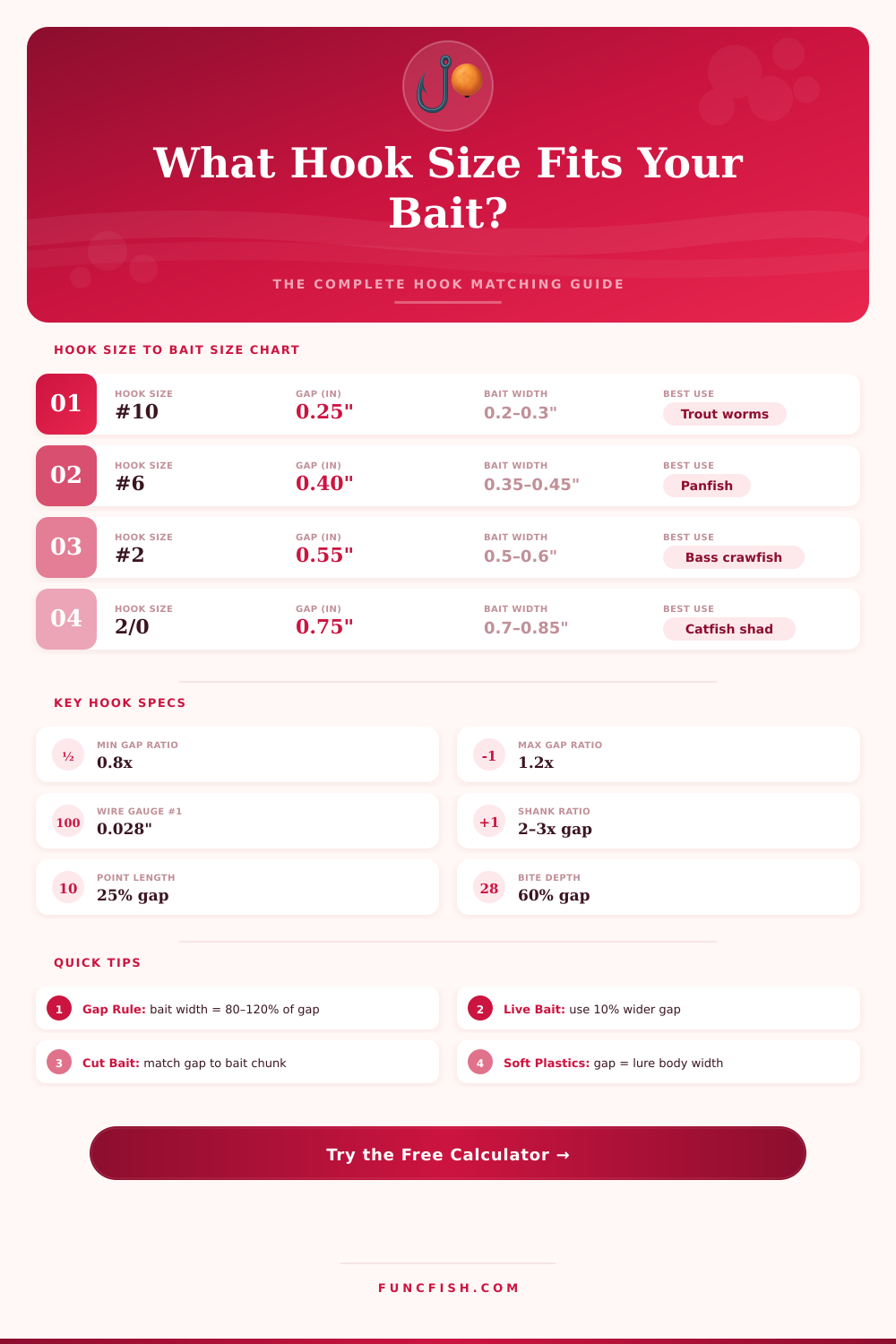
| Hook Size | Gap (in) | Gap (mm) | Ideal Bait Width (in) | Ideal Bait Width (mm) | Wire Gauge |
|---|---|---|---|---|---|
| #12 | 0.15" | 3.8 mm | 0.12–0.18" | 3–4.5 mm | #3 Fine |
| #10 | 0.25" | 6.4 mm | 0.20–0.30" | 5–7.5 mm | #4 Fine |
| #8 | 0.30" | 7.6 mm | 0.25–0.35" | 6.4–9 mm | #5 |
| #6 | 0.38" | 9.7 mm | 0.32–0.44" | 8–11 mm | #5–#6 |
| #4 | 0.44" | 11.2 mm | 0.38–0.52" | 9.5–13 mm | #6 |
| #2 | 0.52" | 13.2 mm | 0.45–0.60" | 11.5–15 mm | #7 |
| #1 | 0.60" | 15.2 mm | 0.50–0.70" | 12.5–18 mm | #7–#8 |
| 1/0 | 0.65" | 16.5 mm | 0.55–0.75" | 14–19 mm | #8 |
| 2/0 | 0.75" | 19 mm | 0.65–0.88" | 16.5–22 mm | #8–#9 |
| 3/0 | 0.85" | 21.6 mm | 0.75–1.0" | 19–25 mm | #9 |
| 4/0 | 1.00" | 25.4 mm | 0.88–1.18" | 22–30 mm | #10 |
| 5/0 | 1.15" | 29.2 mm | 1.0–1.38" | 25–35 mm | #11 |
| 7/0 | 1.50" | 38 mm | 1.30–1.75" | 33–44 mm | #12 |
| 10/0 | 2.25" | 57 mm | 2.0–2.6" | 51–66 mm | #14 |
| Species | Typical Weight | Recommended Hook Size | Typical Bait Width | Hook Style |
|---|---|---|---|---|
| Bluegill / Sunfish | 0.25–1 lb | #10 – #6 | 0.2–0.35" | Aberdeen |
| Crappie | 0.5–2 lb | #6 – #2 | 0.25–0.45" | Aberdeen |
| Rainbow Trout | 0.5–5 lb | #12 – #6 | 0.15–0.38" | Octopus / J |
| Largemouth Bass | 1–10 lb | #2 – 4/0 | 0.5–1.0" | EWG / Circle |
| Smallmouth Bass | 0.5–5 lb | #4 – 2/0 | 0.4–0.75" | EWG / J |
| Walleye | 1–8 lb | #6 – 1/0 | 0.3–0.6" | Octopus |
| Channel Catfish | 2–20 lb | 1/0 – 4/0 | 0.75–1.5" | Circle / J |
| Northern Pike | 3–20 lb | 2/0 – 5/0 | 0.8–1.5" | Treble / J |
| Striped Bass | 5–40 lb | 3/0 – 7/0 | 1.0–2.0" | Circle |
| Offshore Tuna | 20–200 lb | 6/0 – 10/0 | 1.5–2.5" | Circle / J |
| Hook Style | Gap Ratio to Std | Best Bait Type | Hookset Rate | Cover Suitability |
|---|---|---|---|---|
| EWG (Wide Gap) | 1.25x wider | Soft plastics, frogs | High | Heavy cover |
| Standard J-Hook | 1.0x (baseline) | Live bait, cut bait | High | Open water |
| Circle Hook | 1.15x wider | Live bait, cut bait | Self-setting | Open / surf |
| Octopus Hook | 0.95x | Worms, minnows | Moderate–high | Light cover |
| Treble Hook | 0.7x per point | Cut bait, plugs | Very high | Open water |
| Drop Shot Hook | 0.9x | Finesse plastics | High | Open / structure |
| Aberdeen (Wire) | 1.05x | Worms, small minnow | Moderate | Weeds / light |
| Jig Hook | 1.1x | Trailers, soft baits | High | Bottom / cover |
Selecting the correct hook gap are necessary for successfully fishing because if the gap between the teeth of the fishing hook is incorrectly sized to a bait, the fishing hook’s point will snag on the bait. If the hook gap is too small for the bait, the point of the hook will not have enough room to swing through the bait to hook the fish. If the hook gap is too large, the fishing rig will look unnatrually to the fish or the hook point will have to much slack when hooking the fish.
Therefore, a person must select the correct hook gap for they fishing bait based off the baits thickness. The thickness of the bait body is the most important measurement to use to determine the hook gap. The length of the bait should not be used to determine the size of the hook gap.
How to Choose the Right Hook Gap for Your Bait
The height of the bait body should be measured. Depending on the type of bait being use, the height of the bait body will change the hook gap that is required. For example, if a person is using a slender worm bait, the height of the body is between 6 to 9 millimeter.
The hook gap for this type of bait require 7 to 10 millimeters of gap between the teeth of the hook. For a craw-style bait, the height of the body is between 10 to 14 millimeters. The hook gap for this type of bait require 11 to 14 millimeters of gap between the teeth of the hook.
Additionally, if the bait used is soft plastic bait, it is important to take into account how much the bait will compress when the fish bite onto it. Very pliable soft plastic bait can compress up to 20% or more when the fish bite on it. Beyond the thickness of the bait and the size of the gap that is required for that thickness of bait, there are other factor that will influence the necessary hook gap.
Nose hooking will require less hook gap than bury the point of the hook to protect it from weeds. If the person buries the point of the hook into the bait to protect it from weeds, a larger hook gap will be required because the point of the hook will take up some of that gap. Texpose rigging will require a larger hook gap than nose hooking because texpose rigging will protect the point of the hook but require extra room for the point of the hook to swing through the bait.
Skin hooking is in between nose hooking and texpose rigging in terms of the protection that it will offer the point of the hook. It will require a hook gap that is in between those two rigging style. These different rigging styles will change the path of the hook through the bait, which will change the gap that the hook require.
Additionally, the environment in which the person will be fishing and the behavior of the fish will also change the hook gap requirement for the bait. In open water, where there are no weed or cover for the fish to encounter, a precise hook gap can be used. In heavy cover or weed areas, fish may have to fight against weeds to get at the bait.
Using a larger hook gap will allow the point of the hook to punch through these weeds to hook the fish. Depending on the style in which the fish will strike at the bait, the hook gap will have to be adjusted. If the fish will inhale the bait slowly, the hook gap will have to be larger than if the fish will strike quick at the bait.
If the fish will strike violently at the bait, the bait may be mashed against the fish’s mouth sideways. In this situation, a larger hook gap will allow the hook to slide sideways to hook the fish. The type of fish that is being targeted can change the hook gap requirement.
Some fish species has larger mouths than others. Trout species have small mouths to hook the bait slowly. A smaller hook gap is required for these fish species.
Conversely, species like pike have much larger mouths that allow them to take in the bait quickly. These fish species will require a larger hook gap in their bait to account for their large jaw size. A person can use these factor to determine the correct size of the hook gap.
First, the person should measure the thickness of the bait. Second, the amount of compression that the bait can take when hooked to the fish should be accounted for. Third, the hook gap should be adjusted to account for the rigging style, the environment in which the fish will be targeted, the behavior of the fish to account for the style of the strike, and the type of fish that will be targeted.
A clearance score can be used to determine the hook gap. The hook gap should be set to be 30% larger then the height of the body of the bait. If the gap between the teeth of the fishing hook is too small, the fish will not be hooked successfully; the point of the hook will remain buried in the bait.
By following these step, a person will ensure that the point of the hook will have enough room to hook the fish.